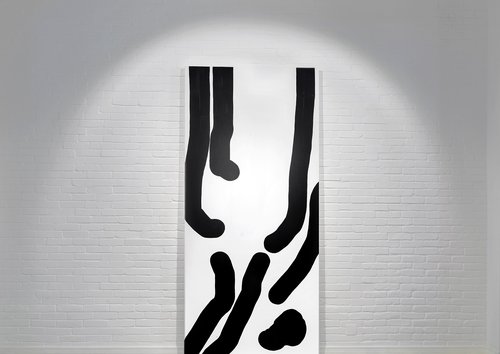


Sandro Breus: Monumental Emotion and the Poetics of Documentation

Sandro Breus. The Witness (Strolling through Chicago), 2025. Courtesy of the artist
Young Georgian-Russian artist, Sandro Breus (b. 2003), is emerging on the international art scene with a distinctive multimedia practice that combines monumentality, theatricality, and archetypal imagery. Working across painting, sculpture, lithography, and drawing, Breus investigates how human emotions can be translated into universal visual forms.
At the core of Sandro Breus’s practice lies an interest in emotion as a staged condition suspended between personal experience and collective memory. Rather than treating emotions as singular or deeply individual phenomena, Breus approaches them as shared human states. To articulate this universality, he draws on archetypal imagery derived from religious iconography, folk traditions, children's toys, and totemic forms. These visual codes establish common ground with the viewer, operating simultaneously on formal and symbolic levels.
I first encountered Sandro Breus at Folk House Porakishvili in Tbilisi, where his solo exhibition 'Cain's Dream' was presented earlier this year. Bringing together paintings, drawings, prints and carved wooden sculptures, the exhibition entered into dialogue with the institution's permanent ethnographic collection. The choice of venue was integral to the project, allowing contemporary works to engage directly with historical artefacts and vernacular decorative traditions. Drawing on Georgian ornamental culture, Breus activates visual languages rooted in collective memory while repositioning them within a contemporary artistic framework.

Alongside craftsmanship and vernacular traditions, Sandro Breus's practice is informed by Soviet unofficial and nonconformist art, particularly the work of Vitaly Komar (b. 1943) and Alexander Melamid (b. 1945), Erik Bulatov (1933–2025), Ivan Chuikov (1935–2020), Grisha Bruskin (b. 1945), and Boris Orlov (b. 1941). Their engagement with symbolic systems, ideological imagery, and mechanisms of representation resonates with Breus's own exploration of visual codes and collective narratives.
His multidisciplinary approach reflects a commitment to finding the most appropriate medium for each idea. Rather than privileging a single format, Breus moves fluidly between painting, sculpture, lithography, and drawing, seeking a balance between concept, materiality, and visual impact. Although many works originate from personal experiences or observations of those around him, these sources undergo a process of abstraction and depersonalization. Individual narratives are distilled into theatrical compositions populated by anonymous figures that function less as portraits than as embodiments of emotional and existential conditions.

This strategy is particularly evident in his paintings and graphics, where faces are frequently omitted. Identity is conveyed instead through posture, gesture, clothing, and symbolic attributes. The resulting figures occupy an ambiguous territory between character and archetype, inviting viewers to project their own experiences onto the image.
This engagement with archetypal imagery is especially apparent in ‘Cain’s Dream’ (2025), the painting that lends its title to the artist’s recent solo exhibition in Tbilisi. The composition depicts a geometric figure sprawled across a monumental architectural block beneath a moonlit sky. Constructed from angular planes and stripped of individual features, the body appears suspended between sleep, collapse, and metamorphosis. Although the title invokes the biblical figure of Cain, Breus resists narrative illustration. Instead, the work transforms a familiar story into an image of guilt, alienation, and psychological unease that extends beyond its religious source.


Documentation constitutes another important dimension of Breus’s practice. For the artist, documentation is not merely a means of recording reality but an ongoing process of collecting objects, stories, gestures, and visual fragments. He likens this activity to assembling a natural history collection, where each specimen contributes to a broader system of observation. Yet Sandro Breus remains conscious of the impossibility of fully capturing reality through artistic means. Once translated into art, documentation enters a separate realm governed by interpretation.
In the carved wooden sculpture ‘Budgerigar’ (2024) and the lithographic diptych ‘Alive and the dead’ (2025), Breus addresses questions of authority, violence, and military power. In ‘Budgerigar’, an authoritarian figure covered with military decorations is reduced to a simplified, toy-like form, stripping away both individuality and symbolic authority. The work suggests that official heroism often depends upon the erasure of personal identity and agency. ‘Alive and the dead’ extends this inquiry. The first print depicts a depersonalized soldier collapsing after being shot, while the second presents a firearm aimed at a supposedly higher-ranking officer, questioning hierarchies of sacrifice and exposing the unequal distribution of violence during wartime.

Movement functions as another vehicle for psychological expression in Breus's work. The ‘Witness (Strolling through Chicago)’ (2025) depicts a faceless white figure striding through a simplified urban landscape. Although the title identifies a specific city, the setting is reduced to abstract vertical forms, rendering the environment almost interchangeable. The protagonist appears less as an individual observer than as a universal witness navigating a world marked by political violence and social instability. Rather than merely observing, the figure seems caught in an urgent attempt to flee contemporary catastrophe, transforming movement itself into an expression of existential anxiety.
It is within this tension between observation and invention, the concrete and the abstract, that Breus’s work finds its strength. His compositions operate as theatrical reconstructions of lived experience, replacing individual identities with condensed archetypal figures that function simultaneously as mirrors for the viewer and vehicles for the artist's reflections. Through this process, personal emotion is transformed into a shared visual language concerned with memory, identity, and the enduring search for common human experience.

Sandro Breus is currently developing a new series of works on paper centred on the idea of instrumentality. The project explores the comforts provided by tools, technologies, and weapons alike, questioning how instruments simultaneously extend and diminish human experience. Echoing Martin Heidegger’s reflections on technology, the series considers whether the pursuit of comfort ultimately distances us from direct engagement with the world itself.