

Tbilisi Art Fair: Surviving at the Crossroads of Cultures

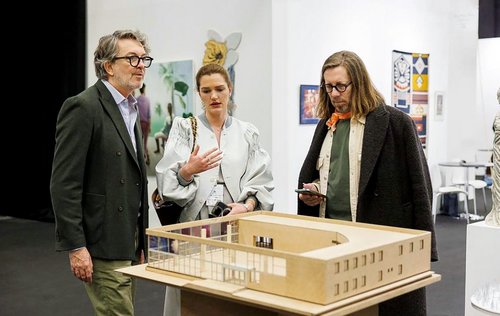
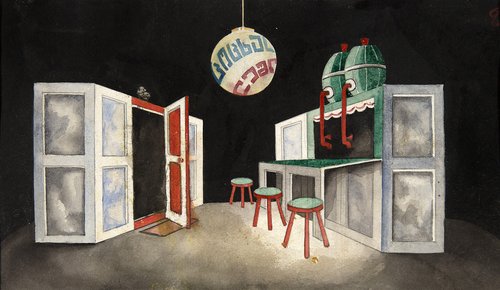
Sandwich Gallery booth. Exhibition view, 2026. Tbilisi Art Fair. Courtesy of Sandwich Gallery
This May, Tbilisi hosted the fifth edition of what is still the country’s only contemporary art fair, but increasingly one of the more intriguing cultural meeting points between Europe, the Caucasus and Central Asia. Thirty-five galleries from fifteen countries gathered in the cavernous halls of Expo Georgia, bringing together artists from Georgia, Armenia, Kazakhstan, Uzbekistan and beyond.
Tbilisi Art Fair, founded by French curator Erik Schlosser, Georgian businessman Kaha Gvelesiani and his team of local curators and art professionals was first held in 2018, and today its mission remains to create a unique, high-quality, and distinctive space for dialogue between the art of the West, the Caucasus regions, and Central Asia. TAF has traditionally served as a platform where galleries, artists, collectors, and art enthusiasts from some fifteen countries converge.

This year’s edition reflected Georgia’s increasingly confident position within a broader post-Soviet and Eurasian cultural landscape. Alongside established European galleries were newcomers from Central Asia, including Bonum Factum Gallery and Dump Gallery, whose presence brought a markedly different visual language to the fair.
The contrast was striking. Much of the Georgian and European work leaned toward restrained palettes and conceptual subtlety, while several Central Asian artists embraced ornament, symbolism and vivid colour. “We are accustomed to leaving indirect messages within our work,” explained Uzbek artist Sanjar Djabbarov. “Events like TAF allow audiences to encounter something unfamiliar.”

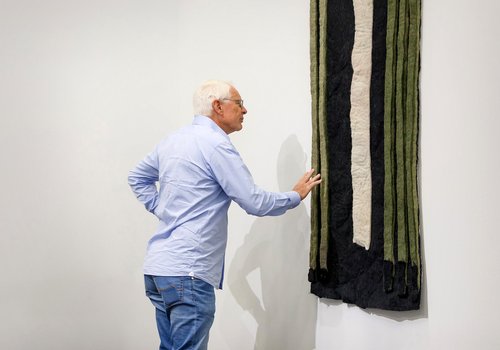
Some of the strongest presentations were those rooted most directly in Georgia’s artistic history. At Window Project Gallery, works by Gia Edzgveradze (b. 1953), Koka Ramishvili (c. 1956) and Vakhtang Kokiashvili (1930–2010) traced the development of Georgian contemporary art from the late Soviet period through the turbulent years following independence. The presentation focused particularly on the 1980s and 1990s – the formative decades of Georgia’s contemporary art scene.
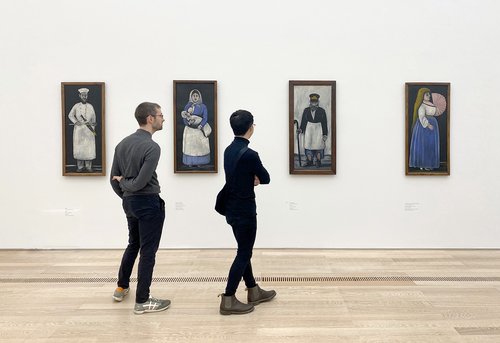
Elsewhere, younger galleries approached that legacy with greater irony and fragmentation. At Vere Gallery, works referencing Niko Pirosmani (1862–1918) combined elements of Georgian naïve painting with gestures borrowed from European postmodernism. Novo Gallery presented a broader mixture of painting, sculpture and miniature ceramics by Tutu Kiladze (b. 1981), while the Graphic Contemporary Center stood out for the consistency and quality of its graphic works.


Several European galleries also left strong impressions. The Romanian gallery Sandwich presented an almost solo-style installation by Leo Toteanu (b. 1969), dominated by a monumental graffiti lion that became something of an unofficial emblem of the fair. The work played ironically on both the artist’s surname and Romania’s national currency, the leu.
One of the liveliest sections remained The Hive, dedicated to independent emerging artists, where works are capped at relatively accessible prices in an effort to encourage new collectors. Here the fair shed much of the stiffness associated with commercial art fairs: artists stood beside their works speaking directly with visitors, and experimentation often took precedence over market calculation.

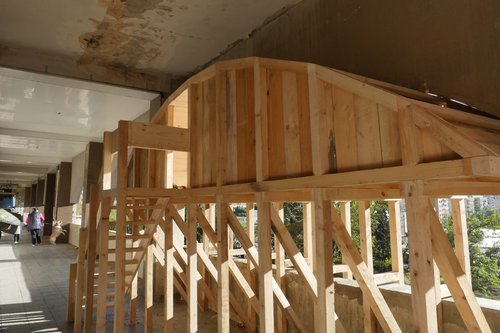
Among the strongest contributions was an installation by Georgian artist Teo Baramidze (b. 1986), whose cyberpunk-inspired metal construction carried the atmosphere of speculative fiction and fragmented mythology. Nearby, Marseille-based artist Philippe Chea Oum (b. 1998) presented graphic works balancing grotesque humour with the visual energy of high-end comics, while Brazilian-French painter Mariam Angeli Padilha (b. 1999) exhibited vivid landscapes infused with a subtle magical realism.
TAF remains modest by international standards, yet that is partly its strength. In a region shaped by political tension, shifting identities and competing cultural influences, the fair has become something more than a commercial event. It increasingly functions as a meeting point between artistic worlds that rarely occupy the same space – and perhaps that, rather than market scale, is what gives Tbilisi Art Fair its particular significance.

Tbilisi Art Fair