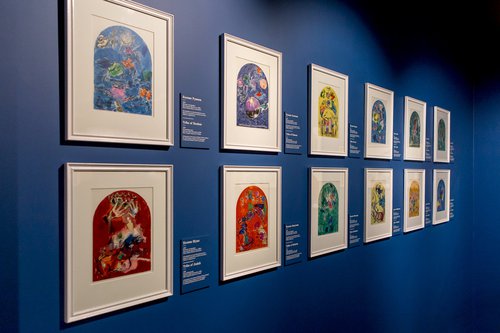


Marc Chagall. The Joy of Gravity. Exhibition view. Moscow, 2025. Courtesy of the State Pushkin Museum
Chagall in Isolation: A Journey Through Artist’s Early Works in Moscow
A new Marc Chagall exhibition at Moscow’s Pushkin Museum brings together some of the most iconic paintings and works on paper from the artist’s early creative years. Although loans from Western European and North American collections were not possible, the exhibition is nonetheless expansive, representative, and compelling.
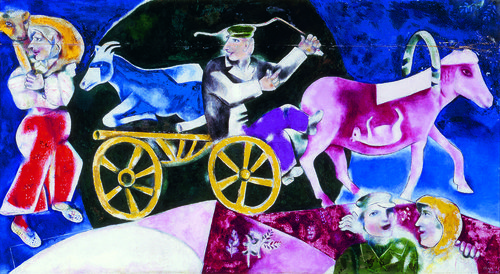
The exhibition ‘Marc Chagall: The Joy of Gravity’ is certain to attract a large audience, given the artist’s enduring popularity and widespread recognition. However, when visitors ascend the marble staircase at the Pushkin museum with violins suspended from above, and enter the White Hall, the museum’s most prestigious space, they may feel surprised. This hall has been transformed beyond all recognition, lavishly hung with panels once created in Moscow in 1920 for the Jewish Chamber Theatre. They have been part of the State Tretyakov Gallery’s permanent exhibition at the Krymsky Val annex since 2016.

One might reasonably ask why it was necessary to move these beautiful if enigmatic, and highly renowned works from one museum to another in the same city, and a walkable 1.5 km? When asked, Tatyana Gorodkova, the chief curator at the Tretyakov Gallery, replied: “This exhibition marks a new stage in the close collaboration between our museums; in January, the Pushkin Museum will be bringing paintings by Henri Matisse and Pablo Picasso to us”. It is a new experience for Moscow audiences and two of the leading national museums in Russia.

In his panels for the Jewish Theatre, which opened in 1914, Marc Chagall (1887–1985) replaced traditional images of the Muses with attendees of Jewish weddings: a green-faced klezmer violinist stands in for the Muse of Music, Euterpe; a badhan jester in a strict black suit replaces Melpomene; a dancing, plump matchmaker stands in for Terpsichore; and a proud scribe of the Torah, dressed entirely in white, represents the Muse of Literature. The largest panel, ‘Introduction to the Jewish Theatre’, features numerous characters, including the artist himself with his wife and young daughter, theatre director Abram Efros dressed in ballet tights, director Alexey Granovsky (who dipped his feet in a basin of water, as devout Jews did to stay awake while reading sacred texts) depicted in four different roles of Solomon Mikhoels, theatre doorman Efroim, goats, and cows.
Often, even when artworks are moved to a different room within the same museum, they change in appearance to the viewer. Here the paintings feel very cramped, though they were originally created for a very small theatre space.

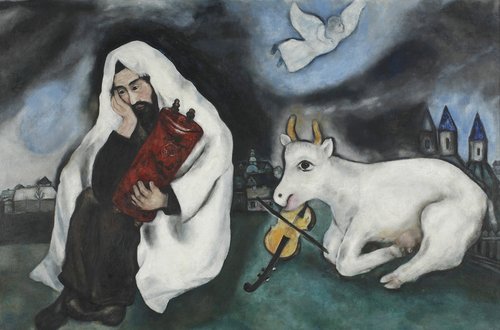
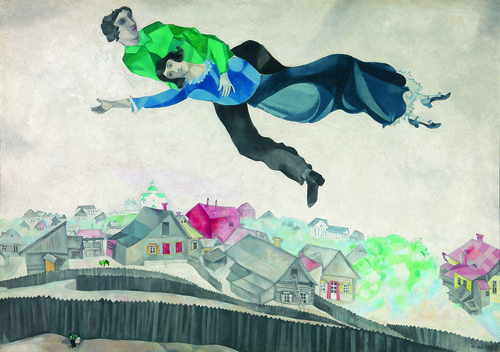
The White Hall also houses Chagall’s most iconic paintings from the collections at the State Tretyakov Gallery and the State Russian Museum, including his popular ‘Over the Town’ and ‘The Promenade’. While the central part of the exhibition will be familiar to visitors, the periphery promises to delight even the most discerning and well versed viewer, featuring works on paper by Chagall not only from Russian museum collections but also from some important private collections. According to museum guide Victoria Aptekman, “the exhibition has gathered together everything we have”.

The exhibition features numerous drawings, gouaches, and works in mixed media on cardboard or paper including sketches of his most famous paintings and series which are rarely seen in museums and known mostly through book and album illustrations. While the painting ‘Rain’ from 1911 is in Venice, a highlight of Peggy Guggenheim’s fabled collection, a detailed sketch for it with tilted houses, a sailor with an umbrella, a drunkard, and a shepherd driving a goat across the sky can be seen at the exhibition.

While ‘Rain’ and most of the paintings show the expected folk-fantasy Chagall, and the ‘Blue Lovers’ from the same year from a private collection are poetic to the point of being sentimental, other series of works on paper show unusual dramatic restraint. These include portrait sketches of the artist’s family and his ‘War’ series. Alongside the frequently reproduced ‘Wounded Soldier (On a Stretcher)’, depicting a youth with a tormented face and exposed stomach, one can see a grotesque, tragic drawing ‘Man with a Cat and Woman with a Child. Refugees’.

The exhibition features only early works by Chagall all of the highest museum quality. To further engage the audience, a model of Chagall’s Vitebsk room, filled with family household items including a samovar, has been brought to the Pushkin from the State Russian Museum in St Petersburg. This cheery theatrical installation feels a little out of place in the museum’s otherwise austere ceremonial hall.
The expanded exhibition labels which accompany almost every work are also unusual. They are written in a simple language, devoid of art-historical flourishes, and quote relevant passages from Chagall’s autobiographical book ‘My Life’, which is beautifully written.
Before entering the White Hall, one encounters the 1961 German edition of Franz Meyer’s ‘Marc Chagall: Life and Work’. This is the first monograph about the artist, written by his son-in-law who was a respected art historian. The title page features a drawing and an inscription in Russian (albeit with mistakes) dedicated to late director of the Pushkin Museum, Irina Alexandrovna Antonova, which was made by Chagall himself.

It was here, at the Pushkin Museum in 1987, that the first exhibition dedicated to the centenary of Marc Chagall’s birth took place. It was a huge success, with visitors queuing for hours to see it. This current show will likely also attract crowds despite the fact that most of what is shown can easily be seen in the two main museums of Russian art. The name Marc Chagall has a magnetic effect on people, drawing them in. Perhaps the only thing that is confusing is the title – the exhibition of an artist’s works, where people, houses, and goats fly, has been called ‘The Joy of Gravity’.