

Why are Russian Collectors Creating open storage for their collections?

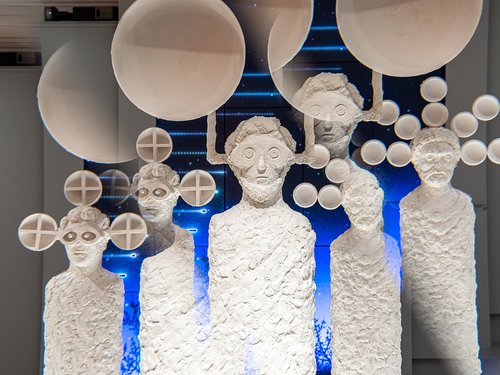
Street Art Storage. Exhibition view. St. Petersburg, 2026. Photo by Anna Skudar. Courtesy of Street Art Storage
Contemporary art collectors in Moscow and St Petersburg are increasingly bringing their collections into the public sphere, lending works to exhibitions and establishing their own foundations and exhibition spaces. Alongside this growing openness, a further model is emerging: open storage, which private collectors and institutions are beginning to explore in a variety of forms.
Open storage as a way of engaging with and viewing art remains relatively rare in Russia, even among major museums. The Hermitage pioneered the approach in the mid-2000s with the opening of Staraya Derevnya [Eng. The Old Village], a dedicated restoration and storage centre on the outskirts of St Petersburg. Moscow followed only two decades later, when spaces were created in the restored pavilions of the legendary VDNKh Park, where institutions including the Museum of the East and the Polytechnic Museum began exhibiting parts of their collections. From the outset, the Hermitage’s new storage facility offered special tours for small groups, gradually expanding access as new buildings were added to the complex.


“I visited the ‘Old Village’ for the first time last summer - the centre is phenomenal! Everything there amazed me from the highest level of organization to the storage itself, and excursions conducted in this holy of holies of a museum,” collector Natalia Opaleva shared with Art Focus Now.
Opaleva is the founder and owner of the AZ Museum in Moscow, dedicated to Anatoly Zverev (1931–1986), one of the most brilliant nonconformist artists to emerge in the Soviet Union in the 1960s, whose expressive style reportedly earned the admiration of Pablo Picasso. Her private museum opened a decade ago, and from the outset its team has taken an experimental approach to displaying the collection and designing exhibitions. After visiting Staraya Derevnya, however, Opaleva was so inspired by the Hermitage’s approach that she decided to adopt the open-storage format for the museum’s next permanent exhibition. Today, visitors can explore the collection independently or as part of a guided tour, moving racks fitted with metal grids on which works are arranged according to dedicated themes.

“Most visitors, especially young people, were delighted by the decision. But there were also some who did not like it, who did not expect such a radical change in a museum, and some refused to move the metal grids themselves preferring to visit onlyand only the second floor, where paintings are hung on the walls,” the owner notes.
Even before Opaleva’s initiative, Street Art Storage, an institution in St Petersburg, had developed its own open-storage model around the extensive collection of Russian street art assembled by Natalia Voznesenskaya. In 2023, a dedicated 88-square-metre exhibition space opened in the fashionable Sevkabel Port art cluster. Here, street-art researchers can explore the collection and its archive, while the wider public can access the space through guided tours and educational events.

“Open storage allows us to simultaneously exhibit a large number of works and create different thematic journeys within one space. Since the works are housed in retractable sections, we can conduct several tours simultaneously without changing the exhibition. For example, we currently offer a basic introduction to street art, the Ural and Nizhny Novgorod scenes, as well as curatorial tours of the temporary exhibition,” Ms. Voznesenskaya explained to Art Focus Now.
The Street Art Storage collection currently contains over eight hundrede works, with approximately three hundred of those on display at any time. There are also limitations, as Natalia Voznesenskaya admits: “This storage format does not allow for extensive explanations of the works and therefore is not suited to free access. An exhibition can only be visited through guided or curator-led tours. In our experience, independent viewing leads to misunderstandings about street art due to the lack of context – which is almost paramount for this genre.”
Other contemporary art collectors are also fast gathering experience in this format to varying degrees. Last year Sergey Limonov, founder of Limonov Art Foundation, announced the construction of an open storage in a former factory in St. Petersburg, but so far there is no further news about it.

Anton Kozlov, today one of Moscow’s most active collectors, exhibits works from his collection throughout Russia, but only allows professionals into his storage in central Moscow. “My collection is open primarily to those who really need it such as art community professionals. And they, of course, have access to the storage, because they need to see the material and interact with it. And I advocate for works to become part of the cultural field through exhibitions,” he explained to Art Focus Now. His atmospheric storage is located in a large five-room apartment in a historic building, literally piled high with art from floor to ceiling. So, there is no space for any meaningful exhibition.
In the centre of Moscow next to Kozlov’s space, collecting duo Alexander and Victoria Artemov are building their open storage. “The idea came from the desire to constantly interact with the works. When they are packed up and piled under the stairs, it is terrible. This way people can come and look at the works in peace,” said Mr. Artemov. They presented a dozen items from their collection for the first time this Spring at a show during Contour art fair in Nizhny Novgorod. Their collection has already surpassed three hundred works by contemporary Russian artists and they have no plans to stop. The storage facility is scheduled to open this Autumn.


Moscow’s first large-scale private open-storage facility was intended to be housed at GES-2 House of Culture, founded by billionaire collector Leonid Mikhelson. His V-A-C Foundation, which also operated a space in Venice, has assembled an impressive international art collection. Before GES-2 opened in 2021, Teresa Mavica, the foundation’s former director, repeatedly spoke in interviews about open storage as one of the institution’s most exciting forthcoming features. The anticipation was considerable, and understandably so: visitors expected access to works by artists including Francis Bacon (1909–1992), Wassily Kandinsky (1866–1944), Auguste Renoir (1841–1919), Jeff Koons (b. 1955) and Antony Gormley (b. 1950), among many others. Sadly, five years after GES-2 was inaugurated, its promised open storage is no longer even mentioned.