

Why Rekindle the Vibe of the 1980s?

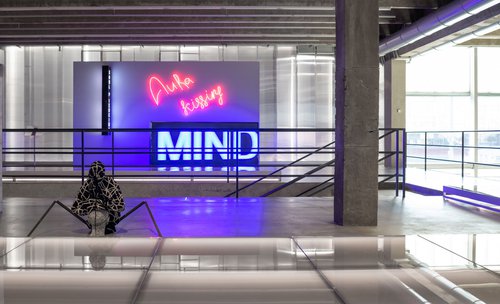
Art on the 1980s Wavelength. Exhibition view. Moscow, 2026. Photo by Daniil Annenkov. Courtesy of Garage Museum of Contemporary Art
At the Garage Museum of Contemporary Art in the Russian capital ‘Art on the Wavelength of the 1980s’ transforms the late-Soviet underground into a rigorously structured, ever-evolving public archive.
‘Art on the Wavelength of the 1980s’, a current project at the Garage Museum of Contemporary Art in Moscow is both an accessible guide to the era and a research tool for rethinking the late-Soviet underground. Presented as an open storage, it traces how, from the mid-1970s to the early 1990s – almost clandestinely – art gradually entered into dialogue with television, cinema, the rock scene, fashion, and new forms of public life, moving step by step out of what was its closed professional circle and into the broader social sphere.

Today the attention given to late-Soviet underground art is bound up with a wider shift in cultural institutions in Russia: there is a growing investment in working with their own archives, re-examining local artistic traditions, and searching within them for models of audience engagement in conditions of shifting regimes of publicity and control over culture. The period of the “extended 1980s” proves a particularly useful lens through which to trace how experimental art built a dialogue with mass culture and state infrastructure – from houses of culture to television – without reducing that experience either to underground opposition or to straightforward absorption into the official canon.
The curators Anastasia Kotyleva, Anastasia Mityushina, Nikita Nechayev, Sasha Obukhova and Oksana Polyakova work from the concept of the “extended 1980s”, treating the period from late stagnation to the early post-Soviet years as a single temporal arc in which it is not so much styles that change as regimes of publicity and mediality. This optic makes it possible to avoid the convenient but overly crude division between ‘underground’ and ‘perestroika-era freedom’. In its place, visitors are offered a map of interconnected processes – from apartment exhibitions to VHS documentation, from squats to the television screen.

The project is structured as an open-storage display of the Garage’s own collection of Russian art from the 1980s–1990s, which the museum has been systematically exhibiting since 2024. The functional architecture of grid shelving – developed for an earlier project called ‘Open Storage: Prologue’ – enables the Garage’s curators to constantly reconfigure the display, reducing the distance between a work’s entry into the museum collection and its presentation in public. In this sense, ‘Art on the Wavelength of the 1980s’ is not a one-off curatorial gesture but a phase in the longer institutional project of making sense of the recent past.
Although Garage has traditionally been associated more strongly with the Moscow scene, the project clearly aims for a balance between the two principal cities of late-Soviet art, presenting works from Garage’s Saint Petersburg branch. Moscow narratives – from the Gnezdo group and TOTART to Mukhomor, the squats Detsky Sad and Furmanny, the band Srednerusskaya Vozvyshennost, and the action ‘Bittsa za Iskusstvo’ (‘To Fight for Art’) – sit alongside Leningrad material: Sergei Solovyov’s film ‘Assa,’ the activities of the Leningrad New Composers, the Assa Gallery, and the history of the ‘Zero Object’ by Timur Novikov (1958–2002) and Ivan Sotnikov (1961–2015).
This approach is particularly telling at the close of the project. As the curatorial texts remind us, whilst in 1982 the scandal surrounding the ‘Zero Object’ was still possible at the first official exhibition of the Tovarichchestvo eksperimentalnogo izobrazitelnogo iskusstva (Fellowship of Experimental Visual Arts), by 1986 the 17th Youth Exhibition had effectively dissolved the boundary between ‘official’ and ‘underground’ art, and the street action ‘Bittsa za Iskusstvo, or Art Against Commerce’ confirmed that the time of the bulldozers had passed. The Leningrad narrative, then, is no decorative appendage to the Moscow story; rather, it establishes the historical horizon: the transition from repressive reaction to a conflicted but already institutionalised publicity.

The exhibition opens with a reconstruction of the action ‘Incubating the Spirit’ by Gennady Donskoy, Mikhail Fyodorov-Roshal (1956–2007), and Viktor Skersis (b. 1956), originally performed in 1975 at the opening of an exhibition of Moscow artists in the Dom Kultury pavilion at the VDNKh. In contemporary accounts this episode is increasingly regarded as a turning point: an object-process work appeared for the first time within an official exhibition, calling into question the habitual distinction between painting and sculpture.
The Garage emphasises the dual status of this action. On the one hand, it was a radical attempt to make the viewer an active participant, inviting them to join in the collective incubation of a metaphorical spirit - a gesture that slots into the tradition of Moscow conceptualism and performance. On the other, the 2026 reconstruction in the form of a museum video is a reminder that any institutional reproduction of a performance inevitably transforms a living process into an object of memory, subordinated to the logic of the project.

The section devoted to the TOTART collective shifts this line of inquiry into the space of the kitchen. Natalia Abalakova (1941–2024) and Anatoly Zhigalov (b. 1941), who began with painting and collective performances, developed in the 1970s and 1980s a distinctive language in which ‘Kitchen Art’ became a gesture of demystifying the sacralised artistic act. The display makes the point: this kitchen is not a symbol of cosy everyday life but a laboratory in which the conventions of artistic language are laid bare. A work first shown in an apartment enters the exhibition as a kind of ironic commentary on the very notion of “art for the initiated”. In this way, the early experiments of Gnezdo and the kitchen installation of TOTART form the axis on which the analysis of the transformation of late-Soviet artistic discourse is built.
The section of the project about the cult film ‘Assa’ draws on a familiar media resource: many visitors arrive at the museum already carrying their own emotional projections onto this film. The curators, however, do not limit themselves to nostalgic quotation of its cult scenes. Attention shifts instead to the way Sergei Solovyov builds a dialogue with the artistic milieu: his collaboration with members of the Gnezdo group, the inclusion of objects and installations in the frame, his work with the imagery of underground music and alternative fashion.

Running in parallel is material on the Leningrad New Composers – a collective that from the late 1970s experimented with tape and sound, producing hybrids of music videos, performances, and video-art works. For visitors unfamiliar with the Soviet context, it is important that these practices are shown not as an imitation of Western MTV but as an independent strand that grew out of the local rock scene and artistic groupings. Taken together, the sections on film and music demonstrate that the late-Soviet underground was not so much catching up with global trends as translating them into its own language, making use of existing infrastructure – rock clubs, houses of culture, film studios.
A separate narrative concerns the Moscow band Srednerusskaya Vozvyshennost, formed in the mid-1980s around Sven Gundlakh (1959–2020), Nikita Alexeev (1953–2021), Nikola Ovchinnikov (b. 1958), and Sergei Volkov (b. 1956). Photographs and video footage shot by Sergei Borisov (b. 1947) document rehearsals in Alexeev’s apartment and concerts at the House of Culture of the Institute of Atomic Energy, the House of Models on Kuznetsky Most, and the Central House of Culture of Medical Workers.

These materials underline once more that the underground’s emergence onto the wavelength of mass culture took place not only through cinema and television, but also through the reappropriation of the infrastructure of late-Soviet leisure time. “Houses of models” and “houses of culture,” designed to serve official ideology, were unexpectedly transformed into stages for hybrid rock performances and alternative fashion shows – precisely that space in which late-Soviet art ceased to be underground.
The action ‘Bittsa za Iskusstvo, or Art Against Commerce,’ which took place on 30th November 1986 in Bitsevsky Park on the outskirts of Moscow, occupies a special place in the project. Contemporaries already described it as an event that made clear how radically the situation had changed since the Bulldozer Exhibition of 1974. Moscow conceptualists and their allies brought their works into an art market previously dominated by craft objects, naïve painting, and souvenir goods.
The account of this action published in the Russian Art Archive Network (RAAN) and reproduced at Garage highlights the event’s ambivalence: on the one hand, the artists were asserting their right to a presence in a semi-legal economic space; on the other, their incursion provoked a conflict with local traders who feared losing their livelihood. The situation ended with police intervention and the presence of foreign television cameras, transforming a local conflict into a media event. In placing this episode at the centre of the exhibition, Garage makes an important point: the underground of the 1980s was not only an aesthetic but also an economic practice, working out its own relationship to the market and to commerce.
The series of works on paper in gouache by Nikita Alexeev (1953–2021) from 1986 – ‘Fight for Humanist Ideals!!!,’ ‘Fight for Art!!!,’ ‘Fight Against Vulgarity!!!,’ ‘Fight Against Bourgeois Influences!!!,’ ‘Fight Against Vestiges of the Past!!!’ – functions in the exhibition as a kind of textbook in the deconstruction of Soviet agitational language. In the context of the Bitsevsky action and the activities of Srednerusskaya Vozvyshennost, these slogans read simultaneously as parody and as a serious exercise in retuning official rhetoric.

The curatorial emphasis on these works demonstrates that late-Soviet art of the 1980s worked as intensively with language as it did with image. For an international reader accustomed to Western examples of appropriation art, the gesture may seem familiar; but in the Soviet context, where the slogan was part of a real disciplinary everyday, it acquires a particular political density.
The project concludes with a section dedicated to Leningrad art, in which the key narrative node is the celebrated ‘Zero Object’ by Timur Novikov (1958–2002) and Ivan Sotnikov (1961–2015), shown at the first exhibition of the Fellowship of Experimental Visual Arts at the Kirov Palace of Culture in 1982. As sources recall, the work provoked a scandal and nearly precipitated the closure of the exhibition, yet within a few years similar experiments had become part of official youth exhibitions.
Ultimately, ‘Art on the 1980s Wavelength’ makes a strong impression as a well-structured, carefully considered project in which the museum consciously resists the temptation of nostalgia for the carefree 1980s. In place of a stylised retro corner complete with vinyl and posters, visitors are offered a scrupulously assembled yet open-ended archive, in which the artistic, musical, and media practices of the late Soviet era are examined as a complex system rather than as a collection of legendary episodes.

It is precisely this principled analytical rigour that makes the project particularly valuable for an international audience. Garage demonstrates that the late-Soviet underground can and should be viewed not merely as an exotic history of resistance, but as a significant contribution to the global history of the relationship between art and mass culture. And the open-storage format hints that this story is far from over: the collection will grow, the display will change, and the wavelength of the 1980s will make itself heard again.
Art on the 1980s Wavelength
Garage Museum of Contemporary Art
Moscow, Russia
11 June – 23 September 2026