

Head of a Contemporary: Denis Khimilyayne’s Collection

Head of a Contemporary. Artists from a Collection. Exhibition view. St. Petersburg, 2026. Photo by Vitaliy Kolikov. Courtesy of Third Place
‘Head of a Contemporary’, drawn from the collection of Denis Khimilyayne and curated by Alexander Dashevsky, is less a conventional survey of contemporary art than a psychological portrait of Russia today. Set against the haunting backdrop of Third Place’s ruined interiors, the exhibition stages a dialogue between generations of artists united by themes of trauma, loneliness and historical disorientation.
One of the most renowned Russian collectors of contemporary art, St.Petersburg-based Denis Khimilyayne, has opened a major exhibition of his collection. The title chosen by the collector himself is strikingly simple – ‘Works from the Collection’ – and seems to echo a well-known Wittgensteinian idea: that in contemporary Russia there are things which cannot be clearly articulated and about which one must remain silent.

Head of a Contemporary. Artists from a Collection. Exhibition view. St. Petersburg, 2026. Photo by Vitaliy Kolikov. Courtesy of Third Place

Head of a Contemporary. Artists from a Collection. Exhibition view. St. Petersburg, 2026. Photo by Vitaliy Kolikov. Courtesy of Third Place

Head of a Contemporary. Artists from a Collection. Exhibition view. St. Petersburg, 2026. Photo by Vitaliy Kolikov. Courtesy of Third Place
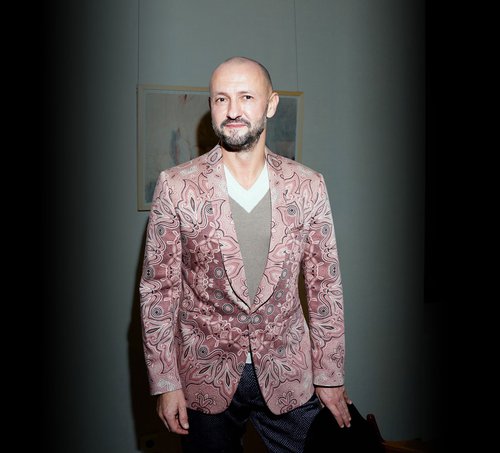
The project itself bears a different title, ‘Head of a Contemporary’, given by its curator and one of the exhibiting artists, Alexander Dashevsky (b. 1980). Khimilyayne often refers to works of art as “pieces”, a term more commonly associated with seasoned connoisseurs and collectors. It is not the first time that Khimilyayne’s collection has been exhibited in public. In 2019 a selection of works from it were shown together with works from the private collection of Sergey Limonov at the Anna Nova gallery in St. Petersburg.
It was originally planned that ‘Head of a Contemporary’ would be shown at the Moscow Museum of Contemporary Art’s building on Petrovka. Subsequently, however, a new venue was found in St. Petersburg: Third Place, a building rich in history and architectural character, abandoned in the early 2000s and gradually undergoing restoration since 2020.
Although museum spaces in Moscow tend to be more expansive than those in St. Petersburg, it is in the latter that ‘Head of a Contemporary’ feels most at home. The ruined palace interiors of Third Place provide an almost ideal context for the works on display. The motif of existential catastrophe, central to the project, is also one of Khimilyayne’s defining criteria in evaluating art: he often speaks openly of contemporary art as something rooted in pain and suffering.

Head of a Contemporary. Artists from a Collection. Exhibition view. St. Petersburg, 2026. Photo by Vitaliy Kolikov. Courtesy of Third Place

Head of a Contemporary. Artists from a Collection. Exhibition view. St. Petersburg, 2026. Photo by Vitaliy Kolikov. Courtesy of Third Place

Head of a Contemporary. Artists from a Collection. Exhibition view. St. Petersburg, 2026. Photo by Vitaliy Kolikov. Courtesy of Third Place

Head of a Contemporary. Artists from a Collection. Exhibition view. St. Petersburg, 2026. Photo by Vitaliy Kolikov. Courtesy of Third Place
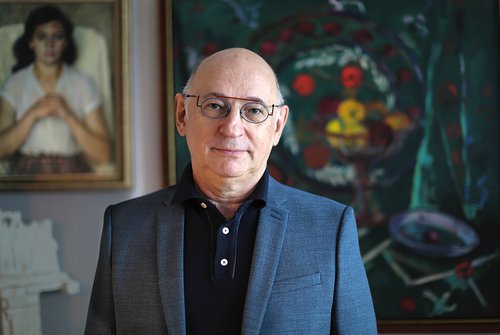
Denis Khimilyayne has been collecting contemporary art for more than a decade. Against the backdrop of other prominent Russian collections of recent years, many of which contain all the expected major names, his approach is distinguished by its selectivity, reflecting his own understanding of the field and a clear personal vision.
Compared with some other collectors, Khimilyayne – managing partner of the audit and consulting group Prime Advice – is not what one might call a Croesus. As he has often emphasised, the composition of his collection is shaped by his financial means. He belongs to a new generation of collectors for whom socialising and buying through galleries has largely replaced the close studio-based symbiosis with artists that was characteristic of collectors of the Soviet and early post-Soviet periods. At the same time, his collection includes not only recent acquisitions, but also a substantial selection of works by Non-Conformist artists.

Head of a Contemporary. Artists from a Collection. Exhibition view. St. Petersburg, 2026. Photo by Vitaliy Kolikov. Courtesy of Third Place

Head of a Contemporary. Artists from a Collection. Exhibition view. St. Petersburg, 2026. Photo by Vitaliy Kolikov. Courtesy of Third Place

Head of a Contemporary. Artists from a Collection. Exhibition view. St. Petersburg, 2026. Photo by Vitaliy Kolikov. Courtesy of Third Place

Head of a Contemporary. Artists from a Collection. Exhibition view. St. Petersburg, 2026. Photo by Vitaliy Kolikov. Courtesy of Third Place

Head of a Contemporary. Artists from a Collection. Exhibition view. St. Petersburg, 2026. Photo by Vitaliy Kolikov. Courtesy of Third Place
The meanings embedded in the exhibition by both curator and collector are most clearly articulated through the works of Vadim Sidur (1924–1986). This feels particularly fitting: despite his importance, the outstanding sculptor remains underrepresented in his homeland. Among his major works, only ‘The Formula of Sorrow’, a memorial to the Holocaust in Pushkin, near St Petersburg, has been installed in Russia.
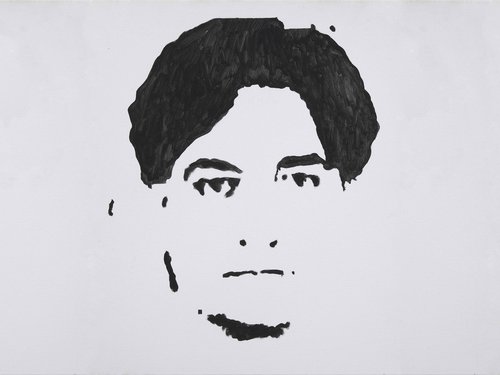
Khimilyayne’s collection includes several works by Sidur, among them the 1964 ‘Head of a Contemporary’, which gives the exhibition its title and appears on the poster.
In the exhibition’s antechamber, the scar-riddled ‘Head of a Contemporary’, which resembles a self-portrait of the sculptor, is juxtaposed with a 1991 bronze head by Sergey Volkov (b. 1956), its face only faintly discernible beneath a veil.

Head of a Contemporary. Artists from a Collection. Exhibition view. St. Petersburg, 2026. Photo by Vitaliy Kolikov. Courtesy of Third Place

Head of a Contemporary. Artists from a Collection. Exhibition view. St. Petersburg, 2026. Photo by Vitaliy Kolikov. Courtesy of Third Place

Head of a Contemporary. Artists from a Collection. Exhibition view. St. Petersburg, 2026. Photo by Vitaliy Kolikov. Courtesy of Third Place
The exhibition’s nine sections are intended, according to curator Alexander Dashevsky, to describe the historical, personal, psychological and cultural identity of someone living in Russia today. This vision unfolds through sections titled ‘Man of Labour’, ‘After Experiments’, ‘Urban Alienation’, ‘Strange Sprouts’ and ‘Fragmentation’, each pointing to a different aspect of contemporary Russian experience.
Meanings emerge from the diversity of media and the pairing of artists from different generations: two installations – ‘Cast Me Not Away from Thy Presence’ (2011) by photographer Vladimir Kupriyanov (1954–2011) and ‘The Head of a Worker’ (2016–2017) by Semyon Motolyanets (b. 1982), made of cobblestones – appear in the first section, ‘Man of Labour.’ Meanwhile, ‘Russian Writers’ (2021), carved with an axe by Nestor Engelke (р. 1983), sits alongside Andrey Krasulin’s (b. 1934) ‘Bronze about Mandelstam’ (2021), marking the section ‘Yesterday. Today. Forever.’ Other themes unfold in an almost monologic fashion – such as Liza Bobkova (b. 1987) in the section ‘I Am Here’ with her eponymous video (2021), and Vitaly Pushnitsky (b. 1967), whose objects from the ‘Occam’s Razor’ series (2012) form a kind of iconostasis in the section ‘Hotel Called Culture.’

Head of a Contemporary. Artists from a Collection. Exhibition view. St. Petersburg, 2026. Photo by Vitaliy Kolikov. Courtesy of Third Place

Head of a Contemporary. Artists from a Collection. Exhibition view. St. Petersburg, 2026. Photo by Vitaliy Kolikov. Courtesy of Third Place

Head of a Contemporary. Artists from a Collection. Exhibition view. St. Petersburg, 2026. Photo by Vitaliy Kolikov. Courtesy of Third Place

Head of a Contemporary. Artists from a Collection. Exhibition view. St. Petersburg, 2026. Photo by Vitaliy Kolikov. Courtesy of Third Place
The route exhibition goers take through the enfilade of halls is marked out by ramps and a ruby red carpet runner. There are constant shifts in the registers of perception throughout: at times the art seems to close in densely around the viewer, at others it deliberately keeps its distance. The journey occasionally recalls a fairground ‘House of Horrors’, except that here the visitor moves through it on foot, encountering the frightening, the tragic and the enigmatic.
Khimilyayne and Dashevsky assume the difficult role of psychotherapists yet are compelled to choose therapeutic silence over any in-depth examination of the notion of censorship. In a private conversation, the collector mentioned several artists from his collection who had been excluded from the exhibition for reasons beyond his control. Knowing these artists and their work, one may reasonably assume that many shared a distinctly critical social tone.


The juxtaposition of art from different periods is visually intriguing and serves as a reliable driving force for the exhibition almost until the very end. Yet it also carries inherent contradictions: just as all historical parallels are imperfect, and likening today’s reality to the Soviet past cannot fully explain what is happening now, it is equally impossible to evaluate works from the 1970s by the standards of the 2000s.
In general, artists today produce far more than they did in the past, sometimes giving the impression that they create in an almost physiological mode. Half a century ago, their colleagues in Russia were also prolific, but they approached art with far greater purposefulness. It is not enough simply to bring works together in one space; it is necessary to reconcile the unique experience behind each of them. This is a nontrivial task, and one that the exhibition poses to a viewer accustomed to a surrounding reality that does not require special skills to understand.

Head of a Contemporary. Artists from a Collection. Exhibition view. St. Petersburg, 2026. Photo by Vitaliy Kolikov. Courtesy of Third Place

Head of a Contemporary. Artists from a Collection. Exhibition view. St. Petersburg, 2026. Photo by Vitaliy Kolikov. Courtesy of Third Place

Head of a Contemporary. Artists from a Collection. Exhibition view. St. Petersburg, 2026. Photo by Vitaliy Kolikov. Courtesy of Third Place
As Denis Khimilyayne puts it: “The feeling of fear or loneliness was perfectly described in the 9th century, and later in the 15th, and the 20th, and will be described in the 22nd. It seems to me that artists of the 1960s perfectly express our feelings today.”
This reasoning, together with the exhibition’s title, prompts us to consider the current meaning of modernity - a concept that once marked the beginning of the era of modernism. As ‘Head of a Contemporary’ shows, modernity remains an ambivalent, living and therefore dangerous notion.


Head of a Contemporary. Artists from a Collection
St. Petersburg, Russia
24 April – 31 July 2026