

Evgeny Rukhin: The Memory of Things

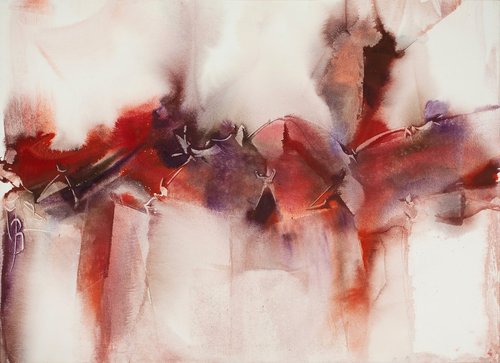
Evgeny Rukhin. Composition with Icons, 1974. Courtesy of AZ Museum
Evgeny Rukhin transformed the ordinary materials of everyday life into a language poised between object and abstraction. The MMOMA exhibition ‘Rukhin. A Step into Non-Objectivity’ traces how, over the course of a brief career, these familiar objects were fragmented, scorched, layered and absorbed into the painted surface. In doing so, it reveals an artist whose work moved far beyond the category of Soviet nonconformism towards a highly individual exploration of material, memory and form.
The exhibition ‘Rukhin. A Step into Non-Objectivity’, currently on view at MMOMA is not simply a memorial exhibition marking half a century since the artist’s tragic death, but also an attempt to restore to the history of Russian art a distinctive creative legacy that has become dispersed across museum and private collections in Russia, the United States, Europe and elsewhere. Organised across nine thematic spaces, the exhibition brings together more than a hundred works, documents and archival materials selected by curators Yan Ginzburg, Elena Milanovskaya and Evgenia Shuster. Together, they trace Rukhin’s artistic development from his early landscapes and fascination with Russian antiquity to increasingly complex textural assemblages, signs, objects and, ultimately, radical abstraction.

Evgeny Rukhin (1943–1976) belonged to a generation of Leningrad and Moscow nonconformist artists for whom painting was not merely a private aesthetic pursuit, but a means of defending the right to an independent artistic language. Yet his place within unofficial art cannot be reduced either to the biography of an ‘underground’ artist or to his participation in the landmark exhibitions of the 1970s. His work developed at the intersection of several seemingly incompatible traditions: Old Russian icon painting, the material poetics of the humble, everyday object, Pop Art, geometric abstraction, the conceptual gesture and post-war European painting. In Rukhin’s work, the object never disappears entirely. Instead, it undergoes processes of deconstruction and deformation, subjected to a series of experiments - fragmentation, imprint, packaging and sign - through which it acquires a new existence on the boundary between the recognisable and the non-objective.

Rukhin was born in 1943 in Saratov, into a family of geologists who had ended up there after being evacuated from Leningrad. His father worked on palaeogeographical maps, and his maternal grandfather was a topographer. The artist himself later graduated from the Faculty of Geology at Leningrad University and worked as a survey geologist. This biographical background matters not as a direct source of imagery but as a particular way of seeing the surface of the world: landscape, layers, fault lines, the traces of time, the combination of heterogeneous rocks.
Rukhin first felt the impulse to paint while taking part in a geological prospecting expedition, when he was around twenty years old. In the mid-1960s, he began by working from the natural environment of the Leningrad region before turning to Old Russian architecture, monasteries and the landscapes of the Russian North. He was drawn in particular to Pskov, Vologda, the Arkhangelsk region and the Solovetsky Islands - places that lay beyond the country’s officially constructed tourist image.
Even in these early landscapes, space is not so much depicted as gradually built up through layers of paint. Horizon, earth, sky, walls and the silhouettes of churches emerge from a dense accumulation of pigment. Landscape begins to be understood not simply as a view, but as a surface endowed with its own memory.
It was northern landscapes with churches that were shown in New York at the Betty Parsons Gallery in the winter of 1966–1967. It was an exceptionally early international success: Rukhin was only twenty-three, and the Parsons gallery was associated with American modernism and the circle of the Abstract Expressionists. Ten of the artist’s works were shown at the exhibition. However, Rukhin resisted being cast simply as a painter of ‘Russian views’ for foreign audiences. On the contrary, the experience of his early landscape became the point from which he began radically to rethink the painting itself – as a material object, as a field of action and as a trace of destruction.


The decisive turning point in Rukhin’s work came at the end of the 1960s. In a 1970 letter to Betty Parsons, he described his own development as a progression from pure abstraction towards the incorporation of doors, rough hinges, nails, locks and charred wood. These objects do not function as illustrations of everyday life. Stripped of their usual purpose, they become plastic elements in their own right: reliefs, signs and, at times, almost icon-like symbols.
One of the most important motifs of this period is the lock, particularly the axe-head lock, whose metal plate recalls the blade of an axe. In contrast to the key - so prevalent in the art of the period as a symbol of searching, discovery or loss - Rukhin’s lock suggests closure, obstruction, prohibition and boundary. It may be embedded in the painted surface, reduced to a simplified silhouette, or set against a charred board so that the composition begins to evoke the form of a cross. Here, the recognisable object does not explain the composition but resists it, remaining as a material fragment of reality within the abstract field.
Closely connected to this is Rukhin’s turn towards coarse fabrics - sacking, linen and waffle-weave towelling. He deliberately avoids aestheticising these materials: what interests him is not luxurious texture, but ordinary, abject matter. Cut canvases, patches, stitches, layered fragments and traces of wear bring his practice close to European Arte Povera, above all to the work of Alberto Burri (1915–1995). Within the Russian context, however, this treatment of fabric acquires an additional resonance. The surface of the painting may evoke the wall of a stairwell, a worn domestic object or even a burial shroud. Here, the sacred is not derived from an established canon, but emerges from the condition of the material itself - from its wounds, damage and ageing, and from its resistance to the passage of time.
In his early assemblages, Rukhin still sought to create a plastic equivalent of the object. Around 1972, however, a different shift took place: the object itself became fragmented. Pieces of furniture entered his compositions — parts of armchairs, fragments of joinery and boards marked by traces of use. Stripped of their original integrity, they became frameworks around emptiness. In the 1972 work ‘Untitled’, fragments of a broken armchair are distributed across five canvases arranged in a cruciform configuration. The object is neither represented nor simply incorporated into the picture; instead, it is dismantled and reassembled as a spatial structure.

Red occupies a distinctive place in Rukhin’s artistic language and cannot be understood simply as a direct reference to Soviet propaganda. In his paintings, a red field, stripe, number, letter or diagonal functions above all as a signal of alarm - a flash of danger, a trace of violence inflicted upon the surface, an internal cut within the body of the painting. Red can operate like a wound: it does not decorate the image, but opens it up.
In the later works, red often enters into a tense relationship with white. Yet Rukhin’s white is far removed from any notion of modernist purity. It is a whiteness that has absorbed dirt, dust, abrasion and the traces of public space - a stairwell, a corridor, an abandoned room. Across such surfaces appear inscriptions and warnings: ‘Close the door!’, ‘Do not switch on!’, ‘Men at work’, ‘Stop! Danger’. These belong not to the realm of individual expression, but to the impersonal language of instruction, prohibition and control.

It is here that Rukhin’s painting comes closest to a conceptual sensibility. His inscriptions do not function as commentary on the image, but as an active layer within it. They establish a limit: the freedom of gesture collides with prohibition, and the surface of the work becomes a space in which traces of external pressure are preserved. Object, text and colour together form a kind of archive of Soviet everyday life, yet Rukhin never describes that reality in a straightforwardly realist manner. Instead, he translates it into a language of signals, imprints, scratches, stamps and damage.
In works incorporating crates and boxes, another important theme emerges: the movement and circulation of the artwork itself. As an artist who travelled constantly between Leningrad and Moscow and worked within a network of collectors, diplomats and foreign intermediaries, Rukhin understood that a work of art exists not only in the studio, but also within systems of packing, transport, export and storage. Broken crates, protective markings, diagonal stripes recalling the warning ‘Keep away from fire!’, and impressions of cast-copper icons form a complex visual vocabulary. Within it, the image of St Nicholas the Wonderworker, patron saint of travellers, appears alongside the language of cargo, transit and fragile goods.

By the late 1960s, Rukhin had developed close ties with the Moscow nonconformist circle, particularly with Oscar Rabin (1928–2018) and Vladimir Nemukhin (1925–2016). His career thus connected the two principal centres of unofficial art in the Soviet Union: Moscow and Leningrad. In 1974, he took part in the ‘Bulldozer Exhibition’, the notorious confrontation between unofficial artists and the Soviet authorities. He later participated in exhibitions at the I.I. Gaz Palace of Culture and the Nevsky Palace of Culture in Leningrad, events that helped to shape what became known as ‘Gaz-Nevsky culture’. Rukhin was one of the movement’s most active and committed participants.
Yet Rukhin’s significance extends well beyond his position within Soviet nonconformism. What distinguishes his work is the way he brought the experience of Western post-war art into dialogue with a distinctly Leningrad sensitivity to material and surface. Pop Art, in his hands, does not become a borrowed language of consumer culture, nor is Arte Povera reduced simply to the use of humble materials. Old boards, rusted iron, fragments of furniture, impressions of icons, coarse fabrics and inscriptions drawn from communal spaces together form a distinctive archaeology of late Soviet everyday life. That reality is not merely recorded; it is broken down and transformed into the very substance of painting.

Rukhin’s life was cut tragically short on 24 May 1976, when he died in a fire in his Leningrad studio, just weeks before his thirty-third birthday. The circumstances surrounding the fire have never been conclusively explained. His death quickly became part of the mythology that grew up around him, often overshadowing the complexity and range of his work. This makes the present exhibition all the more significant. It invites us to see Rukhin neither simply as a legend of the Leningrad underground nor through the prism of his tragic death, but as an artist whose work underwent a remarkably intense and rapid evolution.
The significance of the MMOMA exhibition lies above all in the scale of the research behind it. Rukhin’s legacy is widely dispersed: a substantial number of works left the Soviet Union during his lifetime or shortly after his death, while others remain in private collections and institutions abroad. According to the exhibition materials, the Zimmerli Art Museum at Rutgers University in New Jersey holds around eighty works from the Norton Dodge Collection, making it one of the most substantial and representative holdings of Rukhin’s work. The exhibition does not therefore attempt the impossible task of assembling a fully comprehensive retrospective. Instead, it reconstructs the trajectory of Rukhin’s career by bringing together early and late works, archival documents, museum loans and rarely seen works from private collections.

Particularly important is the exhibition’s inclusion of Rukhin’s early work. For many years, he was known primarily for his mature textural assemblages, red-and-white compositions and works poised between painting and object. Yet the early landscapes, the ‘blue’ compositions and the works centred on motifs of walls and grilles reveal that his move towards non-objectivity was not the result of a sudden stylistic rupture. Even in these first experiments, there is already an impulse to transform the visible world into a layered construction, and natural space into a field of charged colour relationships.
The title ‘A Step into Non-Objectivity’ aptly captures this trajectory. Rukhin does not turn away from the world of things; on the contrary, he reaches non-objectivity through the intensely concrete - through a lock, a door, a piece of fabric, a fragment of furniture, a packing crate, an icon, an inscription, a stain or a burn mark. His abstraction is never sterile. It retains the memory of the object: its physical presence, its function, its loss, its vulnerability and its displacement.

It is here, perhaps, that Rukhin feels most contemporary. His work demonstrates that a painting can exist simultaneously as a field of colour, a material relief, an archive of its time and a site of resistance - not through overt declaration, but through the very substance and construction of the work itself.
Rukhin. A Step into Non-Objectivity
Moscow, Russia
30 September – 22 November 2026