The Right to Disappear from View

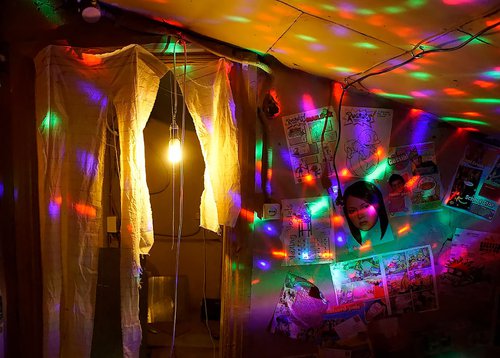
Ludmila Konstantinova. Come Over. No One Will Be There. Exhibition view. Moscow, 2026. Courtesy of Syntax Gallery
Ludmila Konstantinova’s exhibition ‘Come Over. No One Will Be There’ at Syntax Gallery in Moscow turns an invitation into absence. Art historian and curator Olga Turchina examines how the artist hones her signature visual language of creative ambiguity, working with deliberate incongruity between image, title and material.
In the title of Lyudmila Konstantinova’s exhibition, the promise of closeness turns into a statement of absence. The phrase “come over, no one will be there” usually implies a meeting alone together, yet in the joke that the artist retells in her accompanying text it is realised literally: having received such an invitation from a girl, a young man arrives and indeed finds nobody at home. Konstantinova is drawn to the absurdity of the story and to its “sense of poignant melancholy”. Between the invitation and the failed meeting there opens a gap that defines the tone of the project: objects remain recognisable, but the presence of another is no longer a necessary condition of what takes place.
This duality is characteristic of Konstantinova’s whole practice, in which an attractive surface does not guarantee pleasant content, nor a recognisable object a clear function. Image, title and material form do not quite confirm one another, so that in recognising the familiar the viewer begins at the same time to doubt whether the recognition is correct.

Konstantinova was born in Moscow in 1980, graduated from the Moscow Architectural Institute and the Institute for Contemporary Art Problems (IPSI), and worked as an illustrator for a long time. Since 2010 she has been a member of the VGLAZ group, while maintaining an independent practice. Her solo projects include ‘This Is Not an Abstraction ‘at the Triangle Gallery (2015), ‘Hello Reality!’ at the Moscow Museum of Modern Art and No Ambitions at the private Erarta Museum in St Petersburg (both 2016). The artist ties her own starting point less to her education or a first exhibition than to a change in the place of art in everyday life.
“I planned to be an architect or a decorator, and studied at MARCHI (Moscow Architectural Institute – Ed.). But then, in 1999, I met the contemporary artist Gosha Ostretsov, and my trajectory changed. I took part in his projects, but I can probably begin to consider myself an ‘artist’ from the time when we started to ‘pay’ for the rent of a studio with our works to the Artika foundation. That was around 2009–2010.”

In Konstantinova’s work, canvas and paper sit alongside painted plywood, wood, fabric and three-dimensional objects. The material basis of the works draws on habitual ways of perceiving, which the artist then disrupts from within. Her use of trompe l’oeil is not limited to imitating texture: what is deceived is the very expectation of what a work of art should be. Behind the meticulousness of execution, the possibility of deviating from a preordained order remains. “The most important thing is that I try to let in some uncontrollability, some chaos, even though my works look as if they came from the hand of a maniacal perfectionist.”
This logic emerged clearly in the exhibition ‘Welcome or Go to Hell’ (2023), devoted to formulas of politeness behind which it is impossible to recognise a sincere feeling with any confidence. Konstantinova transfers ready-made spoken cliches into the sphere of private communication, asking whether we are really expected in the places where we are invited. In ‘Come Over. No One Will Be There’ the contradiction is concealed within a single phrase, and for the invitation to turn into absence it is enough to carry it out literally. Doubt about the sincerity of the other thus gives way to doubt about the need for their presence.

In the artist’s commentary the joke is joined to a childhood fantasy about a world in which no people are left. For the artist, imagined solitude is associated not with horror but with safety and calm: the apocalypse frees one from other people’s demands and responsibilities. The exhibition does not, however, illustrate this scenario directly, and there are almost no signs of catastrophe here. Instead we see flowers, stones, furniture, work gloves, a plastic lid. The world is still full of things, although their relations with the human being become uncertain. The absence of people does not empty the world but seems to let it become even denser. “Imagine nature abandoned by humans: it begins to take over the spaces that have been freed, that are deprived of human control.”
The two parts of the exhibition offer different ways of living through this uncertainty. In the open space there are large paintings and a pair of vertical objects, while in a narrow, almost private zone there are small sheets in white frames: watercolours from different years that complement the new project. Where painting works through the saturation of its surface and collisions of colour, the graphic works require the viewer to come closer and notice that an object is being used not as it should be, or retains a function for which there is no longer an addressee.

The key to the intimate part is the image of a beach changing cabin, placed at the entrance. This little piece of architecture in the middle of an open landscape is intended for temporary disappearance from the common field of vision. To use it one need not be alone; it is enough to obtain the right not to be seen. Perhaps the point is less the elimination of those around us than the possibility of suspending their access to oneself.
It is important, though, to distinguish the history of a work from its present reading. Konstantinova herself does not connect the emergence of this image with the theme of shelter: “This part of the exhibition brings together watercolours from different years that complement, in meaning, my main project, made specially for the exhibition. The ‘Cabin’ dates from 2020, and I simply liked it graphically; it looked so alien against the backdrop of wild nature.”

The motif of shelter arises in the present juxtaposition of the works, but does not explain the original intention. The absence of a human figure does not yet prove that nobody is inside, since the opaque walls make it impossible to find out. The person has probably not vanished but has simply become inaccessible to the gaze.
If solitude implies the absence of others, privacy allows one to regulate the boundaries of their intrusion. Passing the image of the cabin into the narrow gallery zone, the visitor finds themselves in a separate space, and a rhyme arises between the depicted shelter and the actual conditions of viewing. The very purpose of the cabin, changing clothes, adds an everyday precision to this connection: it concerns the possibility of being vulnerable, not meant for display. But the desirability of seclusion does not exclude anxiety, and the need for another person does not always coincide with a readiness to let them in. “It is a complicated mix of feelings. For some reason I remembered the meme with the cat on the windowsill: ‘I’m all alone, nobody needs me, get your hands off me!’”

In the works on paper, strangeness is born of a small displacement of habitual relations. A doormat with the word WELCOME goes on welcoming, although it is depicted separately from a door and a house. Readiness to receive a guest is signalled, but the place of meeting and the host remain outside the image, so that the gesture of address persists after the disappearance of the one who makes it.
In a plastic chair, multicoloured ribbons or cords occupy the seat, spill over the armrests and descend to the floor, filling the place meant for a person with a tangled form. Next to this work, the figure of a barefoot girl, who seems bristling with an overturned chair, is perceived differently. The appearance of a person does not restore order: the woven surface overlaps the figure, turning it into a conglomerate of the living and the inanimate in which it is hard to separate possession from encumbrance. “This is also an old work, from 2023. My daughter put a chair on herself, and I liked how the object became part of her.”

Strangeness need not be invented in the studio; sometimes it is enough to notice it in a chance action. Read this way, the exhibition speaks less about the disappearance of the human being than about their loss of control over the situation. The image of the work gloves is constructed in a similar way: they retain the shape of hands but do not contain them, and the folds turn an empty shell into an almost independent organism.
In the sheets with stones, ants and a blue-and-white spiral object appear among the pebbles. Life continues here without human participation, a reminder that the absence of people does not equal the absence of inhabitants.

If the graphic works isolate an object amid the free margins of the paper, painting leaves almost no unoccupied space. In the composition with large flowers, orchids with red veins, pale petals, leaves and a pleated, translucent wrapper form a tight interweaving of surfaces. A landscape opens at the side, but this gap only emphasises how far the view is blocked. Baroque objecthood does not invite one to enter but screens off a possible silence and depth, joining flower, packaging and decorative form into a common system of attractiveness. The human being is absent, but the ways of organising the visible that they created continue to operate.
In the monochrome composition with a bouquet, vessels and a reflection, the renunciation of colour does not reduce the excess. The mirror produces an additional image but does not return the figure of the viewer, and the interior continues its visual exchange without a host. In the work with night trees, by contrast, the effectiveness of the colour relationships can outweigh the anxiety, and the connection of the decorative scene with the theme of the project becomes tangible thanks to its proximity to the other works.

In the horizontal canvas with pebbles, many elements receive their own contours and surface patterns. Pink petals, plant remnants and a blue plastic lid are included in a dense structure in which there is no sharp opposition between the natural and the domestic. It is, however, the lid that proves a deliberately introduced interference. “It is the lid of a milk bottle with a date on it that is significant to me. It was not there in the original versions of the works. I added it, violating my own concept of conveying with the greatest possible photorealism the way I saw the composition. I needed the bright blue accent for a harmonic disruption. After all, there is no such bright blue plastic in nature!”
In one detail, personal memory and the calculation of painterly effect converge. The credibility of an image is not the same as documentary truth: the precision of the surface conceals the freedom of intervention, and the absence of a human being in the picture does not mean the absence of their will in the arrangement of this world. The “disruption” does not destroy the composition, but prevents one from taking its harmony for a natural state that nobody has organised.

Two tall sculptural forms gather this motif into an almost bodily knot. Pale cylinders, golden bands and long, silvery crumpled tops resemble enlarged cigarettes or cigarette ends, so that an object associated with a brief action and with being thrown away acquires the scale of the human body. The title ‘A Couple’ restores another dimension.
“And I also love cigarettes, and the fact that, if you think about it, they turn into a column of cold ash. In the exhibition, ‘A Couple,’ if you put both sculptures side by side, turns into an image of a man and a woman, cold and fragile.”

Thus things offer their own version of closeness: the proximity of separate verticals that retain their vulnerability. This device was preceded by an enormous “snot” covering a whole wall and a three-and-a-half-metre “muscle” made of painted wood. Enlargement makes it impossible to dismiss what seems insignificant or unbecoming to art, yet in ‘A Couple’ grotesque corporeality passes into a reflection on fragility. The sculptural verticals require visitors to relate their own height and route to them, turning them into the missing figure of the exhibition, one who breaks its emptiness of people.
Instead of a single image of the apocalypse, there arise situations in which the human being loses their habitual position: things take the place of the body, a reflection does without a face, and a domestic remnant acquires painterly significance. Some canvases, however, are so convincing as beautiful images that solitude remains for them an external theme. The graphic works act more precisely, since the displacement of the object directly changes the logic of perception. It is precisely the two-part structure of the exhibition that gives it coherence: the sheets lend painting its missing awkwardness, while painting draws private situations into a saturated world of objects.

The question of what happens to things without the human being gradually reveals a more personal dimension. Of two possibilities, to look at the trace left by a person or to imagine the independent existence of the world without them, Konstantinova chooses the second:” What happens to a world in which you are not there. Like mourning someone who has departed, when the one mourned no longer cares, and the mourner is longing rather for themselves, for missed opportunities, for something left unsaid, for the warmth that can no longer be passed on.”
This remark does not turn the exhibition into a statement about death, but it allows one to hear its poignant tone more precisely. In the absence of the other, what is lost is not only the possibility of meeting but also the possibility of giving them something.

Seclusion here is connected with Konstantinova’s constant question: how reliable are the relations between a thing and its purpose, a word and its intention, an attractive image and the promised pleasure? In the present project this strategy acquires a personal tone, and behind the distrust of formulas of communication a need for warmth is revealed, warmth that cannot always be passed on to another. A world where our presence no longer explains what is happening is not necessarily hostile: in it one can step aside, take shelter, cease to be accessible. “Come over” sounds at once like a promise of a meeting and an offer of a space in which one need not continuously present oneself to others. The poignant tone is born between the desire to find another and the need to disappear from view oneself.
Ludmila Konstantinova. Come Over. No One Will Be There
Syntax Gallery at Cube.Moscow Art Centre
Moscow, Russia
7 November – 7 December 2026