

Moscow’s Philosophical Club Unites Artists through Medieval Texts

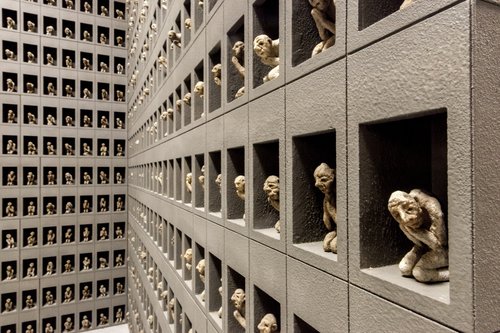
Prothoklethos. Exhibition opening. Moscow, 2026. Photo courtesy of Maxim Ilyasov
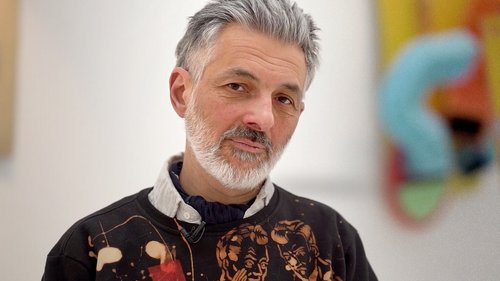
In a Moscow basement, artist Georgy Ostretsov gathers together a group of strangers twice weekly to read together the texts of medieval philosophers. He has created an unlikely community he calls ‘theurgic’, and their readings, exhibitions and shared portfolios reveal how faith, philosophy and art quietly intertwine amid uncertain times.
Can reading aloud the texts of medieval philosophers make one’s art more profound? Whether or not it does, when a group of artists gathers twice a week to undertake such an esoteric exercise, it inevitably forges an unusual intellectual and creative community. Such is the case with the Philosophical Club, which has been meeting regularly since the beginning of this year. Its first exhibition took place in April, and its third, ‘Prothokletos’, is now on view.
The club was founded by Georgy (Gosha) Ostretsov (b. 1967), one of the defining figures of the late Soviet New Wave. Active on the Russian art scene since the 1980s and following a decade in Paris during the late 1980s and early 1990s, Ostretsov developed one of the most distinctive visual languages in contemporary Russian art, drawing on the aesthetics of comics in a way few of his contemporaries attempted. After returning to Russia in 1998, he attracted widespread attention with ‘The New Government’, a project whose dystopian vision of a technocratic future now appears strikingly prescient. During the 2010s, the expansive two-storey studio he shared with artists Ludmila Konstantinova (b. 1980) and Sergei Pakhomov (b. 1966) in a semi-abandoned factory became one of Moscow’s most vibrant artistic meeting places, hosting weekly exhibitions whose vernissages often continued into the early hours. The community that formed around the studio evolved into the informal collective VGLAZ, which even published its own magazine, while works by several of its members entered the collection of British collector Charles Saatchi.

It all ended when the landlord decided to increase the rent and lease the studio to someone else. In 2026, Ostretsov felt a strong need to create a close community again. He had to build it from scratch. “Most of my close friends have left the country – Georgy Litichevsky is in Germany and the EliKuka duo have moved to France,” says Ostretsov. A real estate development company allowed him to convert an unused basement in a newly renovated building in central Moscow into a studio, art storage, and exhibition space. There, he decided to organise free, open readings in the hope of connecting people who shared his interest in philosophy. “It was not a deliberate act. I did not plan it as a PR stunt, nor did I plan to make money from it,” he told me. “None of my friends came; the people who turned up were complete strangers, mostly artists.” He recently came to a realisation that Dante’s Divine Comedy contains verses that perfectly encapsulate the spiritual essence of contemporary art, and he was eager to share this discovery with the world. However, before delving into Dante’s epic poem, there was necessary preparation, Ostretsov decided that for the first few months they should read early Christian writers and medieval philosophers who preceded the Florentine titan.

I attended the first few sessions of the club initially with some scepticism about the longevity of the initiative. Just six people attended the first gathering in January, having learned about it from an announcement on Ostretsov’s Telegram channel. After a brief introduction by a friend of the artist who is a philosophy professor, all the attendees took turns reading short excerpts from Boethius. Complex and obscure passages were discussed together as a group. Afterwards, everyone gathered at an Ostretsov-designed buffet counter for refreshments. The text was both weird and boring, the crowd random, and conversation was stilted. Yet, after a few sessions, a true sense of community began to emerge. More people began to show up, so reading time was reduced to five minutes per person. Gradually there was a core group of loyal regulars. “We are doing the readings twice a week now. If anyone cannot attend, they call me to apologise,” says Ostretsov. He believes that the participants of the group “felt a calling”. He is convinced that “an existential need for such an association was already hanging in the air”. On principle, he has kept the club free and open to all. Throughout the club's brief history, just one person has been expelled for trying to take over the leadership and introduce his own rules.

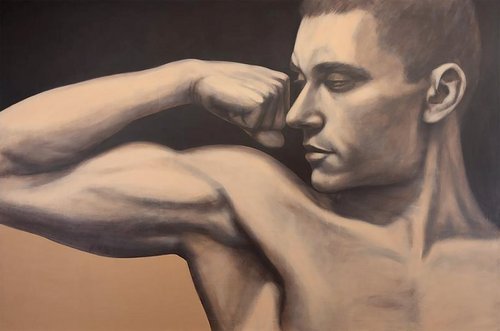
When it became clear that the group consisted of many artists, Ostretsov invited them to bring USB sticks with their portfolios, which he shows on a big screen after a reading – one portfolio per session. This has given the artists an opportunity to get to know each other’s work. It turned out that they had little in common aside from their interest in philosophy. Some were professional artists, albeit not particularly well-known or represented by a gallery, such as Irina Motorina (b. 1971) or Alexey Sergeev (b.1976). Konstantin Fomin works as an architect but is planning to restart his career in the art world. Nestor Povarnin (b. 1975) is a self-taught artist with an impressive track record of gallery exhibitions where he shows his meticulous ink drawings of macabre scenes. Death metal bands often commission him to create drawings for their album covers and merchandise. Ostretsov put together an exhibition of their work in his basement, realising that the difference in style and training was so great that careful curating was necessary. For the second exhibition, he introduced the criteria that all works had to be in black and white. This current, third exhibition, Prothoklethos (‘First-Called’), features only objects, although most of the artists had never worked in this medium before. “Formal rules help artists to change their focus,” believes Ostretsov.


He refers to his community as ‘theurgic artists’, borrowing the term from ancient philosophy. According to Russian thinker Nikolay Berdyaev, theurgy (god-making, or creating with God) is “an action of humans together with God – a theological action, divine-human creativity”. Ostretsov believes that artists materialise ideas that come to them through collaboration with God. He states that “Our goal is to create contemporary art in accordance with Christian doctrine'” However, he stresses that his method transcends confessional boundaries. Indeed, his maxim, “Christian art cannot be perfect; it is in search of perfection – truth lies in the moment of its seeking”, can be applied to all art worthy of the name. For other members of the group, the religious motive does not seem to be as important as it is for Ostretsov.


Povarnin says, “The theurgic gatherings and reading medieval literary prose offer a better way of situating our creative experiences within the context of world culture. They also provide useful contact with an established artist and an opportunity for discussion suited to religious and artistic consciousness. Not to mention that this is an immersion in world history.” Meanwhile, the club is gradually evolving into a fully-fledged, self-organising institution. This summer, it is moving from its basement to a flat in central Moscow. Ostretsov is full of enthusiasm: “The club’s sessions will continue there, and there will be an apartment gallery where exhibitions will take place each month. We will produce risograph zine-like catalogues.” Last but not least, readings of Dante will begin. In Moscow today, a city plagued by fuel shortages and frequent drone attacks, the idea of seeking refuge in religion, poetry, and philosophy seems both strange yet topical. If not Dante, then who?