

Sukhanov and Private Collecting as a Collective Pursuit

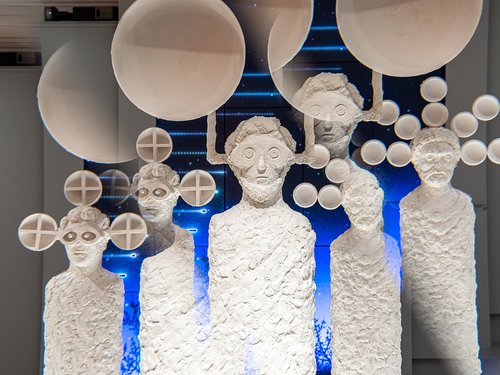
Andrey Kuzkin. The Second Circle. Exhibition view. St. Petersburg, 2026. Photo by Ekaterina Senina. Courtesy of Anna Nova Gallery
St Petersburg collector, patron of the arts, and founder of DK Gromov, Igor Sukhanov has quietly built one of the most original private collections of contemporary art in Russia today. The current exhibition of Andrey Kuzkin’s work at the Levashovsky Bread Factory, realised with Sukhanov’s support, stands as the latest expression of his enduring commitment to artists whose work challenges, expands, and redefines contemporary culture.
One example of collector solidarity is the current exhibition of works by Andrey Kuzkin (b. 1979), ‘The Second Circle’, at the Levashovsky Bread Factory, a former industrial bakery transformed into an arts centre. Its central element – the reconstructed installation ‘Heroes of Levitation’ – could scarcely have come into being without the active involvement of the collector Igor Sukhanov, who acquired the work by underwriting its highly complex restoration. Yet the rescue of ‘Heroes of Levitation’ was itself a genuinely collective endeavour. The initiative for its reconstruction came from Anna Nova Gallery, particularly from its then director Liliana Marré; collector Zoya Galeeva secured storage for the surviving elements of the installation; curator Elena Krylova proposed the acquisition to Sukhanov; and collector Denis Khimilyaine covered the transportation costs. The final touch was provided, at least temporarily, by the Levashovsky Bread Factory itself – a private venue affiliated with the Masters School of Art History – where the work, in a sense, completed its circle. During the opening, Kuzkin performed continuously, walking in loops around the audience throughout the evening, while the building’s architecture proved so perfectly suited to the installation that it elevated the project into a true Gesamtkunstwerk.


This example demonstrates that the community of collectors is increasingly assuming functions once reserved for museums. Other recent instances include the ‘Biennale of Private Collections’, launched last year, and the exhibition ‘Head of a Contemporary’, drawn from Denis Khimilyaine’s collection and curated by Alexander Dashevsky (b. 1980). Although the project failed to open at the state-run Moscow Museum of Modern Art, it ultimately found a home at the privately run exhibition and cultural venue Third Place. Yet it is the entrepreneur Igor Sukhanov who stands at the forefront of this development within the contemporary art scene of St Petersburg. His principal creation, DK Gromov – which from the outset, under the artistic direction of Dmitry Milkov, combined exhibitions, concerts, and a collectors’ club – celebrates its tenth anniversary this year. What began as years of “irresponsible collecting” has evolved into the construction of a thoughtful institution, one that has played a vital role both in the emergence of new forms of patronage and in sustaining the Russian art world more broadly.
At the heart of this vast collection, numbering more than 4,000 works, lies what might be called an emotional principle of selection. Sukhanov has repeatedly emphasised that he acquires art impulsively, guided by intuition and the thrill of discovery, while the phrase he coined – “irresponsible collecting” – functions simultaneously as a meme and a disclaimer. “This is not about an absence of responsibility towards the cultural community. On the contrary, I feel a hyper-responsibility towards it. What the term conceals is a declaration of the actual absence of any collecting strategy. I know many people who build collections within specific parameters and towards defined goals. I, on the other hand, consider it a priority to remain within the joyful process of gathering – to collect what I love.”

Sukhanov divides the works in his collection into two categories: those of personal significance and those of museum-historical importance. The former inhabit his private spaces for years: “I have a very strong sense of spatial association. There are things that hang in my homes, in my offices, in my kitchen. They are often not especially valuable or expensive, but they please the eye and are dear to the heart. I have long grown accustomed to them, and they will remain there, as they are honestly bound up with those spaces.” Alongside these are works of museum quality, which the collector is in no hurry to incorporate into his domestic environment, believing instead that they ought to be seen, studied, and appreciated by viewers and experts alike.
It is here that what Sukhanov calls his “collecting ambitions” come to the fore – ambitions he acknowledges with disarming candour: “Sometimes one wants to show a work to a small circle of collectors, friends, connoisseurs, and experts. To show it in order to receive applause for oneself as the acquirer of this remarkable thing. This too is a kind of measure of the significance and value of a purchase – when you imagine the applause, the likes on social media, the simple expressions of admiration, or even the envious glances and gnashing of teeth of fellow collectors. This selfish feeling, this anticipation of praise, of someone giving you a nervous pat on the shoulder and saying, ‘Well done, great buy’ – that, too, forms part of the underlying motivation.”

That said, Sukhanov also seeks to lay the foundations for something larger: “I believe, in general, that a collection must be: (a) public; and (b) shown as widely as possible by any available means. In the end, I hope that all our private accumulations of art will find their way into some common repository – a museum of private collections or another unified structure. I do not know what form it will take, but it seems to me that everything of value contained within the tens and hundreds of our collections should, ideally, eventually arrive at the proper place called a museum. There, serious experts – which I do not consider myself to be, nor is it my task to become – will determine what is most important according to the changing perspective of time. Perhaps it will be a virtual museum; perhaps a large physical museum of contemporary art. All of us, in our own way, are now preparing our individual dishes for this future banquet.”
The scope of Sukhanov’s collection is genuinely vast and, at times, seemingly inexplicable: from established figures such as Mikhail Roginsky (1931–2004) and internationally renowned artists like AES+F to the latest works by the Parasites collective and entirely unattributed pieces; from traditional painting and the full spectrum of printmaking techniques to unwieldy installations and even promptography, however uncertain its aesthetic status may remain. Although Sukhanov insists that his collection makes no claim to scholarly completeness or museum-like coherence, his deeply personal and intuitive choices have, over time, come to function as a remarkably perceptive curatorial radar. There is little trace of cold market calculation – not least because, by his own admission, he “has a poorly developed selling muscle,” and almost nothing ever leaves the collection. Yet the scale of such “irresponsibility” demands rigorous discipline, and here the collector is once again exemplary. Unlike many of his contemporaries, every object in his collection has been catalogued, digitised, described, and uploaded to the Artocratia database – an aggregator of private collections designed to unite disparate holdings within a single digital environment accessible to all.

This openness has also shaped the trajectory of DK Gromov. In 2016, the space on Malaya Okhta, on the outskirts of St Petersburg, opened with an exhibition entitled ‘Boring Places’ – a title that wryly acknowledged the district’s remoteness while immediately establishing the institution’s curatorial direction. The exhibition brought together works from the collections of nine private collectors, and such collector-led projects have since become an annual tradition. In Sukhanov’s view, collecting contemporary art in St Petersburg was still a “niche phenomenon” a decade ago, but before his eyes – and not without his active involvement – the movement acquired momentum, expanded, and gradually became institutionalised, bringing an entire supporting infrastructure in its wake, from galleries to local art fairs. Contemporary art collecting, he believes, has become not only fashionable but has matured in both scale and sophistication.

After a pause in recent years, when it was unclear how best to articulate an artistic response adequate to the times, DK Gromov returned with the large-scale exhibition ‘Re-collection (Perekolektsiya)’, whose prefix suggests both excess and reassessment. In both iterations, the project assumed the character of an open storage facility and revealed a marked shift towards photography, video, and other lens-based practices. Sukhanov attributes this development both to a transformation in contemporary visual perception – in the age of social media, the digital image is often more immediate and legible than painting – and to a search for what he describes as “photodocumentary precision that combines naturally with pictorial power and artistic force.” He points to the work of Olga Chernysheva (b. 1962), alongside younger artists such as Maresiy Ivashchenko (b. 1997) and Kirill Savelyev (b. 1989), in whose practice “the clarity of photography interweaves with artistic distinction.” The exhibition itself engages with the anxious and unsettled condition of the present moment – the visitor is confronted almost immediately by ‘Echelon’ by Blue Soup and SOAP by Evgeny Granilshchikov (b. 1985) – while also returning to the enduring chimera and distortions of the St Petersburg myth, visible in the urban photographs of Andrei Chezhin (b. 1960) and the staged imagery of Oleg Maslov (b. 1965) and Viktor Kuznetsov (b. 1960). Running alongside these themes is the inexhaustible tradition of the Leniniana, whose most compelling contemporary expression may well be found in the celebrated video installation by the Blue Noses group.


Looking to the future, Sukhanov remains faithful to his instinctive, emotionally driven approach: all his plans, he admits, ultimately depend on his state of mind. Against the backdrop of a prolonged global malaise, the collector and patron has found both equilibrium and purpose in supporting artistic initiatives beyond the walls of his own institution. He is a patron of Moscow’s Garage Museum of Contemporary Art and the Multimedia Art Museum, Moscow (MAMM), as well as St Petersburg’s Kuryokhin Centre and the museum ‘Poltory Komnaty’ (A Room and a Half). This year, he is also involved in the creation of a large-scale work by Irina Korina (b. 1977) for the Archstoyanie festival in Nikola-Lenivets.


According to Sukhanov, an important inner transformation is now taking place: “A transition from the accumulation of physical art objects in my collection to the accumulation of emotions and joy derived from participating in creative processes – shared processes involving artists, curators, and museum professionals. This activity within a community is deeply valuable to me because it offers the opportunity to strengthen one’s self-respect through whatever contribution one is able to make.” In this republic of collectors, the personal and the public appear inseparable: private fulfilment is achieved through service to a wider cultural community, a prospect that cannot but inspire a measure of hope.
Andrey Kuzkin. The Second Circle
St. Petersburg, Russia
20 June – 16 August 2026