

Ivan Boiko and the Materiality of Photography

Ivan Boiko. Old Believers. Courtesy of the artist
In an age of instant images, Moscow photographer Ivan Boiko moves deliberately against the current. He shoots on film, makes prints on watercolour paper, and believes that slowness whether in a landscape, in portraiture or in the darkroom is not a limitation but the very soul of the medium.
When was the last time you held a physical photograph in your hands? Or, if I may ask, taken one yourself? For many people these days, the answer would go something like “In my past life”. As technology has advanced, photography has gradually been reduced to a digital image on a screen – a fleeting mirage that captivates us for a moment before dissolving into the ether of social media platforms. In the worst-case scenario, it continues its ghostly afterlife as a meme.
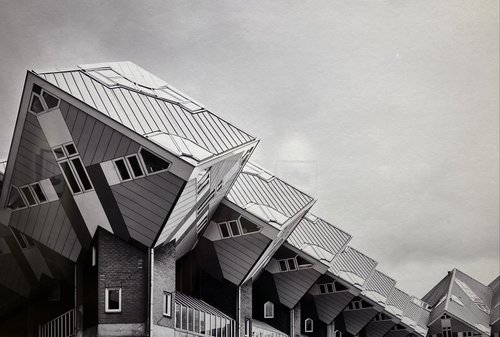
Most of us now seem to accept this as the new norm (or the only norm for Gen Z and younger). However, Moscow photographer Ivan Boiko (b. 1976) swims against the current. In his artistic universe, a photograph is a work on paper and a subgenre of the traditional fine art print. He uses exotic hybrid techniques such as photogravure and liquid silveremulsion on cotton rag papers. He shoots on film and often prints the pictures on watercolour paper, or sheets of copper. Among his cameras is a monster that produces unique monochrome positive prints, much like Polaroids, but measuring 28 by 35 cm. Each one takes about 15 minutes to develop. “The rhythm matters a lot,” he explains. “In landscape as well as portrait photography, slowness is important. Sometimes you have to be very quick to catch the moment, and sometimes you have to be very slow.”


Boiko was born into a family of artists and for him it was normal to find sheets of paper covered in drawings, sketches or paintings lying around the house from an early age. He grew up with a understanding that, in order to become a work of art, an image had to be something physical. For Boiko, a picture that has not been printed is a picture that is unfinished. His works are exasperatingly difficult to view on a screen. Materiality is key to their power. Size, texture and printing techniques, even the weight and smell of paper matter a lot. “Until I print it, I cannot tell if a photo has any value,” he says. This is an understatement, of course – with thirty years experience, he can predict the final result. Nevertheless, there is still room for surprise, and sometimes it verges on the miraculous. While working on the project ‘The Geniuses’ Place’, in which he attempted to connect with 19th century Russian poets and writers through the landscapes that inspired them, he set himself a challenge: “What would happen if I photographed nothing?” Armed with a camera obscura – a device dating back to the Renaissance – he stood in the middle of a snow-covered winter steppe. There was nothing but endless expanses of whiteness in every direction. The resulting print was a minimalist abstraction – a three-metre-long panorama of nothing that, paradoxically, arrested the eye with its spiritual power. “To my astonishment, it works,” he says, pride mingling with surprise. “There was nothing there, yet when I printed it on this long sheet, it began to breathe.”

Ivan Boiko. Old Believers. Courtesy of the artist

Ivan Boiko. Old Believers. Courtesy of the artist

Ivan Boiko. Old Believers. Courtesy of the artist

Ivan Boiko. Oldbelivers. Courtesy of the artist

Ivan Boiko. Old Believers. Courtesy of the artist

Ivan Boiko. Old Believers. Courtesy of the artist

Ivan Boiko. Old Believers. Courtesy of the artist

Ivan Boiko. Old Believers. Courtesy of the artist

Ivan Boiko. Old Believers. Courtesy of the artist
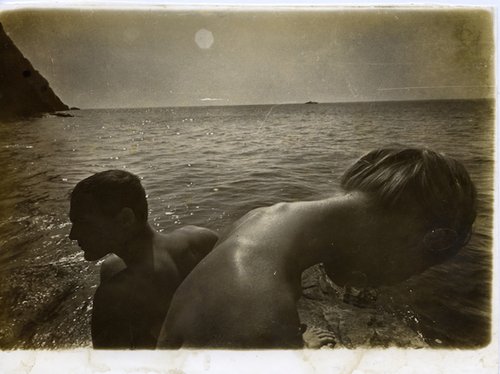
Almost ironically, he started out as a documentary photographer. Trained as a historian at Moscow State University, his first photo series emerged from an expedition with a group of scientists to a village of Old Believers in Moldova, which he joined as an undergraduate. Boiko became fascinated by the culture and outlook on life of these people, who were wary of outsiders and had kept the same lifestyle for centuries. Generation after generation, they grew the same crops, harvested them with the same tools, and prayed in the same churches, paying little heed to technical progress, world wars, and collapsing empires. Boiko then began travelling to different regions of Russia, looking for other groups of Russian Orthodox Old Believers. The black-and-white images he took were full of hidden references to classical paintings and subtle biblical allusions. He spent ten years photographing the Old Believers – a project, rooted in visual anthropology, turned into something close to an obsession. Eventually, it brought him international recognition. He was invited to exhibit his work at Rencontres d’Arles, one of the world’s leading photography festivals, held in the south of France. The invitation included an exhibition and a photo book.

Ivan Boiko. Japanese Paper. Courtesy of the artist

Ivan Boiko. Japanese Paper. Courtesy of the artist

Ivan Boiko. Japanese Paper. Courtesy of the artist

Ivan Boiko. Japanese Paper. Courtesy of the artist

Ivan Boiko. Japanese Paper. Courtesy of the artist

Ivan Boiko. Japanese Paper. Courtesy of the artist

Ivan Boiko. Japanese Paper. Courtesy of the artist
The offer came from well-known Magnum photographer Raymond Depardon (b. 1942) who was program director of the festival that year. This event could have kick-started an international career. After it, he collaborated with BBC Radio 4 on ‘Siberian Stories’, a project about everyday people of Siberia. Yet he never became a globe-trotting star photojournalist, nor did he ever aspire to do so. The job lacked the slowness he was looking for. Reporters capture the spirit of the times. Boiko, however, seems to be more interested in eternity. “First of all, I am interested in the magic that happens when a human being meets nature, no matter if it is myself or other people,” he says.
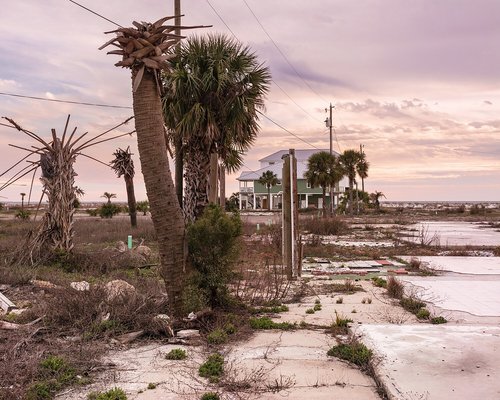
Over the years, he has become increasingly interested in complex printing techniques, spending a great deal of time experimenting with different types of paper, printers, and chemical ingredients. He has earned a living by photographing private gardens for design magazines, as a logical compromise between slowness and a steady income.


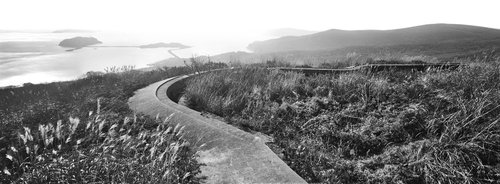
In his early project, Old Believers, the relationship between humans and nature is one of his main themes, with nature being depicted in both a realistic and a symbolic way. Every road and mountain captured by his lens is a new part of the soul’s spiritual journey – yet still, at the same time, they are very specific roads and mountains in their materiality. Each of his pictures hints that a landscape is more than meets the eye. Boiko approaches his work with the eye of a painter: hence the distorted colours, the slight mist in the air and the otherworldly light captured on film. He has been working on a series about Vladivostok Fortress for many years. This gigantic fortification in Russia’s Far East was never used in a battle and now stretches for many kilometres along the city's border, overgrown with grass and shrubs, and almost forgotten. This human-made structure has become a “thing-in-itself”, a part of the landscape that exists without any particular purpose – almost like the Great Wall of China, but without the tourist buzz. Art Focus Now covered this series back in 2019. Seven years on and Boiko still says it is “unfinished.”

Today as he reaches his half century, with his unique painterly approach to photography he is gravitating increasingly towards abstraction. In his ‘Blue’ series, he explores the simple motif of a blue stream running through the snow which becomes an interplay of pure form, vaguely reminiscent of Japanese painting. There is something Zen-like about his way of thinking, so it is probably no coincidence that he is drawn to the Far East. For him, as for Chinese and Japanese landscape artists of the past, narrative is a distraction and contemplation of nature is philosophy.