

Andrei Rudyev: Civilization X and the Fabrication of Well-Being

Andrei Rudyev. Eternal Youth. Exhibition view. St Petersburg, 2026. Navicala Artis Gallery. Photo by Artyom Bondarenko. Courtesy of Pushkinskaya-10 Art Center
In 2005, Andrei Rudyev first drew wide attention in Saint Petersburg with ‘Antarctic Mission’, an installation that transformed the façade of the Museum of the Arctic and Antarctic into a drifting iceberg populated by forty-three enormous penguins. Twenty years later, marking his sixtieth birthday, he is taking stock of his career with three exhibitions across the city.
The project Andrei Rudyev (b. 1966) initially conceived for his anniversary gradually grew organically into something like a self-generating event, steadily accumulating layers, associations, and details. In principle, material from all three exhibitions could have been brought together in a single large venue and arranged along a carefully structured route. Yet major institutions tend, almost by definition, to be bureaucratic and cautious, all the more so when they remain highly visible to censorship and external scrutiny.
For that reason, Rudyev chose three galleries he felt he could trust. It is no coincidence that all three are tied to the history and legacy of St Petersburg’s nonconformist art scene: Borey Art Center, a pioneering underground venue founded in 1991; Navicula Artis Gallery, established in 1992 by a group of students of the influential art historian Ivan Chechot and now based within the well-known art centre Pushkinskaya-10; and the much newer, guerrilla-style gallery-workshop Mosya, a nomadic initiative created by the artist Ivan Khimin (b.1975).
The project thus evolved into a kind of mini-festival, in which viewers moved not only across the city but also through time.
Taken as a whole, it is divided into eight thematic rooms: four at Borey Art Center, three at Navicula Artis Gallery, and one at Mosya. Within each of these eight spaces, self-contained narratives unfolded. At the same time, the project as a whole carried a distinct theatrical or cinematic quality: its stories were not static, but developed over time, generating flashbacks and spin-offs. It is therefore no surprise that each section bore its own title.

Andrei Rudyev. Eternal Youth. Exhibition view. St Petersburg, 2026. Navicala Artis Gallery. Photo by Artyom Bondarenko. Courtesy of Pushkinskaya-10 Art Center

Andrei Rudyev. Eternal Youth. Exhibition view. St Petersburg, 2026. Navicala Artis Gallery. Photo by Artyom Bondarenko. Courtesy of Pushkinskaya-10 Art Center
The first exhibition to open was ‘Eternal Youth’. The phrase already carries a note of bitter irony, made clear in the two posters the artist designed for the show. In the first, the word “youth” is tightly clamped between a set of elderly dentures; in the second, it makes a playful, almost irreverent allusion to ‘The Tibetan Book of the Dead’. In other words, the very idea of youth is approached through the lens of ironic gerontology.
And Rudyev has returned to his penguins. Off the main gallery space there is a tiny side room, visible only if one peers inside. In the doorway stands a family of penguins. As the artist explains: “I only had one penguin left over from a project in 2006, but I decided to give it a family of five little penguin children. What are they looking at? One of Russia’s most overused symbols of the ‘eternally living’: the mummy of Vladimir Lenin in Lenin’s Mausoleum, which today is periodically subjected to attempts at revival, in the spirit of Luigi Galvani, who famously demonstrated how a dead frog’s leg twitches under electricity. And so this poor family of penguins is forced to watch these convulsions of resurrecting a bygone grandeur.”
‘Civilization X’ is conceived as a total installation, bringing together works from different periods of the artist’s career. Andrei Rudyev (b. 1966) recalls that he held his very first exhibition at the Borey Art Center in St Petersburg in 1994; now, three decades later, he comes full circle.
The exhibition evokes the halls of a local history museum, with each room bearing its own title. ‘Traces of Material Culture’ brings together collages, assemblages, and textured objects, revealing the artist’s fascination with the things and details of the surrounding world – elements he continually collects and recombines to generate new meanings.
A hall titled simply ‘Fine Arts’ pays tribute to figurative painting, whose subjects and details are likewise assembled through the juxtaposition of paradoxes. Here, the origin of any given element is irrelevant: it may derive from a fresco by Giotto (c. 1267–1337), an illustration from science fiction, naïve advertising, or a still from a horror film. What matters is that these fragments begin to interlock, forming a self-contained narrative – one that also speaks to a world saturated with images that have long since taken on lives of their own.

Andrei Rudyev. Eternal Youth. Exhibition view. St Petersburg, 2026. Navicala Artis Gallery. Photo by Artyom Bondarenko. Courtesy of Pushkinskaya-10 Art Center

Andrei Rudyev. Eternal Youth. Exhibition view. St Petersburg, 2026. Navicala Artis Gallery. Photo by Artyom Bondarenko. Courtesy of Pushkinskaya-10 Art Center
Elsewhere, the ‘Synthetic Arts’ hall presents hybrids and mutations. Here, painting merges with short videos, pre-composed sounds, and collages that intrude unabashedly into the very fabric of the canvas.
And finally, a room titled ‘Temporary Storage (New Acquisitions)’ reveals the underlying premise of this “museum of the self.” It is constructed as a kind of Platonic artist’s cave from which the artist observes the world. It contains familiar objects of everyday life, transformed into theatrical props: a bed, a work desk, a television, a computer, trophies in the form of antlers, a muttering radio, a clock, a floor lamp, a wall calendar, and a vinyl record player. And yes – the calendar is, of course, open at ‘Friday the 13th’, in the Year of the Fire Horse. Behind a curtain in one corner hangs a black thought-form resembling a traditional comic-book speech bubble. But there is no text. Instead, a projection of smouldering fire flickers slowly across the wall, directly over the artwork. It is still low but already spreading – and only by bending down does one notice, in the corner, a standard fire extinguisher with a crooked note: ‘out of order’.
Yet the full impact of ‘Civilization X’ cannot be understood without also visiting the Mosya Gallery on Moiseenko Street, near the contemporary admin and business district of Nevskaya Ratusha, where Saint Petersburg’s city administration convenes. Here rather incongruously the Mosya gallery occupies a dilapidated interior in a run-down 19th-century building. Such are the realities of today’s Saint Petersburg.

Andrei Rudyev. Civilization X. Exhibition view. St Petersburg, 2026. Photo by Mikhail Grigoriev. Courtesy of Mosya Gallery

Andrei Rudyev. Civilization X. Exhibition view. St Petersburg, 2026. Photo by Mikhail Grigoriev. Courtesy of Mosya Gallery

Andrei Rudyev. Civilization X. Exhibition view. St Petersburg, 2026. Photo by Mikhail Grigoriev. Courtesy of Mosya Gallery
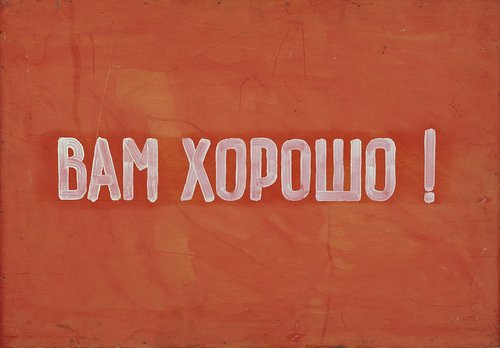
This part of ‘Civilization X’ was staged as a kind of exhibition party with apocalyptic undertones. The space is full of imitation record players and huge gramophones letting out a melody on loop which in turn forms a rondo around one recurring phrase: “All is calm in Baghdad.” This refrain belongs to the Soviet past and to nostalgia for fairy tales. The phrase and the music come from the 1966 film ‘The Magic Lamp of Aladdin’ in which it is sung by the guards; since then and over time, it has become an idiom signifying the fabrication of the appearance of well-being.


The Soviet era film about Aladdin’s adventures was shot in Crimea, with all the Baghdad sets constructed at Cape Chersonesus – where, fifty years later, the Military Construction Complex of the Russian Ministry of Defence built a museum complex that includes not only a Museum of Antiquity but also a Museum of Novorossiya.

As the artist comments: “I have gone through various different stages from complete confusion and the sense of art’s futility at a time of military aggression to the discovery of new ground. The profession of the artist is, after all, bound up with reflection and, in part, psychotherapy. And this particular moment in time has knocked on my window so I feel I can no longer engage in purely aesthetic experiments; I have to respond.”