

Women Beyond the Page at the Garage

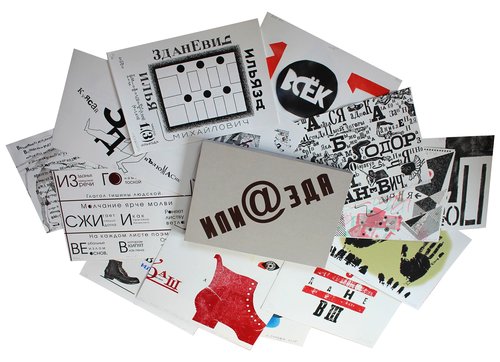
Vera Khlebnikova. A Woman Engaged in Art, 2004. Edition 102/125. From Garage Museum of Contemporary Art collection. Courtesy of Garage Museum of Contemporary Art
Today, the artist’s book exists as a fluid medium where literature, visual art, sculpture, performance, and digital practice converge, challenging conventional ideas of reading, authorship, and materiality. The project ‘The Woman Artist’s Book: Tattooed with Emptiness’ at the Garage Museum in Moscow offers a timely reflection on this expanded field, tracing the artist’s book as conceived by women artists – not as a fixed format, but as a continuously evolving artistic language.
‘The Woman Artist’s Book: Tattooed with Emptiness’ has been on view at the Garage Museum since mid-March as part of the museum’s Open Storage program. The project is curated by writer Katya Morozova, co-founder of the now-defunct literary journal Nosorog (Rhinoceros), and head of the publishing house of the same name. Over the years, Nosorog press has introduced Russian readers to overlooked works of international literature, including ‘Icosameron’ (1788) by Giacomo Casanova and ‘The Iguana’ (1965) by Anna Maria Ortese, while also reviving significant but neglected monuments of Russian literature, such as ‘Beyond Tula’ (1931) by Andrei Nikolyev (Egunov) and Vasily Trediakovsky’s eighteenth-century translation of ‘Voyage to the Isle of Love’ (1663) by Paul Tallemant. Many books published by Nosorog feature designs specially commissioned from contemporary artists, including Alexander Povzner, Ekaterina Khasina, Nikolai Alekseev, and Alexander Pogorzhelsky. Morozova has therefore long and consistently been thinking about the intersection – or even fusion – of the book format and visual art. At the same time, it was important for her, as the project’s curator, to bring to Garage not only works created in the medium of the livre d’artiste, but also the literary texts that are often concealed within these objects and, just as importantly, written by the artists themselves.

The Woman Artist’s Book: Tattooed with Emptiness. Exhibition view. Moscow, 2026. Photo by Daniil Annenkov. Courtesy of Garage Museum of Contemporary Art

The Woman Artist’s Book: Tattooed with Emptiness. Exhibition view. Moscow, 2026. Photo by Daniil Annenkov. Courtesy of Garage Museum of Contemporary Art
The project unfolds across four sections. The first, ‘The Plane of the Page’, occupies a long table on which sheets of paper are deliberately laid flat in order to emphasize what the curatorial text calls their “non-volumetric” quality. Among highlights is the series ‘The Simplest Ones’ (late 1980s) by poet and artist Anna Alchuk (1955–2008), whose life was marked by tragedy. Across three pages, ten squares composed of repeating letters are printed, generating minimalist visual poems. The same graphic constructions have also been reproduced on monumental panels which hang vertically by the table, perhaps to intensify the viewer’s perception while also providing an effective backdrop for photographs and videos on social media.

The Woman Artist’s Book: Tattooed with Emptiness. Exhibition view. Moscow, 2026. Photo by Daniil Annenkov. Courtesy of Garage Museum of Contemporary Art

The Woman Artist’s Book: Tattooed with Emptiness. Exhibition view. Moscow, 2026. Photo by Daniil Annenkov. Courtesy of Garage Museum of Contemporary Art
The second section, ‘The Book as Object’, inevitably embraces three-dimensionality. Many of the works presented here are barely recognizable as books at first glance. Some resemble Rubik’s Cubes, as in the work of poet, artist, and literary scholar Daria Fomenko (b. 1998); others take the form of woven textiles, as in the practice of Kristina Pashkova (b. 1992); still others appear as geometric constructions covered with fragments of text, like those by the Moscow Conceptualist Rimma Gerlovina (b. 1951). Meanwhile, poet, artist, and curator Anastasia Albokrinova (b. 1987) assembled her ‘Almanac. Vol. 2’ (2026) as a lightbox that illuminates a combination of blackout texts. Found materials – including newspaper pages – are selectively obscured, allowing isolated words to generate layered and often ambiguous associations.

The third section, ‘Entering Space’, radicalizes the logic of the previous section. Here, the objecthood of these works subordinates its textual component without entirely absorbing it. If the works presented in this section were shown in a different context – for example, as part of an exhibition built around another theme – they would hardly be recognized as artist’s books. The thought would be unlikely to occur to the average viewer.
At the centre of the gallery stands Rimma Gerlovina’s monumental ‘Mirror Cube’ (1975), resembling an oversized suitcase, a beach changing cabin, a hall of mirrors – or perhaps all three at once. On the walls hang two canvases from the ‘Highlighted Line’ series (2014) by Anna Zhelud (1981–2025), another artist with a difficult fate, alongside ‘Landscape’ (1988) by Svetlana Kopystianskaya (b. 1950), a participant in the Soviet unofficial art scene. While Zhelud’s paintings are based on geometric abstraction and contain no words – the image can perhaps only be imagined as asemic writing, something that appears to be written but most likely in a non-existent language – Kopystianskaya’s work, as its title suggests, depicts a rather conventional landscape overlaid with meaningful text, which is neither easy nor necessary to read. Despite their opposing strategies, both artists arrive at a similar conclusion: they acknowledge the presence of sign systems only to dissolve them into the spatial design of the artwork itself.

The fourth section, ‘Returning to the Plane: The Screen’, includes ‘My Boyfriend Came Back from the War’ (MBCBFTW; 1996) by Olia Lialina (b. 1971), one of the pioneers of net art, whose work is described as a “net film,” as well as ‘MBCBFTW Components List’ (2016), an homage to it by the Swiss artist Mona Ulrich (b. 1980), who lives and works in Germany.
These concluding sections are particularly significant because the misconception that the artist’s book must literally resemble a book remains surprisingly widespread. Contemporary artistic practice abandoned this narrow understanding decades ago, yet it still requires patient explanation. One of the exhibition’s greatest achievements lies precisely in how elegantly – and at the same time unequivocally – it makes this expanded definition visible.

The Woman Artist’s Book: Tattooed with Emptiness. Exhibition view. Moscow, 2026. Photo by Daniil Annenkov. Courtesy of Garage Museum of Contemporary Art

The Woman Artist’s Book: Tattooed with Emptiness. Exhibition view. Moscow, 2026. Photo by Daniil Annenkov. Courtesy of Garage Museum of Contemporary Art
Morozova proposes that the artist’s book moves from the flatness of the page through spatial expansion into three-dimensional form before ultimately returning to the plane of the screen. Yet both the initial stage – the imaginative space of literature and the architecture of the book – and the final one – the digital interface and networked environment – also possess their own kind of volume, unfolding into virtual and hypothetical dimensions rather than physical space. It is perhaps this final, poetic dimension that lends the exhibition its particular grace. The artist’s book as a format undoubtedly matters, but the worlds these books generate matter just as much. It is gratifying that ‘The Woman Artist’s Book: Tattooed with Emptiness’ reminds its audience of this.
The Woman Artist’s Book: Tattooed with Emptiness
Garage Museum of Contemporary Art
Moscow, Russia
17 March – 9 August 2026