What Else Is There to Say about AI and Technology?

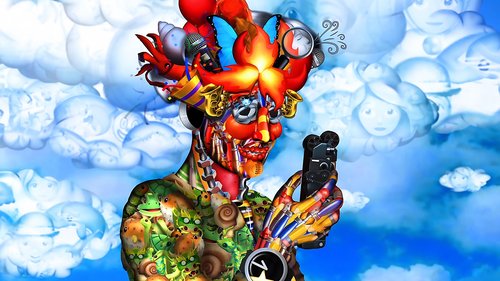
CYFEST 17. Natura Naturans: Human Beings, Nature, Landscape. Exhibition view. Yerevan, 2026. Photo by Mitya Lyalin. Courtesy of CYFEST
At the Cafesjian Center for the Arts in Yerevan, the media art festival CYFEST 17 brings together more than thirty-five artists in the exhibition ‘Natura Naturans: Human Beings, Nature, Landscape’, exploring the shifting relationships between nature, humanity and machines, and asking who controls whom – and whether technology can become a participant rather than merely an instrument of control.
The media art festival CYFEST was established in St Petersburg in 2007 by CYLAND, a laboratory that brings together artists, engineers and software developers, treating technology as an integral tool of artistic practice rather than an exotic curiosity. CYLAND was founded by artist and curator Anna Frants (b. 1965), a graduate of the Mukhina School in Leningrad (now St Petersburg) and the Pratt Institute in New York. Frants is also organising the current edition of the festival in collaboration with Yerevan’s Cafesjian Center for the Arts. Although modest in scale at first, CYFEST quickly developed an international, itinerant format, with each edition unfolding across several cities. The festival has since travelled to London, New York, Berlin, Tokyo and Venice, while a growing video archive has documented its activities since 2008. Throughout this expansion, CYFEST has maintained its commitment to working with local institutions and engaging with the artistic environments of its host cities, allowing the same theme to take on different meanings in different contexts.

CYFEST first came to Yerevan in 2022, spreading across several venues in the city, including the Cafesjian Center for the Arts, a major independent institution dedicated to contemporary art. The festival returned in 2024 with a project exploring the archive of feelings, followed by an interim edition in October 2025. The current edition is its most ‘museum-like’ to date, taking over the Cascade, a monumental staircase of pale stone rising up a hillside in central Yerevan, linking terraces, fountains and galleries. One of the Armenian capital’s most recognisable landmarks, the Cascade also houses the Cafesjian Center for the Arts.
The exhibition ‘Natura Naturans: Human Beings, Nature, Landscape’ runs from 15 October 2026 to 17 January 2027. Its title draws on an ancient Latin philosophical concept that understands nature as a living, continuous process, in contrast to ‘natura naturata’, the world of things already formed. In the 17th century, Spinoza incorporated this distinction into his philosophical system. Applied to art, the idea suggests that nature is not simply a landscape to be contemplated from a distance, but an active force that shapes us and acts through us. Human beings are thus participants rather than detached observers, a perspective that resonates particularly strongly at a time when our sense of agency in the world is increasingly under threat.
The conceptual framework is compelling, but not without risks. The theme of ‘human beings, nature and technology’ is so broad that almost any artwork could be accommodated within it, raising a familiar question for exhibitions of this kind: what connects the works beyond a shared title? The Yerevan festival seeks to address this through a central question about control: who commands and who submits – nature, humanity or the machine? It is a productive line of enquiry, helping to distinguish works that explore genuine tensions from those that merely produce an effect. With more than thirty-five artists participating, visitors would do well to keep this question in mind as they move from one gallery to the next.

The rapid rise of generative AI around 2022–2023 sparked a new wave of unease about artificial intelligence worldwide, a concern increasingly reflected in contemporary art. One installation places a robotic arm in an environment inhabited by live fish, bringing a machine governed by a predetermined algorithm into contact with living organisms whose movements are inherently unpredictable. Like many works at the festival, the installation is an experiment with an uncertain outcome, in which the fish become, to some extent, co-authors. The result is a layered interplay of observation: machines monitor one another, humans observe the machines, and the audience watches the entire process unfold. Yet the work also raises an unavoidable ethical question: what does this experiment mean for the fish themselves, and who bears responsibility for their welfare?
The highlight of the opening was ‘Embodied Dialogues’, a performance by Andy Barrt (the pseudonym of Russian artist Andrey Bartenev, b. 1969). Working alongside choreographer Rima Pipoyan, composer Alexander Dobrinsky (who performed on the piano with Eduard Arevshatyan) and a group of dancers, Barrt responded to the gestures and movements of a humanoid robot, not simply reproducing them but reinterpreting them, transforming programmed actions into living choreography. The organisers describe the robot as an equal participant, neither an adversary to the human performers nor merely their imitator.

The idea of the dancer as a mechanism has a long history in art. In the 1920s, at the Bauhaus school in Germany, artist Oskar Schlemmer (1888–1943) created the ‘Triadic Ballet’, in which performers wearing geometric costumes moved like components of a mechanical construction. There, the human body imitated the machine. In the Yerevan performance, the relationship is more complex: the machine imitates human movement, while the performers, observing it, adapt their own physical expression in response. The copy begins to influence the original, and it is this reversal that makes the concept particularly intriguing.
The music drew on the classical tradition of the early 20th century, creating a contrast between the sounds of the past and the seemingly futuristic body of the robot, underscoring the distance between two eras. Yet this juxtaposition is hardly new, and the more revealing question lies elsewhere: is the audience applauding the artistic achievement, or simply the spectacle of a robot capable of dancing? Ultimately, the performance must be judged by whether the live encounter between human and machine generates something that could not be experienced on a screen.

The second performance shifted the focus inward, towards the human body itself. φø (Fotis Rovolis) used a stethoscope and biosensors to capture signals from his brain, heartbeat, breathing and even digestive system, transforming them into a three-dimensional soundscape. The idea of turning the body into a musical instrument is not new: as early as 1965, American composer Alvin Lucier (1931–2021) used brain waves to activate percussion instruments. What distinguishes Rovolis’s work is its scale and intimacy. The result is an acoustic self-portrait, without a face or a voice, yet seemingly endowed with an individual identity. But how distinctive is that identity? Could these sounds be recognised as belonging to one particular person, or might they just as easily belong to anyone?
Sound, more broadly, has emerged as a recurring thread throughout the exhibition. On 25 October, in the performance ‘Rhythmic Drift’, Alex Pleninger and Anastasia Koroleva set ten spring-driven metronomes in motion, each ticking at its own tempo. Designed to impose order on time, the metronomes instead reveal its instability: as the springs unwind, the rhythms diverge, and the performance gradually draws to a close with the last ticking mechanism. In ‘Stridulations / Tymbals’, Robert Schwarz combines recordings of cicadas with synthetic recreations of their calls, blurring the distinction between natural sounds and those produced by human technology.

There are many Russian participants, and they look at the theme of nature and technology from different sides. Marina Alexeeva (b. 1959), a CYFEST participant since 2010, turned the façade of the Cascade itself into a screen: on the opening evening the projection ‘Looking at You’ was launched on it. The idea fits into one sentence: if you look at the Cascade for long enough, it will eventually look back. For an exhibition in which everything rests on the question of who is watching whom, it is a rather precise move.
The following day, the collective AES+F presented ‘Digital Safari: Fables of the Jungle’, a short programme that draws on a long visual tradition of depicting humans with animal heads, from the gods of ancient Egypt to European political caricature. In an exhibition concerned with the boundary between the human and the non-living, AES+F introduce another distinction: that between humans and animals.
Another strand of the exhibition engages with the legacy of the Russian avant-garde. Elena Gubanova (b. 1960) and Ivan Govorkov (b. 1949), a St Petersburg-based duo who have worked together since 1990, present ‘Victory over the Sun’, a series of moving constructions powered by solar panels that turn to follow the sun. The title references the 1913 Futurist opera in which the characters capture the sun. Gubanova and Govorkov, however, challenge this vision of human mastery over nature. Their work emphasises humanity’s dependence on sunlight, demonstrating how even the slightest change in illumination can expose the fragility of our assumptions about the future.
Ludmila Belova (b. 1960), meanwhile, explores the relationship between artificial intelligence, human consciousness and the natural world. In her video work ‘Diary of Observations’, she imagines a scenario in which artificial intelligence encounters the natural environment for the first time. In the installation ‘Inner Landscapes’, she represents the brain’s neural networks as an intricate web of white tubes illuminated by blinking lights. Both works question where the boundaries lie between the brain, thought and the world around us.

The festival extends beyond the works. An educational programme of lectures and workshops makes the language of media art accessible even to newcomers, while offering artists an opportunity not only to present their work but also to discuss the technologies behind it. Among the participants is Lev Manovich (b. 1960), one of the leading theorists of digital culture, who examines what remains of human creativity and agency when machines can generate an endless stream of appealing, compliant images. He is joined by Barbara London, a pioneering curator and influential figure in the history of video art. Both bring international expertise to the programme.
A separate discussion explores the connections between contemporary media art and the Russian avant-garde, drawing on the ideas of Kazimir Malevich (1879–1935) and other pioneering artists. Particular attention is given to the so-called Organic School, whose approach encouraged artists to develop an ‘expanded vision’: to look beyond the objects directly before them and become aware of the entire visual field, experiencing the space around them as a whole.
Contemporary media art carries these ideas forward through new technological means, and it is perhaps here that the Yerevan exhibition is most successful: in giving an established artistic philosophy renewed practical relevance. Yet one question remains beyond the reach of any exhibition: can technologies designed to control the world learn instead to participate in it?
CYFEST 17. Natura Naturans: Human Beings, Nature, Landscape
Yerevan, Armenia
15 October 2026 – 17 January 2027