

Venice Beyond Borders: Post-Soviet Voices at the Biennale

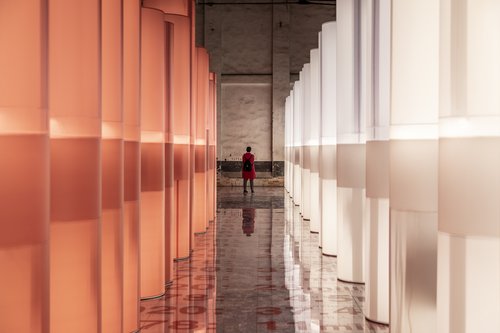
Pavilion of Russia. The tree is rooted in the sky. 61st International Art Exhibition – La Biennale di Venezia, In Minor Keys. Photo by Andrea Avezzù. Courtesy of La Biennale di Venezia
At this year’s Venice Biennale, the meditative and restorative vision proposed by the late curator Koyo Kouoh and her team stands in stark contrast to the pavilions of former USSR countries, many of which are haunted by war, repression and unresolved political tensions.
“Over ten years ago, my husband and I discovered a folder belonging to my great-grandmother containing Samizdat. When we opened the folder, the very first page featured Osip Mandelstam’s poem ‘Venetian Life.’ He himself never visited Venice, yet he wrote this poem – a dream of the city, and one of Russia’s finest literary works about Venice. For my great-grandmother the opportunity to travel out of the USSR also remained a dream for many years. In the 1990s her ‘Venetian dream’ of freedom finally came true”.

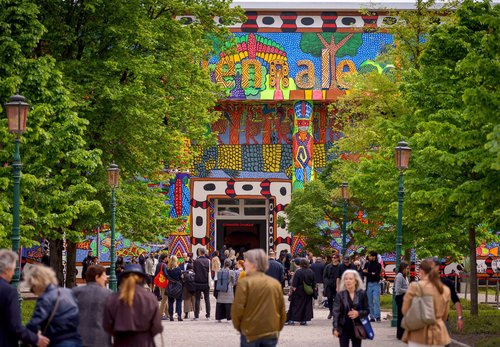
Merike Estna. The House of Leaking Sky. Estonian Pavilion at the 61st International Art Exhibition – La Biennale di Venezia, In Minor Keys. Photo by Agne Raceviciute. Courtesy of CCA

Merike Estna. The House of Leaking Sky. Estonian Pavilion at the 61st International Art Exhibition – La Biennale di Venezia, In Minor Keys. Photo by Agne Raceviciute. Courtesy of CCA
This account by Yevgenia, who emigrated from the USSR, is accompanied by a typewritten poem by Mandelstam, one of the items in the collection of Venetian relics assembled by Ilya Kabakov (1933–2023) and his widow Emilia (b. 1945). Cards bearing reflections on Venice, at times quite whimsical, accompany objects that have special meaning to the writers – an apple, a crust of bread, a fan, a toy… This collection, exhibited in the Venetian pavilion at the 61st Biennale of Contemporary Art, tells of the magnetic pull that this legendary city on the lagoon exerts on those who have chosen it as their home, including those born in the former Soviet Union.
During the Biennale, visitors to the exhibitions have the perfect opportunity to explore parts of Venice that are rarely accessible or even closed to the public. The venues housing the pavilions of countries that were once part of the USSR are often located in places where the average tourist would never venture. The Estonian Pavilion, for example, is housed within the former Church of Santa Maria Assunta in the Castello district, now a school sports hall. The interior of this church, built in the early 20th century, features a fresco on the ceiling by Giuseppe Cherubini (1867–1960) depicting The Glory of the Virgin Mary. Throughout the Biennale, the artist Merike Estna (b. 1980) is staging a daily performance here: dressed in exquisite old-fashioned gowns by fashion designer Lilli Jahilo, she paints twenty-two pictures in front of the audience. The floor of the church is covered with tiles featuring her abstract designs, and it looks wonderful. Unfortunately, the exhibition organizers plan to dismantle all the works and take them back to Estonia in November.

Official. Unofficial. Belarus. Unofficial Belarus Pavilion at the 61st International Art Exhibition – La Biennale di Venezia, In Minor Keys. Photo by Dmitry Volchek

Official. Unofficial. Belarus. Unofficial Belarus Pavilion at the 61st International Art Exhibition – La Biennale di Venezia, In Minor Keys. Photo by Dmitry Volchek
There is no official Belarusian pavilion this year, but émigré artists have set up their own in the Church of San Giovanni Evangelista – under the auspices of the ‘Free Theatre’. The main theme of the collective exhibition is the unbearable nature of a dictatorial state’s total control over the individual. Metal spiders made from prison bars hang above a field of rye (thousands of spicules made by hand), symbolizing a lost homeland; in the confessional, the visitor’s face is scanned to assess trustworthiness; a ball of banned books rests on the buckets of an excavator; we hear stories of political prisoners read by Jude Law, Gillian Anderson and Stephen Fry; in one of the church’s side-chapels, one can breathe in the nightmarish stench of a prison; and in the works of Grodno artist Siarhei Hrynevich (b. 1960), Gospel scenes are transposed into the world of a brutal state that tramples on humanity. The most striking exhibit in the church is a cross covered in CCTV cameras (a work by the exhibition’s curator Daniela Koliada), made from railway tracks from the Auschwitz concentration camp. The opening was attended by opposition leaders recently released from Belarusian prisons.

The exhibition in the Kazakhstan pavilion serves precisely to demonstrate the senseless power of a state that seeks to control everything. At the last minute, at the behest of the Ministry of Culture, Asel Kadyrkhanova’s installation, dedicated to the victims of Soviet terror, was dismantled. The already vague concept of the group exhibition has finally fallen apart, and visitors are left with nothing, but the giant felt horse heads sticking out in the courtyard – and it is hardly a reference to Joseph Beuys’s (1921–1986) favorite material.
Another exhibition in the church (Chiesa dei Santi Geremia e Lucia) is shrouded in darkness. At the behest of the Moldovan artist Pavel Brăila (b. 1971), drones, flashing multicoloured lights, suspend three large and two small carpet-aircraft from the ceiling. A military alarm intrudes upon Scheherazade’s tales; the rumble in the heavens promises both bliss and death. This is how the national pavilion of Moldova looks this year. The project is called ‘On the Thousand and Second Night’.

Zhanna Kadyrova. Origami Deer. 61st International Art Exhibition – La Biennale di Venezia, In Minor Keys. Photo by Andrea Avezzù. Courtesy of La Biennale di Venezia

Pavilion of Ukraine. Security Guarantees. 61st International Art Exhibition – La Biennale di Venezia, In Minor Keys. Photo by Marco Zorzanello. Courtesy of La Biennale di Venezia

Pavilion of Ukraine. Security Guarantees. 61st International Art Exhibition – La Biennale di Venezia, In Minor Keys. Photo by Marco Zorzanello. Courtesy of La Biennale di Venezia
Close to the Arsenale, Ukrainian artist Daria Koltsova (b. 1987) has hung Ukrainian Armed Forces uniforms on washing lines. Not all passers-by realize that these are not ordinary clothes being dried by Venetian housewives, but an art intervention called ‘Echoes’; yet the camouflage colours will undoubtedly strike a chord with everyone: a catastrophe could at any moment destroy even the ivory towers inhabited by the wealthy regulars of VIP art openings. This project was echoed in Sergey Bratkov’s (b. 1960) ‘Iron Drive’ performance that took place nearby on 7 and 8 May: five performers rapidly ironed clothes, scorching the fabric with their irons and filling the room with steam – a symbolic depiction of the trauma left by an endless catastrophe.
The name of the Ukrainian pavilion, ‘Security Guarantees’, serves as a bitterly ironic reminder of the fate of the ‘Budapest Memorandum’. In 2019, in Donetsk Region, Zhanna Kadyrova’s (b. 1981) ‘Origami Deer’ appeared on a pedestal where a Soviet tank had once stood. In 2024, as Russian troops advanced on the city of Pokrovsk, the sculpture was successfully dismantled and removed from the combat zone. A video at the Arsenale documents the deer’s journey to Venice and its stops en route in various countries, whilst the sculpture itself greets visitors in the Giardini – suspended from scarlet cables, it appears as evidence of a crime presented at a court hearing.


Works by Russian artists can be found in the most unexpected of places. For example, in the album ‘La Merde,’ published by the Luxembourg Pavilion, Ivan Volkov’s (b. 1992) snow feces on the Field of Mars in St Petersburg appear alongside stills from films by John Waters and Pasolini. The United Arab Emirates Pavilion features an installation by Moscow-born, Dubai-based artist Taus Makhacheva (b. 1983): in a small room with 52 speakers suspended at varying heights, authentic emails are played out, in which the writers apologize for not replying to a message in time (“Sorry for the delayed response, I was down with COVID”), thus highlighting the constant anxiety that prevails in our hyper-connected world. At CREA space on Giudecca Island, as part of Cyfest, works by Leningrad artists from the Frants Family Collection are on display, along with the video installation ‘Psychosis’ by AES+F. Back in 2016–18, when the artist group was working on it, the installation looked mesmerizing; today, however, advances in AI allow any schoolchild with a vivid imagination to create such lavish surrealist fantasies on screen.
A campaign by the émigré artist Danila Tkachenko (b. 1989) sparked a social media storm: in protest against art-washing, he carved the word ‘ART’ into his own flesh with a scalpel at the palazzo housing the Scuola Piccоla Zattere, owned by the family of oligarch Leonid Mikhelson. Meanwhile, in St Mark’s Square and along the Venetian waterfront, activists from several countries held the ‘Biennale of the Dissent’, a reference to the events of 1977, when dissidents and non-conformist artists were invited to Venice instead of official representatives of the USSR.

Danila Tkachenko at the Russian Pavilion. Photo by Dmitry Volchek

Pavilion of Russia. The tree is rooted in the sky. 61st International Art Exhibition – La Biennale di Venezia, In Minor Keys. Photo by Andrea Avezzù. Courtesy of La Biennale di Venezia

Pavilion of Russia. The tree is rooted in the sky. 61st International Art Exhibition – La Biennale di Venezia, In Minor Keys. Photo by Andrea Avezzù. Courtesy of La Biennale di Venezia
The main source of outrage is the Russian Federation’s pavilion, which a reviewer in The Guardian likened to “the world’s worst florists”. During the Biennale preview, its spaces were filled with bizarre bouquets that would have looked perfectly at home at an oligarch’s wedding or in the lobby of a four-star hotel in Antalya. Unsurprisingly, the centerpiece of the exhibition was a buffet where champagne and vodka flowed freely. Musicians and DJs from Russia, Argentina, Brazil, Mali, Mexico and South Africa performed non-stop for the vernissage crowds. By 9 May, the day of the Biennale’s official opening, the exhibition had been replaced by a façade video projection of concerts recorded over those three days. According to the official version, this substitution occurred due to sanctions imposed on Russia by the European Union. However, it could be said that the floral fantasies and musical sketches are in keeping with the vision of the Biennale’s curator, Koyo Kouoh (1967–2005), who encouraged artists to meditate and selected works for her project that celebrate the diversity and beauty of flora.
Completely detached from any current events or political agenda is the Lithuanian pavilion, which presents Eglė Budvytytė’s (b. 1981) new work, ‘animism sings anarchy.’ Two years ago, the main project of the Biennale featured her choreographic film ‘Songs from the Compost,’ whose characters moved as if they were crabs on the sand. This time, archaeologists in a trance-like state tremble gracefully in Neolithic caves and an archaeological museum. A breathtaking spectacle that transports us not merely to another era, but to another world entirely, where there is no room for the banality of everyday life. Incidentally, Venice itself is just such a planet.

Eglė Budvytytė. Animism sings anarchy, 2026. Exhibition view. Lithuania Pavilion at the 61st International Art Exhibition – La Biennale di Venezia, In Minor Keys. Photo by Andrej Vasilenko. Courtesy of the artist

Eglė Budvytytė. Animism sings anarchy, 2026. Exhibition view. Lithuania Pavilion at the 61st International Art Exhibition – La Biennale di Venezia, In Minor Keys. Photo by Andrej Vasilenko. Courtesy of the artist

Eglė Budvytytė. Animism sings anarchy, 2026. Exhibition view. Lithuania Pavilion at the 61st International Art Exhibition – La Biennale di Venezia, In Minor Keys. Photo by Andrej Vasilenko. Courtesy of the artist
Biennale of Art 2026. 61st International Art Exhibition
Venice, Italy
9 May – 22 November 2026
Cyfest 17. International Media Art Festival. Natura Naturans: Human Beings, Nature, Landscape CREA
Venice, Italy
8 May – 31 August 2026