

Vrubel: a Project for the Future

Mikhail Vrubel. The Meeting of Volga Svyatoslavovich and Mikula Selyaninovich Russia, late 19th–early 20th century. Fireplace (ceramic tiles). Courtesy of All-Russian Museum of Decorative Art
The exhibition ‘Vrubel. The Birth of a New Art’ at the All-Russian Museum of Decorative Art in Moscow, curated by Sergei Khachaturov, presents Mikhail Vrubel beyond the familiar framework of Russian Symbolism. It focuses on the continuing relevance of his formal experiments, tracing a line from Art Nouveau and majolica through Symbolism and the avant-garde to contemporary art.
Marking the 170th anniversary of Vrubel’s birth, the exhibition brings together around four hundred works from major Russian museums and private collections. More than a retrospective, it presents Vrubel as an experimenter whose work across painting, sculpture, ceramics and architectural space challenged conventional boundaries between media.
The exhibition’s spatial design, by artist and scenographer Stepan Lukyanov, is central to its argument. Four sections – ‘The Age of Historicism and the Art Nouveau Style’, ‘Majolica. The Alchemist’s Laboratory’, ‘The Chapel’, and ‘The Prophet’ – move beyond chronology to explore context, material, sacred space and Vrubel’s legacy in twentieth- and twenty-first-century art. Together, they present his practice as a continual movement between media, from object and ornament to architecture and image.

This approach is particularly suited to the All-Russian Museum of Decorative Art, where Vrubel is returned to the world of material – glaze, relief, ornament and architectural space. Majolica emerges not as a peripheral aspect of his work, but as a laboratory for exploring surface, light and the shifting boundary between object and image.
‘The Birth of a New Art’ argues less that Vrubel anticipated contemporary art than that his questions remain relevant. Likewise, ‘The Prophet’ refers not to prophecy in a literal sense, but to his breaking down of boundaries between fine and applied art, the decorative and the tragic, and the unique and the serial.

The central section, ‘Majolica. The Alchemist’s Laboratory’, presents ceramics as a field of radical experimentation for Vrubel and Pyotr Vaulin. Their use of reduction firing produced metallic, pearlescent and iridescent effects, turning the glaze from a surface coating into an active part of the form itself.
Vrubel’s majolica also rejects the tile as a purely serial unit: panels and fireplaces are assembled from shaped fragments whose seams become part of the design. This is especially evident in ‘The Meeting of Volga Sviatoslavovich and Mikula Selyaninovich’, made at Abramtsevo in the late 1890s from more than 150 unique elements and awarded a gold medal at the Paris Exposition Universelle of 1900. Its monumentality comes from the dynamic assembly of fragments – a principle that also runs through Vrubel’s painting and sculpture.

Vrubel’s contemporary relevance is especially clear in his treatment of material. His majolica breaks down distinctions between high art and decoration, object and image, anticipating contemporary concerns with materiality, fragility and the expressive potential of ceramics.
A central motif is Vrubel’s ‘Egyptian Woman’, originally titled ‘Mystery’, inspired by seeing Vera Mamontova whispering to her sister at Abramtsevo. Vrubel transformed this everyday moment into a mysterious, quasi-sacred image. The exhibition brings together four versions of the sculpture, whose differing glazes and metallic effects turn repetition into variation – an almost modern form of seriality without standardisation.

In the decorative dish ‘Sadko’, Vrubel creates a mythic underwater world through colour, pattern and surface rather than narrative, placing the work in dialogue with Bernard Palissy’s ceramics. The final section, ‘The Prophet’, extends this idea of formal resonance from the Symbolists through the Russian avant-garde to contemporary art, focusing on Vrubel’s distinctive “crystalline” language of facets, glimmers and fractured, shifting form.
Vrubel’s forms are rarely static: they seem to grow, fracture and shimmer, like minerals or precious stones. Rather than presenting a stable image, he builds unstable surfaces in which the visible world merges with psychological intensity. This fragmentation gives his work an unexpected contemporary resonance, not because it resembles digital imagery, but because it turns the breakdown of unified form into a new mode of perception.

Seen in this light, Vrubel’s “crystalline” method anticipates aspects of Pavel Filonov (1883–1941) and the Russian avant-garde. Painting becomes less a window onto the world than an autonomous system of form, positioning Vrubel as a precursor to modernist and later artistic practices concerned with process, instability and transformation.
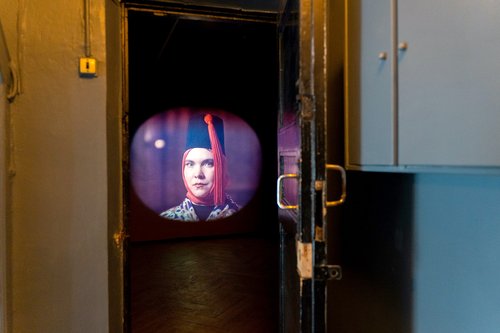
The most demanding part of the project is the inclusion of works by Irina Korina (b. 1977), Ulyana Podkorytova (b. 1984), Artem Filatov (b. 1991), Leonid Tskhe (b. 1983), Vasily Ivanov (b. 1999), Mika Zohn (b. 1996) and Dmitry Filimonov (b. 1997), alongside other contemporary artists. The museum defines this section as a dialogue with Vrubel’s abstract majolica tiles and his drawings on the theme of the pearl.

The section is most compelling where the connection emerges through artistic process rather than literal resemblance. Contemporary artists engage with Vrubel through material fragility, ornament, memory, unstable surfaces, and the shifting boundaries between the natural, artificial, sacred and domestic.
For Irina Korina, who transforms inexpensive domestic and synthetic materials into emotionally charged environments, the connection lies in freeing the decorative from a secondary role. As in Vrubel, decoration becomes a vehicle for memory, anxiety, taste, utopia and collapse. With Ulyana Podkorytova, the dialogue shifts towards folklore, corporeality and myth. In Vrubel, myth is not simply literary subject matter but an unstable, almost bodily reality; contemporary approaches to folk culture, corporeality and myth. In Vrubel, myth is not simply literary subject matter but an unstable, almost bodily reality; contemporary approaches to folk culture and ritual similarly bring collective memory into contact with personal experience.

Artem Filatov, whose work addresses urban space, institutional memory, destruction and traces of time, connects to Vrubel through the idea of surface as a document. In Vrubel, glaze, relief and paint carry their own expressive history; in contemporary art, this logic extends to walls, ruins, urban fragments and archival traces. Leonid Tskhe, Vasily Ivanov, Mika Zohn and Dmitry Filimonov represent different approaches to drawing, objecthood, ambiguity and artistic space. Their inclusion suggests that Vrubel’s relevance lies not in a single line of influence, but in the range of responses his work continues to provoke.
The strength of Sergei Khachaturov’s project lies in presenting Vrubel beyond the familiar framework of Symbolism, Art Nouveau and the Silver Age, placing him instead within a more fluid network of artistic connections. The exhibition moves from Historicism and Art Nouveau to Vrubel’s ceramic experiments, then to the religious explorations of ‘The Chapel’, before extending into 20th and 21st century. Rather than a linear biography, it offers an expanding view of Vrubel’s artistic world.

‘The Chapel’ explores Vrubel’s engagement with ancient Russian church architecture, Byzantium and the period’s search for a new piety. More than a historical reference, it presents his interest in synthesising colour, light, architecture and the viewer’s physical presence into a single experience – an approach that resonates strongly with later installation and spatial practices.
Vrubel’s religious work should not be reduced to a revival of ancient Russian or Byzantine forms. His aim was more radical: to move beyond easel painting by making colour produce light, ornament shape space, and the image surround the viewer – an approach that anticipates later spatial and installation practices. The exhibition also tests the limits of “relevance.” Vrubel needs no contemporary validation; the modern works succeed when they reveal overlooked aspects of his art – the autonomy of decoration, the drama of surface, material experimentation, and the tension between image and object.

The exhibition is most convincing when it resists the temptation to present Vrubel as “a contemporary artist ahead of his time.” Such a formulation too easily collapses historical distance and turns his legacy into a preface to the present. It is more accurate to see him as an artist who challenged the very boundaries between art and object, craft and concept, ornament and tragedy, decorative excess and inner drama.
In this sense, the project at the All-Russian Museum of Decorative Art does not so much modernise Vrubel as restore his complexity. He appears neither as an isolated Symbolist genius nor as a precursor who can be wholly claimed by either the avant-garde or contemporary art. Instead, he emerges as a figure of transition: between Historicism and Art Nouveau, myth and technology, the handmade ceramic object and the image that seems to arise from matter itself.

This is why the idea of “resonance,” rather than “influence,” proves more productive. Vrubel’s abstract tiles, shells and pearl drawings find echoes in the contemporary practices of Irina Korina, Ulyana Podkorytova, Artem Filatov, Leonid Tskhe, Vasily Ivanov, Mika Zohn, Dmitry Filimonov and Danila Tolstov not as direct iconographic sources, but as points of departure for shared concerns: surface, material memory, fragility, ornament, the archaeology of place and the instability of form.
This is the exhibition’s principal achievement. It asks us to move beyond a reverential but static image of Vrubel and instead see him as an artist of an unfinished future. Not because he literally anticipated the artistic languages of the present, but because his practice continues to pose difficult questions about matter and image, beauty and anxiety, the decorative and the tragic, and the fragment as a form of the whole.

In this exhibition, Vrubel appears not as a monument to the Art Nouveau era, but as a contemporary of artists working at the boundaries between craft and concept, object and vision, the archaic and the technological present. It is precisely this fluid and open relationship with the contemporary that transforms the project from an anniversary retrospective into a sustained critical statement about the ways in which classical art can continue to exist in the present.
‘The Birth of a New Art’ should therefore be understood not as an exhibition about a completed past, but about the continuing incompleteness of Vrubel’s project itself. His artistic world still confronts the viewer with unresolved questions: can an object carry a vision? Can the decorative speak of anxiety and loss? How can the fragment preserve an image of the whole? Where does the boundary lie between beauty as the seduction of surface and beauty as an experience of inner tension?


Vrubel. The Birth of a New Art
All-Russian Museum of Decorative Art
Moscow, Russia
18 September 2026 – 17 February 2027