Volga Synesthesia

Adventures of Talents. The Avant-Garde Milieu in Nizhny Novgorod. Exhibition view. Nizhny Novgorod, 2026. Photo by Alexey Shevtsov. Courtesy of Arsenal. The Volga-Vyatka Branch of Pushkin Museum
At the Arsenal in Nizhny Novgorod, the exhibition ‘Adventures of Talents: The Avant-Garde Milieu in Nizhny Novgorod’ challenges the Moscow and St Petersburg centred history of the Russian avant-garde, revealing a vibrant network of artists, poets and composers whose experiments with colour, sound and form helped shape the wider movement.
Every attempt to reduce the history of the so-called Russian avant-garde to a handful of celebrated names and manifestos issued in the major artistic centres is challenged by the emergence of artistic movements elsewhere in Russia. The exhibition ‘Adventures of Talents: The Avant-Garde Milieu in Nizhny Novgorod, currently on view at the Arsenal, a regional branch of the Pushkin State Museum of Fine Arts, offers an alternative prospective. Moving beyond the conventional hierarchical narrative, it reconstructs a distinctive artistic milieu, revealing how, at the turn of the 20th century and in the years immediately following the Bolshevik Revolution of 1917, this city on the Volga was not merely a recipient of artistic impulses from the centre, but also a source of innovation and influence in its own right.

The curators invite us to see turn-of-the-century Nizhny Novgorod in an unfamiliar light, one that does not quite correspond to its traditional image as the merchants’ “pocket of Russia”. Although ‘Adventures of Talents’ opened as part of the events marking the 130th anniversary of the Sixteenth All-Russian Industrial and Art Exhibition, it has little in common with the main anniversary exhibition, ‘Great All-Russian’, at the Nizhny Novgorod State Art Museum. Instead, it explores another side of the story: an artistic milieu that emerged later and developed according to different principles, yet whose aesthetic foundations were partly laid by both the exhibition and the annual Nizhny Novgorod Fair. There is, however, a more obvious similarity between the protagonists of the two projects. The same entrepreneurial spirit and determination that characterised the merchant-industrialists also distinguished the artists, composers and poets who persistently looked towards the future.
According to the curators, the route through the exhibition is intended to resemble a stroll through the city, although it is difficult to see how this flâneur principle operates, since street names do not provide the organising structure of the display. What emerges is not so much a map of the city as a kind of rhizomatic network, which is even reproduced on a wall at the end of the exhibition to make the connections more explicit. The exhibits and, particularly important to this project, the wealth of archival material are loosely organised around three constantly intersecting themes: synesthesia, or what today we might call interdisciplinarity; the intertwining of individual lives and artistic pursuits; and the connections between the Nizhny Novgorod artistic milieu and the wider, more celebrated avant-garde.

The exhibition opens with two self-portraits by Mikhail Matyushin (1861–1934): a realistic, figurative work from the 1900s and a ‘crystalline’ sketch from 1914, in which the face is reduced to its most basic elements. The curator, Ksenia Anufrieva, laments that this key figure of the new art – an artist, composer and colour theorist whose former home in St Petersburg now houses the Museum of the Petersburg Avant-Garde – remains almost unknown in his native city. The museum staff are making a concerted effort to correct this oversight and reclaim Matyushin for Nizhny Novgorod, thereby strengthening the city’s place in the history of 20th-century art. Last year, they launched the audio guide ‘A Walk Around Nizhny with a Russian Futurist’, based on painstaking research into the places associated with his childhood.

Although Matyushin lived in Nizhny Novgorod only until the age of sixteen, he received his early musical education there. His first visual impressions were no less important. According to the curators, the light and atmosphere of the Volga, now central to Nizhny Novgorod’s promotional image as the ‘capital of sunsets’, were indelibly imprinted on the artist’s vision and laid the foundations for his concept of expanded vision, ZOR-VED (‘Seeing + Knowing’), which explored the changing relationships between colours. At the Arsenal, this fascination with optical perception sets the tone for the entire exhibition: colour becomes sound, music takes the form of graphic diagrams, and poetry is transformed into shaped verse. The exhibition concludes with contemporary interpretations of Matyushin’s experiments by Nizhny Novgorod artists Katya Ryblova (b. 1996) and Ivan Belov (b. 1995). A re-enactment of a 1923 production devised by Matyushin’s pupils, featuring moving geometric figures and experiments with light and volume, is planned for the exhibition’s closing event.

Vladimir Dianin, who was forced to leave the St Petersburg Conservatoire and moved to Nizhny Novgorod in 1898, followed a somewhat similar path, although his fate was quite different. Publisher of ‘Nizhny Novgorod Musical News’, a decadent poet and Symbolist mystic before the Revolution, he subsequently became an advocate of innovative scientific theories and the author of mathematical studies on ‘stereomusic’ and ‘phonoheliometry’. He spent decades exploring the relationships between the frequencies of sound vibrations, the wavelengths of light and the positions of celestial bodies. His attempt to bring these different dimensions of the world into a unified system, as well as his use of ‘infographics’ as a form of artistic expression, undoubtedly had something in common with Matyushin’s investigations, even if their methods differed.

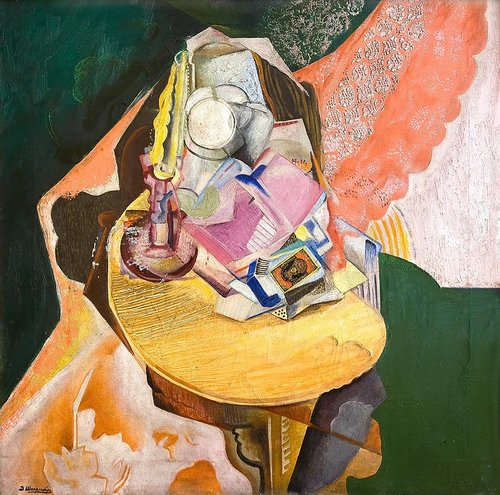
The poet Velimir Khlebnikov (1885–1922) was also connected with Dianin. The composer’s name appears in the manuscript of the manifesto of the mystical society ‘Brotherhood of the Knights of the Spirit’, written by Khlebnikov in 1918, when he arrived in Nizhny Novgorod. Khlebnikov also contributed to the Nizhny Novgorod almanac ‘Without Muses’, conceived by another local visionary, Fyodor Bogorodsky (1895–1959). While studying law in Moscow, Bogorodsky performed in the circus under the pseudonym Ferri, with an act entitled ‘The Man Without Nerves’. He subsequently became a pilot, was shot down at the front in 1917 and, during the Revolution, found a new role in the Cheka (the All-Russian Extraordinary Commission, the first Soviet secret police organisation) and as a commissar of the Volga Flotilla. By the time of his death in 1959, he had become a celebrated Socialist Realist painter, but the exhibition focuses on his experimental and often eccentric early work. Among the exhibits is a decorative, flattened portrait of his schoolfriend, the cocaine-using poet Arseny Mitrofanov (1915), whose palette seems to anticipate that of Piet Mondrian (1872–1944); a Cubo-Futurist self-portrait as a sailor (1918), dating from the period of ‘Without Muses’; and drawings from the series ‘Circus in Berlin’ (1929–30).

Before the 1917 Revolution, formal art education in Nizhny Novgorod was virtually non-existent. The gap was partly filled by Andrei Karelin’s (1837–1906) ‘Photography and Painting’ studio, although, understandably, he has no place in this exhibition: a graduate of the Academy of Arts, Karelin represented an artistic tradition largely opposed to that of the young protagonists of ‘Adventures of Talents’. In 1918, the Nizhny Novgorod State Free Art Workshops opened in the Rukavishnikov mansion, which had been nationalised and converted into an art museum. The initiative owed much to the efforts of the mansion’s former owners, the Rukavishnikov brothers: the artist Mitrofan (1887–1946) and the poet Ivan, who subsequently also headed the Palace of Arts in Moscow. The artist Vladimir Franketti (1887–1969) was invited to teach at the workshops. Although his appointment proved short-lived following a conflict with his students, he was instrumental in bringing works by Kazimir Malevich (1879–1935), Wassily Kandinsky (1866–1944), Aleksandr Rodchenko (1891–1956), Mikhail Larionov (1881–1964), Natalia Goncharova (1881–1962) and others to Nizhny Novgorod. Today, these works form part of the avant-garde collection of the Nizhny Novgorod State Art Museum. The exhibition, however, places the emphasis firmly on local figures. Among the works on display is a self-portrait – the abundance of faces throughout the exhibition is no coincidence – by Alexander Kuprin (1880–1960), who succeeded Franketti and reorganised the workshops into a technical college. Beyond painting, Kuprin pursued a range of other interests, including building a harmonium on which he performed in radio concerts.
Aesthetic contradictions were the norm. The pages of the aforementioned almanac ‘Without Muses’, originally conceived as a periodical but ultimately published in a single issue, brought together writers of different generations and artistic persuasions. The poet Ivan Rukavishnikov (the same figure who had helped establish an art museum in his family mansion after the Revolution) declared polemically, “You are without Muses. I was with a Muse.” Yet the publication’s title itself reads almost as a declaration of independence from traditional notions of art, a rejection of Symbolist conventions. New artistic forms and communities were emerging through these adventures of talent.

The exhibition vividly demonstrates that relations within this artistic milieu were far from harmonious, while the times themselves were becoming increasingly turbulent and brutal. The pursuit of new artistic forms soon gave way to bitter conflicts, sometimes with tragic consequences. Returning to Dianin, we encounter the story of the destruction of his experiments with sound and colour. The Nizhny Novgorod authorities had entrusted the assessment of their scientific and artistic value to the composer and music theorist Arseny Avraamov. Despite Dianin’s appeals, written at a time when he had been left destitute and had lost a daughter, Avraamov remained unmoved.

This was in 1935. Yet back in 1917, in Petrograd, Avraamov himself had helped to establish the Leonardo da Vinci Society for Science and Art, together with Dianin’s cousin. The society explored connections between music and mathematics, and Avraamov pursued his experiments with such audacity that, upon arriving in Nizhny Novgorod in 1919, he conceived his famous heroic-revolutionary ‘Symphony of Sirens’, performed the ‘Internationale’ using the steamship sirens of the Volga Military Flotilla and, according to the recollections of the Nizhny Novgorod writer Anatoly Marienhof, even played the piano with a small garden rake. “This is neither a joke nor an exaggeration. This is history and an epoch,” Marienhof concluded. The exhibition vividly conveys the feverish energy and chaos of that period, as well as the unpredictable trajectories of the avant-garde, revealing it as both a free-flowing network of artistic experimentation and an intricate web of personal and institutional relationships.
Adventures of Talents. The Avant-Garde Milieu in Nizhny Novgorod
Arsenal. The Volga-Vyatka Branch of Pushkin Museum
Nizhny Novgorod, Russia
21 August – 15 November 2026