

The Protective Shell of Imagination: Delirium at The Calderwood Pavilion

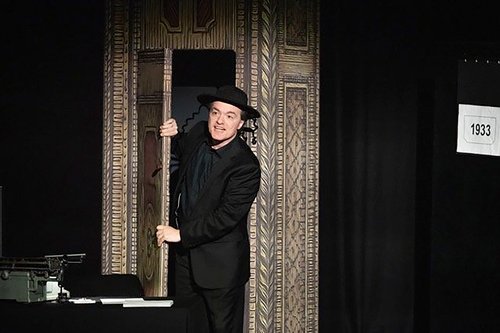
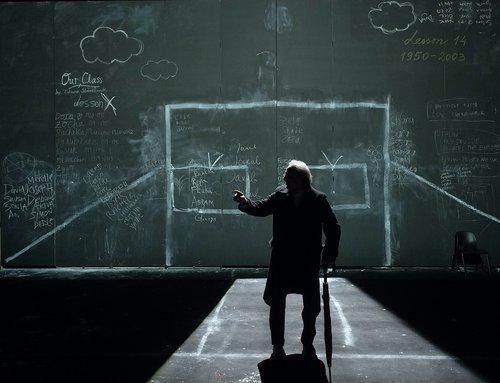
Delirium. Directed by Igor Golyak. Based on Eugene Ionesco's play ‘Frenzy for Two, or More’. Andrey Burkovskiy (Him) and Chulpan Khamatova (Her). Arlekin! production. Photo by Olga Maturana. Courtesy of Arlekin!
Can a work of absurdist theatre written more than sixty years ago speak more directly to our own moment than it did to its first audiences? Arseniy Fariatiev explores how Igor Golyak’s remarkable production of 'Delirium' transforms Eugene Ionesco’s bleak vision into a celebration of imagination, revealing the enduring power of theatre to confront war, uncertainty and the fragility of everyday life.
The case of dramatist Eugene Ionesco (1909–1994) is an unusual one. He occupies an undisputed place within the literary canon yet rarely prevails in the hierarchy of reputation when measured against the playwrights and thinkers with whom he is most often associated – from Jean-Paul Sartre to Samuel Beckett, from Eugene O’Neill to Sam Shepard. As Susan Sontag observed in her essay Ionesco: The Theatre of the Banal, “Compared with Brecht, Genet, and Beckett, Ionesco is a minor writer even at his best.” Published in 1964, the essay can hardly have been welcome, though it was perhaps overshadowed by Beckett’s receipt of the Nobel Prize in Literature five years later. 'Delirium', the 'Frenzy for Two, or More' adaptation staged by the Arlekin Players at the Calderwood Pavilion in Boston, draws on Ionesco’s 1962 play to make a compelling case for a reassessment of his legacy, seeking to redress the balance between the playwright and posterity.

Most of Eugene Ionesco’s plays follow a recognisable dramatic pattern. An extraordinary event erupts into an otherwise ordinary world, expands with relentless, almost geometric logic, until reality itself can no longer contain it, at which point the play reaches its inevitable conclusion. In ‘Rhinoceros’, a single rhinoceros charges through a quiet European town before the entire population is transformed into the beasts. In ‘The Chairs’, an elderly couple prepares for a gathering of distinguished guests who all happen to be invisible, yet chairs must nevertheless be found for each arrival until the stage is so overcrowded that there is no room left for the hosts themselves, who ultimately leap to their deaths before an audience of unseen spectators.
‘Frenzy for Two, or More’ begins with the deceptively simple stage direction: “An ordinary bedroom.” Beyond its walls, however, a brutal war is raging. Inside, a husband and wife remain consumed by an absurd argument over whether a snail and a tortoise are the same creature. Their trivial dispute is punctuated by gunfire, shattered windows and exploding grenades, yet the violence outside barely disrupts the circular logic of their quarrel. When the war finally ends and peace returns, it offers no relief. If anything, peace proves even more unsettling, leaving the couple anxiously awaiting its transformation into something still more intolerable.

‘Delirium’, however, offers an unexpectedly optimistic reading of the absurd. Running in Boston until 2 July 2026 and, judging by the calibre of its producers – Craig Balsam, Patrick Catullo and Thomas M. Neff – seemingly destined for a New York transfer, the production reframed Ionesco’s bleak vision as something unexpectedly life-affirming. Igor Golyak (b. 1979), the artistic director of the Arlekin Players, has adapted and directed the play, taking judicious textual liberties that firmly anchor it in the present day. Born in Kyiv, trained in Moscow, and the founder of Arlekin Players in Boston in 2009, Golyak established the company’s reputation through acclaimed productions such as The Dybbuk and Our Class.
Although Golyak’s intervention is, on the surface, relatively restrained – adding a handful of new scenes while updating the language by removing dated expressions such as “titivate” from the English translation of the French original – the cumulative effect is profound. Where Ionesco’s 'Frenzy for Two, or More' is ultimately an elegy to the banality and futility of everyday existence, 'Delirium' becomes an affirmation of the human imagination and its capacity to transcend even the most irrational realities.
Jan Pappelbaum (b. 1966) has created a set of striking economy: a three-tiered scaffold structure punctuated by sections of corrugated steel. A pile of mattresses lies stage left, while centre stage a large goldfish drifts through murky water in an aquarium. The setting evokes a space suspended between abandonment and renewal – a place that has outlived its original purpose yet remains poised, however tentatively, for transformation. It is neither beautiful nor sentimental, but it possesses the latent possibility of change. With remarkably few elements, Pappelbaum constructs an expansive theatrical arena in which the director and actors can fully exercise their imaginations.

That burden rests almost entirely on the shoulders of Chulpan Khamatova (b. 1975) and Andrey Burkovskiy (b. 1983), who play Her and Him. By removing the three minor characters from Ionesco’s original text, Golyak entrusts the entire dramatic weight of the production to his two performers.
They grab that responsibility from the opening moments. A freestanding door, held open by unseen hands, glides onto the stage, concealing the actors’ bodies while leaving only their feet visible. What follows is one and a half hours of extraordinary theatrical virtuosity – a compelling reminder of the unique possibilities of live performance. Khamatova and Burkovskiy perform with astonishing commitment, drawing upon seemingly inexhaustible reserves of invention. They move effortlessly between emotional registers and comic rhythms, constantly reshaping the performance before the audience’s eyes.
In their hands, even the simplest gesture becomes an elaborate lazzo. When Khamatova’s character asks her husband to close a window and the only prop available is an empty window frame, Burkovskiy instantly transforms the object into a convincing theatrical illusion. His movements unmistakably communicate the act of shutting the window while scarcely resembling it in any literal sense - a perfect demonstration of theatre’s ability to persuade through imagination rather than realism.

Burkovskiy’s remarkable physical dexterity provides the framework within which Khamatova charts the volatile emotional landscape of the couple’s relationship. Early in the performance he opens an invisible door, retrieves an imaginary leash, attaches it to a radio and, through a handful of precisely observed gestures, transforms the radio into a power generator. Any attempt to describe these sequences inevitably reads more like Beckett than Ionesco, highlighting the difficulty of translating such inventive physical comedy into words. Later, Khamatova inhabits the persona of a young girl with such emotional conviction that, by the time the couple approaches its inevitable end, every loss carries the devastating weight of a child’s death.
There is, however, a third character who never appears on stage: the war itself. Its presence is conjured through the exceptional sound design of Denis Zabiyaka (b. 1987) and the haunting score composed by Anna Drubich (b. 1984). Zabiyaka employs an intricate network of concealed speakers to create a strikingly directional soundscape, sculpting the invisible space around the actors with explosions, distant gunfire and unsettling silences. Drubich’s music does far more than underscore emotion; it becomes an essential narrative voice, guiding the audience through the psychological landscape of the play.

The production’s greatest achievement – and, in many respects, the defining quality of Golyak’s direction – is its fearless playfulness. If one can speak of high-performance theatre in the same way one speaks of high-performance sport, ‘Delirium’ undoubtedly belongs in that category. It demands exceptional precision, stamina and imagination from its performers while placing complete trust in the intelligence of its audience. Admittedly, midway through the performance the internal logic of the production occasionally threatens to dissolve into exhilarating chaos. Yet this uncertainty ultimately serves the production rather than weakens it. It reinforces the instability of the world Golyak has created and crystallises his central insight: the only convincing response to the absurdities of the present is boundless imagination coupled with fearless theatrical invention. In Ionesco, humour makes an absurd world bearable. In Golyak’s hands, that absurd world becomes something unexpectedly marvellous.