

The Konchalovsky Effect: Reframing a Career Between Paris and the Soviet State

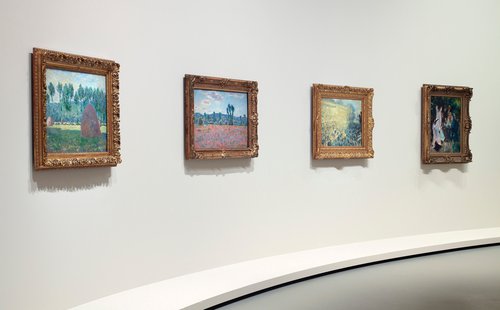
Pyotr Konchalovsky. The Garden in Bloom. Exhibition view. St Petersburg, 2026. Courtesy of The State Russian Museum
A major survey at the Russian Museum in St Petersburg presents Konchalovsky as both a central figure of Russian modernism and a late realist master, revealing how his artistic trajectory has been consistently read as a shift from avant-garde experimentation to ideological maturity.
Prepared in a timeframe scarcely imaginable for an exhibition of such ambition, ‘The Garden in Bloom’, the State Russian Museum’s retrospective of Pyotr Konchalovsky (1876–1956), marking the 150th anniversary of his birth, took only four and a half months to prepare.
In Russian art history, Konchalovsky dominates the first half of the 20th century, today a well-known and exceptionally popular artist in Russia, although little known abroad. In the space of one year both the Tretyakov Gallery and the Russian Museum have mounted exhibitions dedicated to the work of two contemporaries, both painters who began their careers as avant-garde artists and ended them as prominent representatives of Socialist Realism: Konchalovsky and his close friend Ilya Mashkov (1881–1944). Mashkov painted both artists in a famous double portrait in 1910 and a major solo Mashkov exhibition ‘Avant-Garde. Kitsch. Classic’ was held at the Tretyakov Gallery last year. In such exhibition projects, the history of 20th century Russian art finds itself willingly or unwittingly arranged into a narrative sequence which aligns with new ideological and propagandistic agendas. According to this logic, the artist overcomes the ‘modernist delusions’ of youth and arrives at a form of realism that celebrates Russian nature and life in all their glory.

In 1913, artist Alexander Kuprin (1880–1960) described his colleagues from the Jack of Diamonds group as elements of a pictorial universe, placing Konchalovsky immediately after the Sun in an otherwise empty spot and calling him the largest planet: “The Konchalovsky planet, by virtue of its size, mass, volume, and density, exerts a gravitational force incomparably greater than that of the other planets.” Taking this playful metaphor as a point of departure, one may ask what laws and what kind of atmosphere distinguish this planet.
After the unification of artistic life in 1932 and the creation of the Union of Artists in 1937, Russian art itself became, for more than two decades, a separate planet whose existence was governed by Party resolutions and backstage struggles rather than by international artistic fashion or shifting aesthetic movements. The system of dependencies established in the Soviet Union was archaic, yet it suited an artist who looked to the great masters of the past – painters who had themselves served as court artists. Konchalovsky shared precisely such an artistic and social disposition. He died a recognized painter, honored by the state as a laureate of the Stalin Prize in 1943, People’s Artist of the RSFSR in 1946, becoming a full member of the Academy of Arts a year later in 1947. It is therefore not surprising that both of his grandsons, film directors Andrei Konchalovsky and Nikita Mikhalkov, well-known figures in contemporary Russia, hold pro-state positions and espouse radically anti-modernist views. Members of the next generation of the family, Anna, Nadya, and Artyom, great-grandchildren of the artist who have built successful acting careers attended the exhibition’s opening at the Russian Museum.

The exhibition brings together works from state museums across Russia as well as from distinguished private collectors, who were able to lend only works which are currently located in Russia. Artist and architect Yuri Avvakumov adapted an earlier exhibition design project he did for ‘The Jack of Diamonds’ exhibition conceived twenty years ago for the same museum which divided Konchalovsky’s works into those created before and after 1920. He explains the concept as follows: “The right and left sides of the exhibition space are divided by elongated, sharp rhombuses. The viewer first moves along a broken wall on the left which is painted green, each segment of the wall functioning as a kind of passe-partout for the paintings; upon reaching the final hall, they turn around and proceed along the opposite wall painted in dull pink, topped with a cornice.”


The route exists more in the architect’s imagination than in the actual space: the enfilade of rooms is not generous enough to allow the viewer to compare works from different periods simply by letting the eye travel from left to right, especially given the dense, richly layered hanging, which makes the paintings seem larger and more imposing than they are. For Konchalovsky, painting is an organic language – the only language he truly speaks, and one in which he can, at times, also be excessively eloquent. The full range of devices separating his early work from his mature and late production is immediately visible: here, an early fascination with naïve urban folklore; there, the broad Impressionism of his final years. Here, the avant-garde fragmentation of form associated with Cubism; there, a search for harmony in the spirit of the Old Masters. Here, the dry, flattened surfaces of the early works; there, the rich chromatic abundance of the late period. Here, the ascetic pictorial language of the 1910s; there, the consummate mastery of the 1940s.

As one of the founding leaders of The Jack of Diamonds whose first exhibition in 1910 had the effect of a bomb exploding, Konchalovsky experimented with Cubism and Fauvism, yet established himself in the history of Russian art as a consistent ‘Cézannist’. The Jack of Diamonds formally existed until 1917. In 1922, already anticipating the political climate, Konchalovsky joined the Association of Artists of Revolutionary Russia, an organization that regarded the avant-garde as its fiercest enemy. It was a well-calculated move: in 1924, at the 14th Venice Biennale, his work was awarded a dedicated room. “Strategically, Konchalovsky’s path can be seen as a gradual movement, marked by distinct phases, from Russian modernism toward a realist style prioritizing painterly qualities,” writes Anton Uspensky, a curator at the Russian Museum who was involved in curating this show.

Konchalovsky was not inclined toward narrative painting: the genres of portrait, landscape, and still life that brought him fame define a strictly personal world focused on resolving painterly problems. He always fills the entire surface of the canvas, giving equal attention to all elements and parts of the composition (striking in a painter with a modernist background), and paints even the background with evident enthusiasm. His full-bodied, sensuous realism is rooted in the physical core of things.

Running through Konchalovsky’s entire oeuvre, the central themes are private life, family and kinship, comfort and material abundance. A zest for life was one of the defining traits of both the artist and the man, who in the Soviet reality of the 1920s lived like a gentleman of leisure and had no intention of abandoning that way of life. From 1932 he owned an estate in Bugry in the Kaluga region, about 200km to the southwest of Moscow. “His still lifes convey a restrained but distinct pride in his ability to provide for himself and his family,” says Uspensky. In Konchalovsky’s work, every subject is rendered with a palpable sense of material richness and even the commodity-like qualities of things – so vividly that one is tempted to assign each object a price tag, translating this painterly abundance into the language of social success.

The exhibition concludes with his monumental 1947 landscape ‘At Noon’ and still lifes with lilac bouquets, intended as the coda to the project ‘The Garden in Bloom’. In one corner of the room there is even a bouquet of lilacs in a vase but the flowers are artificial, and the air is filled with a lilac smelling fragrance spray. More than ten varieties of lilac grew in the artist’s garden, and in 1956 a variety was even bred and named in his honour.
Lilac was a decadent hue of the early twentieth century, but in Pyotr Konchalovsky’s work it is closer to the purples of the Venetian palette of Titian (c.1488–1576) and Tintoretto (1519–1594). In the 1910 portrait of his daughter ‘Natasha on a Chair’, the lilac background follows the lead of the Fauves and Expressionists; in the family portrait ‘Misha, Go Fetch Some Beer’ (1926), lilac shimmers in the tea standing before the artist in a glass held in a metal holder (half full); in the still life ‘Various Foods’ (1944), the bird, fish, and meat chromatically rhyme with the sweater of the artist’s granddaughter Margot.


In the early twentieth century, like most painters Pyotr Konchalovsky stood on the shoulders of the French yet did not fall short of them in painterly power or intensity with one exception: his works all lack a touch of French lightness. This is evident even in the artist’s approach: he produced his first major paintings only at the mature age of forty and made sustained hard work the foundation of his artistic identity. One may wonder which of the many manners and styles he mastered and employed throughout his long and successful life most fully correspond to his artistic language and gift, ranging from folk prints to Peter Paul Rubens (1577–1640).

Despite his immense popularity with Russian audiences today, Konchalovsky’s achievement ultimately consisted in attaining prominence within the Russian artistic hierarchy and substantial material success during his lifetime. But that was the extent of it. By contrast, his almost exact contemporary from Eastern Europe, the sculptor Constantin Brancusi (1876–1957), who likewise gained his artistic formation in France, emerged as a genuine innovator and the creator of several iconic forms, securing for himself a lasting place in the history of world art.
Pyotr Konchalovsky. The Garden in Bloom
St Petersburg, Russia
3 April – 14 September 2026