Tarusa’s Non-conformists: A Conservatoire of Memory and Untamed Creative Freedom

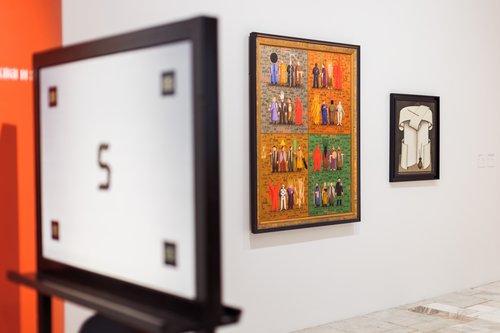
Territory of Freedom. Nonconformists in Tarusa. Exhibition view. Moscow, 2026. Courtesy of AZ Museum
The exhibition ‘Territory of Freedom. Non-conformists in Tarusa’ at Moscow’s AZ Museum revisits the flourishing underground art scene that emerged in this small town on the banks of the Oka during the Soviet era. It explores how a community of fiercely independent artists found refuge and creative freedom beyond the confines of the capital.
The exhibition is the second in a trilogy exploring Tarusa’s place in the history of Russian non-conformist art. The first, ‘Beyond the 101st Kilometre’, held this summer at the town’s House of Writers, laid the foundations for a broader exploration of Tarusa as a refuge for independent artistic thought and creative freedom. For this second chapter, the AZ Museum has brought together works from private collections, the Pushkin State Museum of Fine Arts, the Moscow Museum of Modern Art and the Prometheus Foundation in St Petersburg.

Territory of Freedom. Nonconformists in Tarusa. Exhibition view. Moscow, 2026. Courtesy of AZ Museum
The expression ‘beyond the 101st kilometre’ entered common parlance in the 1930s. Those deemed politically unreliable or persecuted on ethnic or political grounds were forbidden to live in Moscow and banished beyond the city’s 100-kilometre exclusion zone. Among them were many artists, writers and other members of the creative intelligentsia who found refuge in Tarusa, a picturesque little town on the banks of the River Oka. Yet Tarusa’s artistic heritage stretches back much further. At the turn of the twentieth century, the town and its surroundings attracted such figures as the painters Viktor Borisov-Musatov (1870–1905) and Vasily Polenov (1844–1927), and the historian Ivan Tsvetaev, founder of what is now the Pushkin State Museum of Fine Arts. His daughter, the poet Marina Tsvetaeva, spent part of her childhood there with her sister Anastasia.

Territory of Freedom. Nonconformists in Tarusa. Exhibition view. Moscow, 2026. Courtesy of AZ Museum
In the post-war years, Tarusa’s circle of independent creative figures expanded as artists whose aesthetic and ideological outlook ran counter to official Soviet doctrine gravitated towards the town, seeking the freedom to work on their own terms. In 1961, at the height of the Thaw, Tarusa’s House of Culture hosted its first exhibition of unofficial art. Among the participants were Boris Sveshnikov (1927–1998), who had returned from the labour camps; Arkady Steinberg (1907–1984) and his son Eduard (1937–2012); Valentin Vorobyov (b. 1938); Igor Vulokh (1938–2012); Vladimir Yakovlev (1934–1998); and Mikhail Odnoralov (1944–2016). Sixty-five years later, it is the work of these artists that forms the core of both the summer exhibition and the current autumn show.

Territory of Freedom. Nonconformists in Tarusa. Exhibition view. Moscow, 2026. Courtesy of AZ Museum
What strikes the visitor, both at the summer exhibition and at the current show, is the richness and rarity of the material brought together. For the collector, there is a particular pleasure in exploring this archive, savouring its details and discovering unfamiliar works by such well-known masters of unofficial art as Dmitry Plavinsky (1937–2012), Eduard Steinberg and Igor Vulokh. Thanks to Elena Kamenskaya, curator of both exhibitions, and Natalia Volkova, co-curator of the autumn show, the works from Tarusa emerge as precious fragments that enrich our understanding of the otherwise well-documented artistic careers of Anatoly Zverev (1931–1986), Boris Sveshnikov and Dmitry Plavinsky.
Another pleasure is discovering the unexpected talents of figures better known for their achievements in other artistic fields. A striking example in the current exhibition is the Surrealist painting of Arkady Steinberg, known primarily as a poet and translator, and as the father of two celebrated sons: the poet Borukh Steinberg (1938–2003), one of whose relief paintings is also on display, and Eduard Steinberg, the artist renowned for his reinterpretation of Malevich’s (1879–1935) artistic legacy and whose work is regularly exhibited in Moscow. Eduard’s canvases are among the highlights of the current exhibition at the AZ Museum, while his father’s paintings remain largely unknown. Yet the beauty of Arkady Steinberg’s work becomes particularly apparent when seen in dialogue with that of his sons and other artists of the Tarusa circle.

The leitmotif of both exhibitions is the preservation of memory. Yet the community of unofficial artists, writers and musicians that formed in Tarusa beyond the 101st kilometre was not a fellowship of like-minded individuals united by a common artistic purpose. Unlike the artistic colonies of the nineteenth and early twentieth centuries – the Barbizon school of plein-air painting, the Darmstadt Artists’ Colony or Abramtsevo, where Russian Art Nouveau took shape – the ‘Tarusa enclave’ brought together fiercely independent individuals whose artistic sensibilities were often at odds with one another.
Dmitry Plavinsky recalls traveling to Tarusa with the mystically inclined Alexander Kharitonov (1932–1993) and the irrepressible post-Expressionist Anatoly Zverev. The latter needed to produce a substantial body of work for a solo exhibition in Paris. He would stir up muddy puddles, conjuring from them delicate faces or bouquets of lilac. Kharitonov, by contrast, created jewel-like mystical compositions that appeared to have been assembled from tiny fragments of coloured mosaic glass. Plavinsky himself produced works reminiscent of medieval atlases populated with exotic flora and fauna, or landscapes evocative of the Northern Renaissance.

“The whole trinity – Zverev, Kharitonov and I – was barely compatible, so unlike one another was each of us,” Plavinsky writes in his 2006 memoir ‘Zverev in Tarusa’. “Zverev considered Kharitonov a deep schizophrenic whom no madhouse in the capital could help. Kharitonov, for his part, was convinced that behind Zverev’s mask of a ‘filthy, half-drunk idiot’ there hid a king of paranoiacs.”
The myth of idyllic friendships among the ‘boys of the Thaw’ dissolves like the morning mist over the Oka. The artists differ profoundly, both in temperament and in the quality of their work. It is telling, then, that the architect Alexei Podkidyshev has designed the exhibition across three floors of the AZ Museum to evoke the dilapidated interiors of a Soviet clubhouse or domestic dwelling, where reinforcing mesh is exposed beneath crumbling plaster. A fractured community is evoked through the architecture of ruin.

Rather than following a chronological sequence, the curators have arranged studies, drawings and large-scale paintings according to their visual affinities, allowing subtle formal echoes to emerge between the works. An unexpected dialogue unfolds between Boris Sveshnikov and Arkady Steinberg, the man who once saved him in the labour camps. According to Plavinsky’s recollections, Steinberg, who worked as a medical assistant in the camp, rescued the young Sveshnikov, half-dead from exhaustion, from gruelling forced labour, securing him a position as a watchman where he could draw in the warmth.
Sveshnikov’s paintings glow with a strange, neurotic light, recalling both the Symbolist sensibility of the Nabis and the metaphysical landscapes of Giorgio de Chirico (1888–1978). In one of Arkady Steinberg’s paintings, a doll inhabits a phantasmagorical landscape torn apart by jagged rocks, echoing the profound existential anguish that permeates Sveshnikov’s work. Steinberg’s imagery, however, also brings to mind the imaginative worlds of the Surrealists, particularly Max Ernst (1891–1976).

For Tarusa’s community of lone wolves, preserving one’s health and will to live was often a formidable challenge. Perhaps the most tragic fate befell Alexei Paustovsky (1950–1976), son of the celebrated Soviet writer Konstantin Paustovsky, who lived in Tarusa and welcomed the younger generation of artists. A tireless champion of unofficial artistic initiatives, Alexei died at the age of just 26. Some of his works, with their washed-out surfaces, resemble faded Polaroid snapshots. They seem to reach across the decades, anticipating Marlene Dumas’s (b. 1953) explorations of the fragility of bodily presence and the instability of identity.

Igor Vulokh, a major figure in Soviet and Russian abstraction, is represented by landscapes traversed by black threads of craquelure, recalling developments in German art of the second half of the twentieth century. Dmitry Plavinsky’s ‘Moonlight in Khotilovo’ (1973) is a work of remarkable resonance, lending itself to a variety of artistic dialogues. Its radiating disc, rendered in coloured relief on canvas, glows with an inner, mystical light. Maria Plavinskaya (b. 1952) has aptly observed how the pulsation of moonlight is conveyed through the textured brushwork and the delicate graphic articulation of individual rays. The immense energy of the pulsating disc brings to mind the paintings of Edvard Munch (1863–1944) and, of course, Kliment Redko (1897–1956), who was fascinated by the mysterious interplay between physical and mystical light in painting.

As the two exhibitions reveal, the Tarusa community emerged through chance encounters and unlikely affinities between strikingly different individuals. Yet reconstructing its history and immersing oneself in this conservatoire of memory, where every artist has a distinct voice and a solo performance of their own, is an invaluable experience. When these disparate voices come together, even in an imperfect chorus, one begins to discern a common melody: a fierce, instinctive and irrepressible longing for creative freedom.

Territory of Freedom. Nonconformists in Tarusa. Exhibition view. Moscow, 2026. Courtesy of AZ Museum
Territory of Freedom. Nonconformists in Tarusa
Moscow, Russia
19 November 2026 – 25 April 2027