

Soviet Underground Art: a Past that Resonates

Production, Documentation, Intervention. On Unofficial Art in Late Soviet Russophone Culture from the 1960s to the 1980s. Edited by Ilja Kukuj and Brigitte Obermayr. Book cover. Courtesy of Academic Studies Press
Conceived in 2018 and finally published in Boston in 2026, ‘Production, Documentation, Intervention: On Unofficial Art in Late Soviet Russophone Culture from the 1960s to the 1980s’ brings together essays exploring the artistic practices of the Soviet underground. Edited by Ilja Kukuj and Brigitte Obermayr, the volume has acquired renewed relevance in a political and cultural landscape transformed since its inception.
The new book has its origins in a conference held in 2018 at Ludwig Maximilian University of Munich, entitled ‘Production, Documentation, Intervention: Works of Art in the Context of Unofficial Soviet Culture, 1960–1980s’. Organised by researchers Ilja Kukuj and Brigitte Obermayr, the conference formed part of the Prigov Readings, a series established in 2008. Unlike previous events in the series, however, it was not devoted exclusively to the work and legacy of the late poet and artist Dmitry A. Prigov (1940–2007). Instead, participants were invited to examine the particular conditions in which Soviet unofficial art developed between the 1960s and 1980s, and their significance for Prigov’s artistic practice.

Moscow Conceptualism, like Soviet underground art more broadly, emerged in response to a society characterised by doublethink, propaganda and repression. Denied the opportunity to exhibit their work to a wider public, artists developed an intense preoccupation with documentation, which became an integral part of the creative process itself. Following the collapse of the ‘Evil Empire’, this underground artistic world came to resemble a submerged Atlantis, buried beneath an ocean of typewritten pages and blurred black-and-white photographs. For researchers, uncovering its traces was akin to discovering a remarkable lost civilisation. Yet by the time the book finally appeared, the social and political landscape had changed dramatically.
In her preface, written in 2024, Brigitte Obermayr reflects on these changes, noting the tragic death of one of the book’s protagonists, the poet and artist Lev Rubinstein (1947–2024), following a road accident in Moscow. Meanwhile, three Russian contributors – Roman Osminkin, Ilja Kukuj and Stanislav Savitsky – had been forced into exile. Obermayr observes that, viewed from the perspective of 2024, the historical distance separating researchers from the late Soviet era seems to have narrowed considerably, altering the perspective from which that period was understood in 2018. Indeed, the troubling parallels between contemporary Russia and the Soviet Union are increasingly difficult to ignore. The tightening of censorship and the consequent resurgence of apartment exhibitions offer just one example.

Perhaps inevitably, in her preface the editor apologises for the book’s ‘Russocentric approach’ – a seemingly minor concession that speaks volumes about the current climate of academic freedom. In an effort to broaden this perspective, the editors included an essay by Sabine Hänsgen and Tomáš Glanc, leading scholars of Soviet underground culture, in the final chapter. The two had previously curated the exhibition ‘Poetry and Performance’, presented in Dnipro, Ukraine, in 2021–2022 and in Prague in 2024. Their contribution brings together research into poetry-based performance across Eastern Europe, undertaken in conjunction with the exhibition. Bridging the world of Soviet-era underground culture and the artistic practices of a new generation, the essay traces how this shared heritage has been reinterpreted and transformed within the distinct cultural and political contexts of the former Eastern Bloc, including Russia, Ukraine and the Czech Republic.

The book consists of four chapters ‘Art as a Documentation of Soviet Life’, ‘Intervention: (Neo)Avant-Garde and Conceptualism’, ‘Dmitry Prigov as In(ter)ventor’ and ‘Art Production and Documentation’. Given the interrelation of visual art and poetry in the practice of the book’s two central figures, Prigov and Rubinstein, it is logical that the volume covers both. Prigov was active as both a poet and a visual artist. He enjoyed reading his poetry aloud in public, turning these recitals into impromptu performances. The same is true of Lev Rubinstein, whose readings of ‘catalogue’ poems written on library cards have become legendary. Indeed, the entire book, particularly the final chapter, reads as a requiem to Rubinstein. Several articles quote his poetry, and the final one, ‘Comment on Lev Rubinstein’s “Here I am”’ by Ilja Kukuj, contains a touching and humorous memoir of a public reading of a German translation of the poem that turned out to be misaligned with the original.

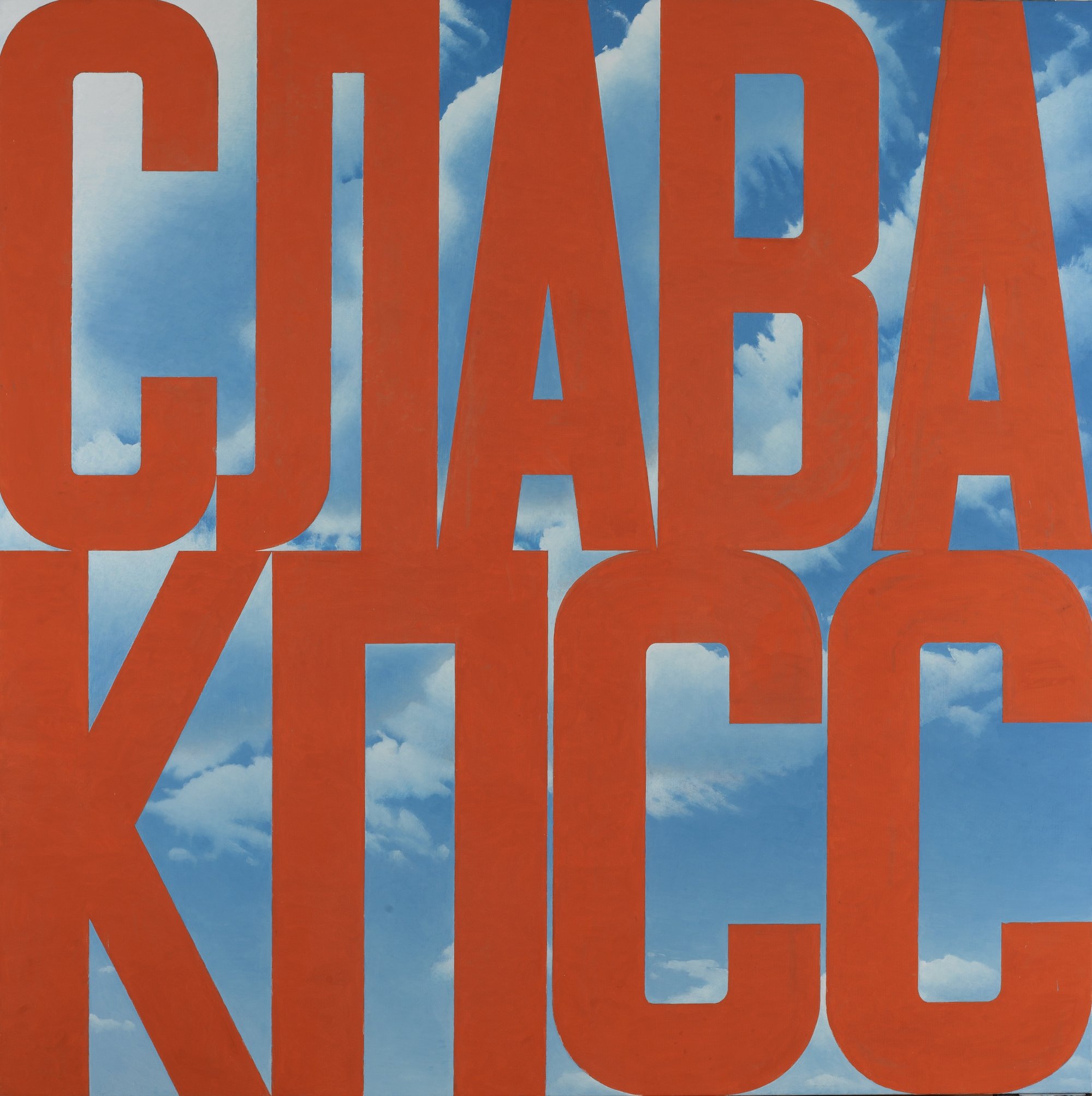
The articles in the first chapter are probably the most enlightening for a Western reader, as they explore how the Moscow Conceptualists and their poet peers were influenced by the everyday absurdity of Soviet reality. In ‘The Origins of Moscow Conceptualism in Everyday Soviet Life’, Stanislav Savitsky analyses this connection using the work of Ilya Kabakov (1933–2023), Viktor Pivovarov (b. 1937), the Collective Actions group, and Lev Rubinstein. Savitsky notes that “conceptualists surpassed their contemporaries in transforming Soviet reality into a nonconformist artistic project”. Philipp Kohl, in ‘Bookkeeping in Limonov, Collective Actions, and Prigov’, builds on Savitsky’s argument with his own findings on the artistic appropriation of bookkeeping – one of the most absurd activities known to humankind – in the USSR and beyond. Hans Gunther dissects the paintings of Erik Bulatov (1933–2025) as collisions between the “social space” of mundane Soviet life and the “quasi-metaphysical space” beyond it.

Some of the essays in this volume seem deliberately provocative or infused with postmodern irony, much like the artworks they examine. In ‘Yuri Albert: Always Getting It Wrong’, in Chapter Two, Ksenia Gurshtein argues that Albert has taken the principle of personazhnost (‘character-ness’), so central to the work of his predecessors Ilya Kabakov, Vitaly Komar and Alexander Melamid, to its logical extreme. By turning himself into a character, Albert has transformed his entire artistic practice into a lifelong performance. As Gurshtein observes, he has “built his career creating a character Conceptual Artist Yuri Albert who consistently fails or refuses to act in accordance with the unspoken norms of ‘proper’ behaviour that implicitly govern contemporary art.”

The highlight of the third chapter, and arguably the entire volume, is Boris Groys’s article, ‘Dmitry Prigov: Haunted Spaces’. Through a series of elegant paradoxes that are typical of his writing style, Groys describes his perception of a transition in Prigov's work from a fascination with the Soviet cosmos in the 1970s to an embrace of chaos following the collapse of the empire. Groys interprets the black blob in the artist’s graphic works as an image of chaos that emerges after the Soviet cosmos disintegrates. “Increasingly, all the images Prigov produced became haunted images,” he notes casually. He compares the artist’s late performances to the performative poetry readings of the Dadaist Hugo Ball (1886–1927), and suggests that Prigov’s unique style of reciting his own poetry is linked to his background as a sculptor: “Poetic recital is undoubtedly the most obvious form of self-sculpturalisation or self-monumentalisation: the poet positions himself in the centre of a public space and is seen by people from all sides, as Prigov notes in one of his poems.”

The core of the fourth chapter is Rubinstein’s ‘Here I am!’ published in full English translation and in the Russian original. In the context of the book, it reads like a ritual incantation – either an absurd auto-eulogy or a protective spell for those forced to return to the Soviet inferno.
Production, Documentation, Intervention. On Unofficial Art in Late Soviet Russophone Culture from the 1960s to the 1980s. Edited by Ilja Kukuj and Brigitte Obermayr
Boston, USA