Putting down Roots: Ivan Tuzov’s Garden in Exile

Ivan Tuzov. Untitled, 2026. Courtesy of the artist
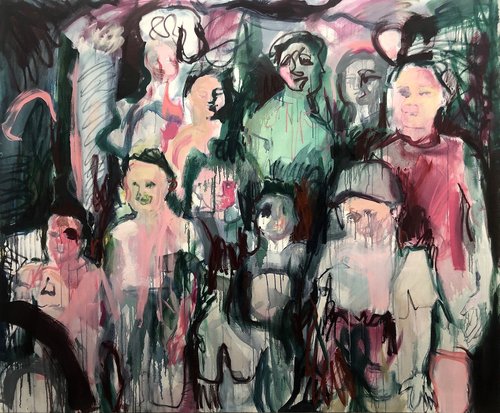
Exiled Russian artist Ivan Tuzov has traded the pixelated imagery that made his name for expressive abstraction inspired by Montenegro’s lush Adriatic landscape. His latest exhibition, ‘The Garden’, explores artistic reinvention, the experience of displacement and the haunting persistence of childhood memories.
Emigration is often described as the painful process of uprooting oneself. Ivan Tuzov (b. 1984) is literally trying to put down roots in his new homeland of Montenegro. Having moved from Russia to this small Balkan country, he has completely changed his painting style – and his most recent solo exhibition is aptly titled ‘The Garden’. Tuzov was born in Leningrad and studied fine art at the Herzen State Pedagogical University. Early in his career, he developed a distinctive style of painting: his laconic, deceptively simple, pixelated images surprise viewers with their unique blend of irony and nostalgia for the early days of the digital world, when computers were still novel and wondrous. Tuzov used pixelation as a tool of estrangement that allowed the audience to see familiar images of popular culture and Soviet propaganda from a humorous and different perspective. His artworks were a staple of Russian art fairs and were displayed at major institutional shows.

Like many other Russian artists of his generation, Tuzov’s life changed irrevocably in 2022. He was on holiday in Montenegro when the armed conflict between Russia and Ukraine began. Shocked by the news, he decided not to return to his homeland. He settled in Budva, a seaside resort town, and struggled to maintain his artistic practice amid a relentless stream of devastating news. Despite the idyllic Adriatic surroundings, he faced the familiar challenges of emigration: loneliness, depression, the ordeal of bureaucratic paperwork, the loss of community and the need to rebuild his career almost from scratch. Tuzov continued to work in his pixelated style but gradually felt the need to explore a new direction. He discovered that improvisational abstraction offered a more immediate expression of his turbulent emotions than the carefully calculated precision of pixel art.

When I visited Tuzov’s studio in Budva, set up in his living room, a few weeks before the exhibition opened, I was struck by the complete absence of colour: all the paintings were covered with paper. “Otherwise, I will just keep adding more and more to them,” Tuzov explained. He told me that the most difficult part of the artistic process was knowing when a work was finished. Whenever he looks at his paintings, he feels an irresistible urge to improve them. He could tweak each one endlessly, repainting and overpainting the canvas.
This sense of continuous evolution is integral to his method. Tuzov makes no preparatory sketches, nor does he begin with a clear vision of the finished composition. “I grow my works as I grow a garden,” he explained at the opening of his solo exhibition at Auditoria, Budva’s cultural hub for Russian speakers, which houses a bookshop and bar and hosts a packed programme of events. “It is a lively, improvisational process – day after day, I add new layers,” Tuzov elaborated. “My moods shift – one day it’s this, the next, something else. It is a garden that has accumulated the layers of my days over the course of this year.”

The exhibition’s title, ‘The Garden’, also has a literal dimension. Tuzov explained that the mosaic of colours and interplay of curving, organic forms in his paintings were inspired by Montenegro’s lush vegetation. The eternal cycle of growth, decay and regeneration in nature seems to fascinate him. An unexpected connection with the centuries-old tradition of vanitas still-life painting emerges: the palette of one of his abstract works was inspired by rotting fruit and vegetables.
Nevertheless, Tuzov’s creative process is not entirely spontaneous. At times, it involves graffiti-style spray painting, which cannot be done indoors, so he takes the canvas outside and hangs it on a wall. He then brings it back into the studio to continue working with a brush and acrylic paint. Two very different techniques thus collide and overlap within a single painting. The composition emerges gradually, with the artist constantly navigating the tension between maintaining spontaneity and allowing the work to descend into chaos. Perhaps it is this delicate balance that gives his paintings their inner tension and makes the creative process so addictive that he eventually has to cover his canvases with paper to resist the temptation to keep working on them.
Sometimes, the process becomes a collaborative exercise. On one occasion, Tuzov organised a workshop in which participants were invited to paint together on a single large canvas. Afterwards, he divided the canvas into several sections, adding his own layers

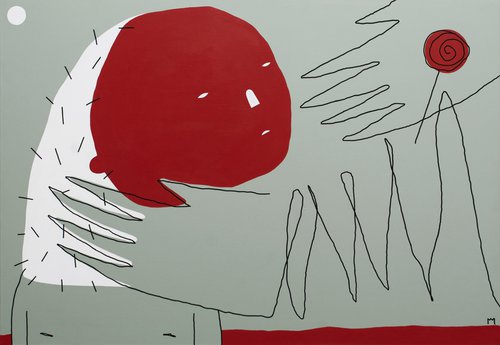
However, Tuzov has not abandoned figurative painting entirely. An important part of ‘The Garden’ is a series of mysterious, unsettling paintings depicting strange, cartoonish characters in a dark palette that lends them a vaguely ominous quality. Tuzov explained that these works explore his childhood traumas, drawing on imagery from Western popular culture that became accessible to Soviet children as the country began to open up during the turbulent years of Perestroika and the period following the collapse of the Soviet Union.
“I don’t want to depict children as cute,” said Tuzov. “Childhood is full of traumas. There is all this Soviet stuff that has disappeared, yet still haunts us, as well as all the American influences I was exposed to.”
The nameless, wide-eyed characters that populate his canvases hover uneasily between the endearing and the sinister. Tuzov places these strange creatures against neutral, dark backgrounds, stripping them of any recognisable context or narrative and making their presence all the more enigmatic and haunting. In ‘The Garden’, these works hang between much larger abstract paintings, which might themselves be read as a commentary on the figurative images. Even in a seaside paradise, there is room for painful memories and dark secrets, and perhaps all we can do is learn to live with them.