

New Book on Krasulin Charts Fifty Years of Sculpture

Andrey Krasulin: Hidden Presence. By Mark Gisbourne. 2026. Book cover. Courtesy of Barton Verlag
A new album ‘Andrey Krasulin: Hidden Presence’ by Mark Gisbourne, published by Barton in Germany offers rare insight into the career of this émigré non-conformist sculptor, from Soviet-era commissions to recent Berlin works.
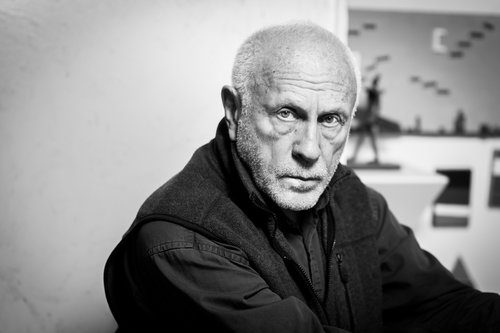
If we look at the Russian art scene these days, the case of Andrey Krasulin (b. 1934) is unique and typical at the same time. The octogenarian sculptor emigrated to Berlin in 2022 and managed to relaunch his career abroad – likely the only one in his generation. At the same time, he is facing the same deadlock as many hundreds of younger artists who fled Russia during the last four years. They left their home country because they would not agree with its government’s policy, arrived in Europe, and quickly discovered that their art is welcome neither here nor there. They cannot exhibit their new works in Russia due to censorship and the mind-boggling logistics of sending them back there as well as the prohibitive cost. In the West, institutions are wary of all things Russian, fearing backlash from the Ukrainian communities and their local supporters.

This is very different from the Cold War era, when Krasulin started his career. Back then, artists who managed to escape behind the Iron Curtain were banned in the Soviet Union, yet attracted wide, albeit short-lived interest in the West, where they drew sympathy as refugees from the Evil Empire. Nowadays, this sympathy seems to be reserved for high-profile activists such as Pussy Riot. Less radical émigré artists can only show their work at a handful of private galleries, mostly those founded by their compatriots or Western dealers with old ties to Russia. One of them is Berlin's Volker Diehl, who used to have a gallery branch in Moscow in the 2000s and was among the co-founders of Cosmoscow art fair. He has been intrepidly supporting Russian artists throughout the crisis unfolding since 2022, along with Ukrainian ones. (It is worth mentioning that before the start of the armed conflict, the cultural scenes of the two countries were largely intertwined. Many Ukraine-born artists, such as Sergey Bratkov (b. 1960), Oleg Kulik (b. 1961) and Sergey Anufriev (b. 1964), have been an important part of the Moscow art scene for many years.)

In such a climate, the publication of a book on a living Russian artist in the West is a rare occasion. Mark Gisbourne’s ‘Andrei Krasulin: Hidden Presence’ launches in Berlin this September. Although not a full-scale monograph, this 90-page album by Barton publishing house is a unique source of up-to-date information on the artist's current creative practice, as well as his rarely seen earlier projects, including public artworks. Krasulin's career spans over fifty years, yet somehow he never enjoyed as much limelight as many of his fellow non-conformists. He was trained as a sculptor at Moscow Art School and Stroganov Higher School for Art and Industry, and worked as an artistic director at Moscow's State Polytechnic Museum. Like many Soviet artists, he worked on his modernist sculptures in the privacy of his studio and took government commissions for a living. The book contains rare archive photographs of his bas-reliefs made for a theatre in Tula and even a wedding hall at a Crimean kolkhoz in the late 1960s and early 1970s. Krasulin did not have the opportunity to show his easel sculptures in a public exhibition until the age of 45. His works are now in the collections of the State Russian Museum in St. Petersburg, the State Tretyakov Gallery in Moscow and Germany's Ludwig Forum Aachen. However, they cannot be shown in the West at the moment due to logistical challenges: the artist’s recent exhibitions at Diehl Gallery showed mostly works on paper – drawings and collages – as well as cardboard objects. Despite being an established artist, there are just a few books on his oeuvre in English. The bilingual catalogue of one of his solo exhibitions in Moscow has long gone out of print. The multilingual monograph published by his long-time dealer, a Russian-Swiss gallerist Nadja Brykina, is also hard to come by. So a new book, written by a renowned British art scholar, Mark Gisbourne, is a welcome addition to his bibliography.

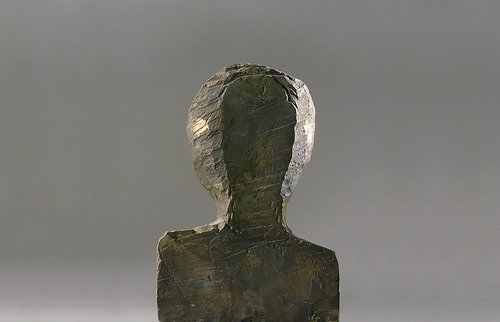
The album focuses on Krasulin’s sculptures, including the recent ones, created in Berlin over the last four years. Paintings and works on paper are left out. Gisbourne himself chose the artworks, paying a lot of attention to public art, including the little-known unrealised project of a memorial to Russian poet Ossip Mandelstam who perished in a GULAG. Krasulin took part in a competition to design the memorial in 2006–2007, although he did not win. As a part of his application, he created a series of wax-and-cardboard models and even had them made in bronze.
The book was edited by Evgenia Kisseleva-Afflerbach, a curator based in Moscow and Berlin, who has been working with Krasulin for the last four years. So, it can be viewed as a catalogue of an imaginary exhibition, the one for which there is currently neither space nor time in present-day Germany or Russia.

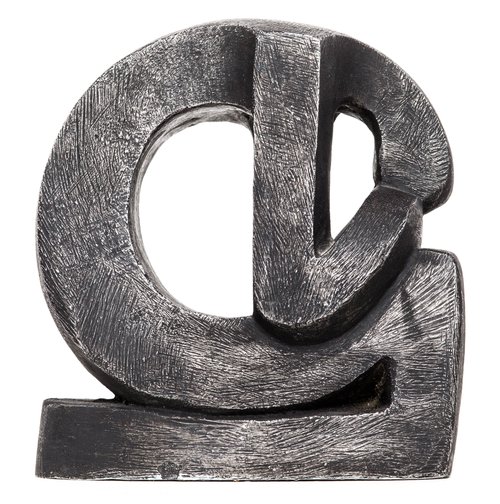
The layout of the album is somewhat confusing – photographs of works of art and exhibition views from different periods, spanning from the 1960s to the 2020s, are thrown onto the pages in aesthetic rather than chronological order, and all the captions are, for some inscrutable reason, located at the end of the volume. The text places Krasulin in the context of international Arte Povera and post-minimalist sculpture and notes an influence of Constantin Brancusi (1876–1957) on the Russian artist, naming “post-minimal equilibrium” an important trait of his style. In the meantime, the obvious references to the Soviet underground art scene are omitted, perhaps intentionally. For years, Krasulin has been creating sculptures from found materials, just like Vadim Sidur (1926–1986) and many others. This practice was not merely an artistic choice of this generation; it was largely born of necessity, due to the scarcity of quality artists’ materials in the USSR.

At least once, the writer’s deliberate detachment from the local context leads to a humorous effect. When writing about Lucio Fontana’s (1899–1968) slashed paintings and similar works by Krasulin, Gisbourne notes: “The Argentinian-Italian argued ‘the wound is where light enters you'’ an access to an interiority, a cosmic paradigm also embraced by the Russian artist, yet its ‘innerness’ or immanence rather than space and light he finds aesthetically prescient." This passage is illustrated by the images of two works of art by Krasulin from his ‘Calligraphy’ series: in these tongue-in-cheek homages to Fontana, the slashes in the paper form a word which is one of the strongest profanities in the Russian language, an obscene designation of a penis. Somehow, the ironic nature of these works happens to elude the attention of this illustrious writer. Unfortunately, the book contains a few rather frustrating typos and mistakes (for instance, in a note to an artist quote borrowed from an Art Focus Now article, our publication is credited as ‘Art in Focus’, and the first name of the writer is misspelled). And in the list of group exhibitions in the biography section there is an art fair – VIMA in Limassol. Hopefully, these will be corrected in the e-book edition, which is already available online.