

Elizaveta Zvantseva’s Crucible of Modernity

Yulia Obolenskaya. Self-portrait, 1918. Courtesy of the Astrakhan State Art Gallery named after P.M. Dogadin
The Museum of Russian Impressionism in Moscow is presenting the first exhibition to explore the remarkable phenomenon of a private art school that became one of the principal laboratories for the development of a new visual language in pre-revolutionary Russia.
Despite the huge contribution her art school made to the evolution of artistic visual language at the turn of the 20th century, today Elizaveta Zvantseva (1864–1921) is only known among a small circle of connoisseurs. This historical injustice can in part be explained by her role at the school she founded where she was more a manager or producer, while the teachers she invited – Lev Bakst (1866–1924) and Mstislav Dobuzhinsky (1875–1957) – taught a whole new generation of artists and received all the fame.
Zvantseva’s artistic path matched the spirit of her times. Her noble birth allowed her early entry into fashionable art circles, to study with Ilya Repin (1844–1930) and Pavel Chistyakov (1832–1919), and then travel to Europe to acquaint herself with the latest art movements. During a trip to France with her friend artist Konstantin Somov (1869–1939), Zvantseva visited private Parisian academies and learned firsthand about the kind of possibilities for artistic expression that an approach based on free mentorship offered. On returning home she opened her first school in Moscow, which lasted only seven years. Work at that first institution – whose history is still being reconstructed by researchers – became an important experience for Zvantseva, after which she decided to move to St Petersburg and create a new focal point for young artists there.

Zvantseva School. Laboratory of Modernism. Exhibition view. Moscow, 2026. Courtesy of Museum of Russian Impressionism

Zvantseva School. Laboratory of Modernism. Exhibition view. Moscow, 2026. Courtesy of Museum of Russian Impressionism

Zvantseva School. Laboratory of Modernism. Exhibition view. Moscow, 2026. Courtesy of Museum of Russian Impressionism

Zvantseva School. Laboratory of Modernism. Exhibition view. Moscow, 2026. Courtesy of Museum of Russian Impressionism

Zvantseva School. Laboratory of Modernism. Exhibition view. Moscow, 2026. Courtesy of Museum of Russian Impressionism

Zvantseva School. Laboratory of Modernism. Exhibition view. Moscow, 2026. Courtesy of Museum of Russian Impressionism
The address of 25 Tavricheskaya Street in St Petersburg is familiar to all devotees of Russia’s Silver Age. It was here that the famous ‘Tower’ – the apartment of the poet Vyacheslav Ivanov (1866–1949) – became a gathering place for many of the leading creative figures of the period. Zvantseva’s school occupied the same building. The international movement to take artistic education beyond the confines of the academy, embracing a more progressive approach to art, found a natural expression within its classrooms. What attracted students above all was the rejection of conservative methods of artistic training, an approach that had not yet taken root in Russia.
The exhibition also reflects the museum’s broader curatorial direction. In recent years, its exhibitions have increasingly focused on research-led projects that explore the origins of the avant-garde, the defining artistic movement of its era. This exhibition follows earlier major projects, including ‘Dobychina’s Choice’ and ‘Les Fauves Russes’, but shifts the emphasis to artistic education and the profound impact it had on a new generation of painters. More intimate in scale, the display reflects the relatively brief lifespan of Zvantseva’s school.

The exhibition is organised around the teaching methods of the school’s three principal instructors – Dobuzhinsky, Bakst and Petrov-Vodkin (1878–1939). The first section focuses on the teachers associated with the ‘Mir Iskusstva’ circle, whose ideas helped shape artists drawn to refined plasticity and decorative elegance. Kuzma Petrov-Vodkin, whose artistic vision diverged significantly from theirs, joined the school after Bakst relocated to Paris. His pedagogical principles were not universally accepted, prompting several students to abandon their studies.
The departure of a number of students after the painting class came under Petrov-Vodkin’s direction can largely be explained by the aesthetic ideals he championed, which differed markedly from those of his predecessor. His sculptural approach to form sat uneasily alongside the artistic programme established by Bakst. Young artists who valued a vibrant palette and celebrated the “naive gaze of the savage” as the primary creative force found little affinity with the more restrained and monumental language of the new master. Others, however, responded with genuine curiosity to Petrov-Vodkin’s innovative ideas about space, an influence that can be clearly seen in the compositions of Favsta Shikhmanova (1886–1937). The material assembled by the exhibition’s curator, Vera Ryabinina, makes it possible to trace the artistic relationships that developed between teachers and their most receptive students.

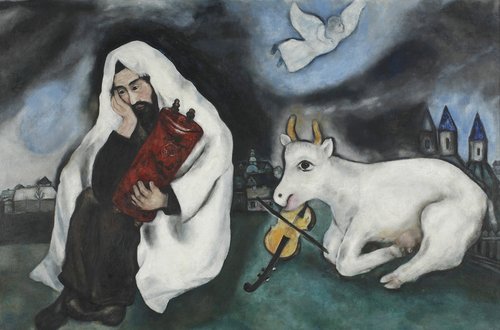
As its title suggests, the so-called St Petersburg ‘Bakst and Dobuzhinsky School’ became a genuine “laboratory of modernism.” Among the artists who emerged from its walls were Elena Guro (1877–1913), Mikhail Matyushin (1861–1934), Sofya Dymschitz-Tolstaya (1884–1963), Nikolay Tyrsa (1887–1942), and Nadezhda Lermontova (1885–1921). Marc Chagall (1887–1985) also studied there for a brief period, although his work ultimately developed along a path quite distinct from the broader visual programme of Zvantseva’s circle.
Throughout the galleries, works by the teachers are displayed alongside those of their closest disciples, allowing visitors to assess the extent of each master’s influence. The displays are not arranged thematically; instead, religious compositions, portraits, landscapes and theatrical sketches are presented side by side. Particularly striking are the graphic works of one of Petrov-Vodkin’s most devoted followers, Raisa Kotovich-Borisyak (1890–1923), whose imagery is imbued with an atmosphere of mysticism. While her portraits clearly reveal her teacher’s influence, her small religious compositions possess a distinctly Art Nouveau sensibility. A similar attraction to the irrational can be seen in the engravings of Sergey Kalmykov (1891–1967), whose later work would become characterised by its enigmatic interpretation of reality.

The school closed in 1917, most likely for financial reasons. The often tragic destinies of many of Zvantseva’s students are only lightly touched upon by the exhibition. Instead, its principal focus is the emergence of a compelling alternative to academic artistic education at the beginning of the twentieth century. Raised in an atmosphere of creative freedom and inspired by a mystical vision of reality, many of the school’s graduates later found themselves unfashionable and largely overlooked.
It is encouraging that, despite the current tendency towards narrowly defined exhibition themes in Russian museums, projects are increasingly seeking to restore the reputations of women who played a formative role in shaping twentieth-century art but were unjustly consigned to the margins of history. Yet, in an exhibition devoted to Elizaveta Zvantseva’s school, it is nevertheless surprising that Zvantseva herself receives comparatively little attention. The principal protagonists throughout the galleries of the Museum of Russian Impressionism remain the male artists.

In many respects, the exhibition is characteristic of the museum’s broader programme, placing forgotten figures alongside recognised masters and allowing visitors to develop a richer understanding of the artistic processes that shaped the early twentieth century. One leaves with a slight sense of incompleteness – but perhaps that is no bad thing. Rather, it encourages visitors to continue exploring this fascinating cultural phenomenon for themselves.
Zvantseva School. Laboratory of Modernism
Museum of Russian Impressionism
Moscow, Russia
25 June – 4 October 2026