

Do You Know Anything About Georgian Art?

You Know Nothing About Georgian Art. Exhibition view. Tbilisi, 2026. Photo by Kirill Vorontsov. Courtesy of Freizeit collective
A fascinating archival exhibition ‘You Know Nothing About Georgian Art’, featuring local photographer Guram Tsibakhashvili’s documentation of Georgia’s art scene from the 1980–1990s, is currently on view at tmp_space, an independent art venue in Tbilisi.
An ambitious exhibition project bringing together over four hundred photographs which trace the emergence of contemporary art in Georgia through artists, exhibitions, performances, and informal cultural networks of the period has opened at tmp_space in Tbilisi. Curated by the Freizeit collective formed by a group of emigres from Russia, with the support of art producer Masha Polnikova (b. 1988), it presents works from the archive of Georgian photographer Guram Tsibakhashvili (b. 1960). He appears here less as an artist than as a witness to a rapidly transforming cultural landscape. His images document key cultural figures of the epoch like Karlo Kacharava (1964–1994), Levan Chogoshvili (b. 1953), Oleg Timchenko (b. 1957), and Merab Abramishvili (1957–2006), alongside curators, collectors, and other participants in the scene. While photographic work from Tsibakhashvili’s archive has been exhibited previously, the photographer emphasises that this is the first time the material has been presented on such a scale.


The title of the exhibition reflects a certain curatorial attitude to the material. Members of the Freizeit collective – Leili Aslanova (b. 1989), Katya Nile (b. 1997), and Vladimir Serykh (b. 1997) – approach the archive as outsiders to the history they were reconstructing, working primarily through fragmented documentation and published sources. Rather than asserting expertise, the title signals an awareness of the limits of their perspective.
While archival research has long been central to Freizeit’s practice, the project also emerged from a desire to understand the history of Georgian contemporary art as newcomers. Drawing on Tsibakhashvili’s archive alongside materials from the Center of Contemporary Art in Tbilisi, the Russian Art Archive, and other sources, the curators managed to identify many of the artists and events that are depicted in the photographs. The process also revealed significant gaps in the documentation of Georgian contemporary art, with numerous images remaining only partially identified.


The exhibition’s central narrative traces the gradual institutionalisation of contemporary art in Tbilisi. The selection of photographs is structured around sites that have played a significant role in the development of Georgia’s contemporary art scene. Leili Aslanova notes that this perspective encourages visitors to experience the city differently: after seeing the exhibition, they begin to look at Tbilisi through the lens of these histories, recognizing not only galleries and museums that continue to operate today, but also former venues that hosted performances, artist-run initiatives, and street art interventions that have ultimately shaped the city’s cultural landscape.
Although not presented as a strictly chronological account, the display traces a trajectory from informal studio-based practices to interventions in public spaces, including the Dezerter Bazaar, and the streets and underpasses of Tbilisi. From there, contemporary art entered privately owned galleries before eventually going on to gain recognition within state museums. By the late 1990s, increasing international interest further integrated Georgian artists into broader global networks.


The exhibition’s Achilles heel is the difficulty of navigating its narrative without prior knowledge of the period or participation in a curatorial tour. The sheer number of photographs, the limited size of the exhibition space, and the brevity of the accompanying texts can initially feel overwhelming. Only through a guided tour does the exhibition’s internal logic become fully apparent: the principles behind the selection and arrangement of images, the relationships between artists, and the broader historical context. The exhibition demands considerable attention and effort from its audience. Yet for visitors unfamiliar with Georgian contemporary art, this challenge ultimately becomes one of the project’s strengths. As an expat myself only beginning to explore the history of the local art scene, I found the experience demanding but highly rewarding. For those who, as the title suggests, “know nothing” about Georgian art, the exhibition functions as a compelling – if occasionally difficult – point of entry.


Beyond identifying artists and events, the tours reconstruct the social and political conditions in which the works were produced: civil war, economic collapse, energy shortages, and cultural resilience. Visitors learn how exhibitions at Orient Gallery (today Baia Gallery) were lit up by candlelight during power outages, how artists gathered on the balcony of the Marjanishvili studio because it was warmer than inside, and how public artworks appeared in underpasses because the city lacked the resources to maintain them. These anecdotes reveal a generation of artists operating under severe material constraints while simultaneously experiencing an unusual degree of experimental freedom.
The political transformations of the late 1980s and 1990s created new opportunities for artistic exchange. Events such as Sotheby’s landmark Moscow auction in 1988, which included works by Gia Edzgveradze (b. 1953), the First Tbilisi International Biennial of Contemporary Art in 1996, and the broader collapse of the Soviet Union opened pathways to international visibility. Artists including Guram Tsibakhashvili, Karlo Kacharava, Oleg Timchenko, and Alim Rijinashvili (b. 1948) and others began exhibiting abroad. While some artists chose to emigrate to the West, Tsibakhashvili himself remained in Georgia, continuing to document the country’s evolving cultural landscape.


The exhibition’s relevance extends beyond historical reconstruction. Many of the featured artists remain highly visible within contemporary exhibition programmes both in Georgia and internationally. Tsibakhashvili’s photographs are currently included in ‘Wonderers’ at the Tbilisi Photography and Multimedia Museum, while LC Queisser gallery recently presented ‘What I Said as I Left the Room,’ an exhibition exploring the relationship between Karlo Kacharava’s poetry and painting. By bringing together archival materials and contemporary resonances, ‘You Know Nothing About Georgian Art’ demonstrates how the questions, networks, and artistic strategies of previous decades continue to shape Georgian art today. A similar engagement with this generation of artists can be found in ‘The Map of Georgian Art’ at Baia Gallery, which brings together works by Irakli Parjiani (1950–1991), Merab Abramishvili, Levan Chogoshvili, Gogi Chagelishvili (b. 1959), and others. Seen alongside the archival material at tmp_space, the exhibition adds another layer to our understanding of artists whose experiments and artistic languages continue to influence contemporary Georgian art. Reflecting on the temporal scope of the project, Tsibakhashvili notes: “More than thirty years have passed since the 1990s. Many of the artists are no longer with us, while those who remain have undergone significant changes over time. This exhibition makes it possible to trace how their practices and interests evolved throughout the years.”

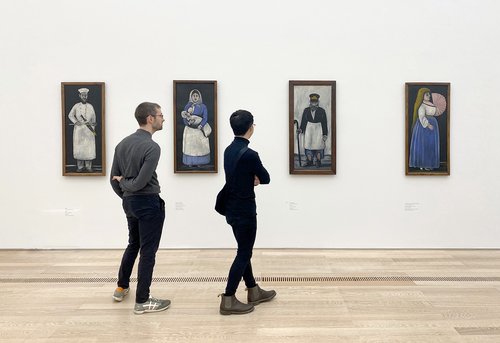
You Know Nothing About Georgian Art. Exhibition view. Tbilisi, 2026. Photo by Kirill Vorontsov. Courtesy of Freizeit collective

You Know Nothing About Georgian Art. Exhibition view. Tbilisi, 2026. Photo by Kirill Vorontsov. Courtesy of Freizeit collective

You Know Nothing About Georgian Art. Exhibition view. Tbilisi, 2026. Photo by Kirill Vorontsov. Courtesy of Freizeit collective
The exhibition does not seek to provide a comprehensive history of Georgian contemporary art. Structured around Tsibakhashvili’s archive, it offers a necessarily subjective perspective shaped by the photographer’s personal relationships, experiences, and observations. Tsibakhashvili himself acknowledges the partial nature of the material, noting that he no longer remembers some of the events and individuals depicted in the photographs and that he neither did nor could document every significant moment of the period.
“You photograph events that are full of energy. The 1980s and 1990s were full of such moments, which is why I kept taking pictures – it was interesting to me. The 1990s were also a very difficult time to live through, and the only way to feel alive was to do something. For me, that was photography,” he explains.

As a result, certain artistic circles, practices, and parallel narratives inevitably remain beyond the exhibition’s scope. Yet this incompleteness is also one of the project’s most compelling aspects. Rather than proposing a definitive account, ‘You Know Nothing About Georgian Art’ foregrounds the mechanisms through which cultural histories are constructed: through fragments, personal archives, selective acts of preservation, and the contingencies of memory. In this sense, Tsibakhashvili’s photographs function not only as historical documents but also as an invitation to further research, opening new pathways for examining the development of contemporary art in Georgia.
You Know Nothing About Georgian Art
Tbilisi, Georgia
28 May – 5 July 2026
Wonderers
Tbilisi Photography and Multimedia Museum
Tbilisi, Georgia
15 May – 15 September 2026
The Map of Georgian Art
1 May – 1 October 2026