

Marina Abramović Opens a Historic Show at Gallerie dell'Accademia in Venice

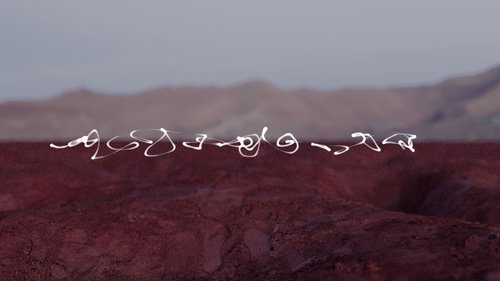
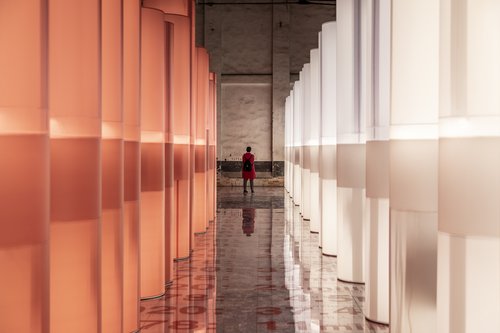
Marina Abramović. Transforming Energy. Exhibition view. Venice, 2026. Gallerie dell’Accademia. Photo by Matteo de Fina. Courtesy of TAEX
Marina Abramović has made history as the first living female artist to receive a major solo exhibition at the Gallerie dell’ Accademia in Venice where she invites the visitors to fully surrender to her immersive world of energy and ritual.
Situated within the former Academy of Venice, perhaps an unlikely setting for ‘Transforming Energy’, visitors encounter a bold intervention unlike anything previously staged within these hallowed walls. Here unfolds an almost religious multimedia experience: the immersive world of performance artist Marina Abramović (b. 1946).
As the crowd parted following the press conference prior to the official opening this May, the artist, accompanied by curator Shai Baitel and Giulio Manieri Elia, director of the Accedemia, entered the hall on the first floor, sitting right in front the of Paolo Veronese’s ‘The Feast of the House of Levi’, a work of art famous for bringing Veronese to the Tribunal of the Venetian Holy Inquisition. Once perceived as a heretic in her own right, Marina Abramović’s celebratory presence in the esteemed institution has marked a major milestone – she has become the first living female artist to be given a big solo exhibition at the museum. It is no small feat – to create a space for the intangible practice of performance in rooms which favour archival predictability.

Marina Abramović. Transforming Energy. Exhibition view. Venice, 2026. Gallerie dell’Accademia. Photo by Matteo de Fina. Courtesy of TAEX

Marina Abramović. Transforming Energy. Exhibition view. Venice, 2026. Gallerie dell’Accademia. Photo by Matteo de Fina. Courtesy of TAEX

Marina Abramović. Transforming Energy. Exhibition view. Venice, 2026. Gallerie dell’Accademia. Photo by Matteo de Fina. Courtesy of TAEX
‘Transforming Energy’ is built around a familiar Abramović proposition: the public is called upon no only to look, but to submit. Here, guided by a team of mediators in white lab coats visitors are asked to follow a ritual of deceleration: they are asked to switch off their phones, to wear noise-cancelling headphones and slow down as much as possible. The goal here lies somewhere between inquiry, immersion, and introspection and the conductor – a series of crystal-embedded sculptures called ‘Transitory Objects’. What Abramović achieves is a performance made of half ritual and half discipline in which the audience is gently coerced into becoming the medium itself.
Wandering through this dimly-lit space, the audience-turned-performers lean on the quartz ‘cushions’ with their eyes closed, letting the stone warm up before passing it on to the next person. There is an exchange of energy everywhere. Time moves slowly, measured by a 14-second metronome as a homage to John Cage. It is, essentially a limbo of perception. Here, it is important to remember that Marina Abramović is the artist of both the moment and the aftermath, hence, clarity is secondary to the experience. Self-awareness, however, is a must.

Marina Abramović. Transforming Energy. Exhibition view. Venice, 2026. Gallerie dell’Accademia. Photo by Matteo de Fina. Courtesy of TAEX

Marina Abramović. Transforming Energy. Exhibition view. Venice, 2026. Gallerie dell’Accademia. Photo by Matteo de Fina. Courtesy of TAEX

Marina Abramović. Transforming Energy. Exhibition view. Venice, 2026. Gallerie dell’Accademia. Photo by Matteo de Fina. Courtesy of TAEX
Beyond this crystal playground, the exhibition pays homage to both the past and the future of Abramović’s practice. ‘Balkan Baroque’, which won her the Golden Lion at Venice in 1997, is referenced here in a neat pile bones assembled in front of a 3-channel video. Marina Abramović’s latest project – a digital avatar powered by TAEX – performs alongside the public on five smaller screens and a single immersive projection titled ‘Slow Walking’, marks the artist's transition into digital immortality.
TAEX, a London-based platform for media arts, has been working with Abramović on the project for over a year, premiering the first iteration of the avatar at the exhibition’s debut in Shanghai. Since then, the digital twin underwent a transformation of its own, shaped by the artist’s desire to create not just a copy of herself, but a virtual entity that lives, performs, and guides the audiences on the path of the Abramović Method. It is not just a character, but a spiritual guide for our digital age.


Spread out across the historic spaces of the Gallerie dell’Accademia the installations do not exist in protest but in succession to the classical paintings and sculptures. It would be unfair to call it a dialogue and although I doubt that Abramović and Titian or Giordano would find common ground in a conversation, their works perhaps reside in the same dialectical frequency. They do not argue with each other or fight for attention, they naturally coexist, as if they were always meant to be in the same room. A Titian and an Abramović engage different modes of perception that do not cross paths. The first one needs historical background, technical knowledge and prolonged studies, the other simply requires submission, dedication, and departure. Marked by this contrast, ‘Transforming Energy’ reveals the evolution of art viewership in a truly performative, experiential way.
Speaking of change, Marina Abramović’s art has not always been so introspective and calm. She has gained wide recognition for her performances that bridge provocation, self-harm, and symbolism, like ‘Rhythm 0’. Today at 79, Abramović is more interested in slower, more complex acts, performed by either the public or her avatar. This distance seems deliberate, a step away from the focus on the performer which opens a door (sometimes literally) to an experience both collective and deeply personal.

Marina Abramović. Transforming Energy. Exhibition view. Venice, 2026. Gallerie dell’Accademia. Photo by Matteo de Fina. Courtesy of TAEX

Marina Abramović. Transforming Energy. Exhibition view. Venice, 2026. Gallerie dell’Accademia. Photo by Matteo de Fina. Courtesy of TAEX

Marina Abramović. Transforming Energy. Exhibition view. Venice, 2026. Gallerie dell’Accademia. Photo by Matteo de Fina. Courtesy of TAEX
With this shift, Abramović’s work arrives at its most institutional moment since her exhibition at the London’s Royal Academy in 2023. For the majority of artists, this marks the time of recognition, reflection, and art on fridge magnets. For her it is a time of experimentation and disruption.
It is important to note that ‘Transforming Energy’ is not a retrospective, even though the usual suspects are there – a historical timeline, archival photographs, and a 2-kilogram catalogue. It is a celebration of the art that endures and of the artist who dares. On the eve of her 80th birthday this November, Abramović is far from making any sort of conclusions.

Marina Abramović. Transforming Energy. Exhibition view. Venice, 2026. Gallerie dell’Accademia. Photo by Matteo de Fina. Courtesy of TAEX

Marina Abramović. Transforming Energy. Exhibition view. Venice, 2026. Gallerie dell’Accademia. Photo by Matteo de Fina. Courtesy of TAEX

Marina Abramović. Transforming Energy. Exhibition view. Venice, 2026. Gallerie dell’Accademia. Photo by Matteo de Fina. Courtesy of TAEX

Marina Abramović. Transforming Energy. Exhibition view. Venice, 2026. Gallerie dell’Accademia. Photo by Matteo de Fina. Courtesy of TAEX
Surrounded by the ghosts of Venetian art history, Marina Abramović stages a counterproposition of value. Speaking the language of crystals, energy and purification, she proposes an experience of art that is rich by means of deprivation, both sensory and conceptual. An antidote to the overstimulating and scandalous 2026 Venice Biennale, ‘Transforming Energy’ offers refuge from the ouroboros of blatant political critique. In turn, it invites us to face ourselves: our energy, thoughts, compulsions, need to take social media pictures. Of course this show will not transform every visitor into a Zen master. But its importance lies in the collision it creates - between object and experience, between distraction and meditation, between perseverance and surrender.