

Venice Biennale: A Minor Key and Political Dissonance

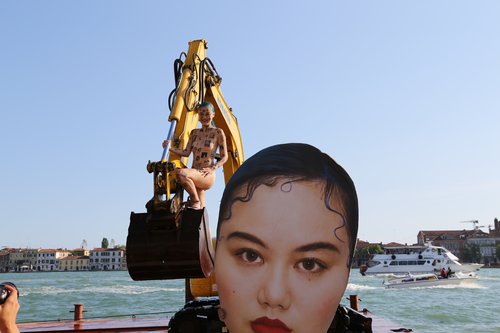
Carolina Caycedo. Ñañay Kculli ~ S’oam Bawi Wenag ~ Kiik K’úum, 2024. 61st International Art Exhibition – La Biennale di Venezia, In Minor Keys. Photo by Luca Zambelli Bais. Courtesy of La Biennale di Venezia
Long before the opening of the 61st Venice Biennale, cancel culture has been attempting to drown out artistic culture. The heated controversies surrounding the national pavilions sound as a counterpoint to the meditative main exhibition.
The opening of the 61st Venice Biennale this week is exactly one year after the tragic passing of Koyo Kouoh, who had been appointed curator of the main exhibition and proposed the theme ‘In Minor Keys.’ The team assembled by Kouoh have endeavoured to realise her concept faithfully, without straying from the ‘score’. The concept itself was born poetically – during discussions held in the shade of a mango tree. According to members of the curatorial team, whenever someone mentioned the name of a particular artist, fruit would fall from the tree – and if it didn’t, everyone would wait in hushed anticipation.

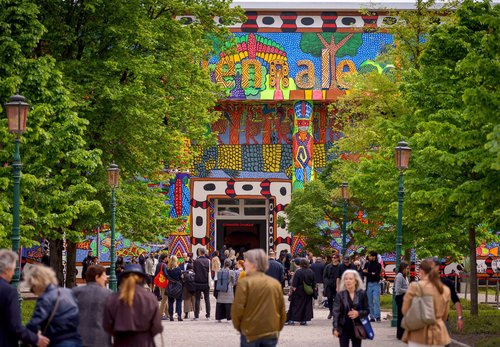
Ranti Bam. Ifa Ile Oja, 2025–2026. 61st International Art Exhibition – La Biennale di Venezia, In Minor Keys. Photo by Marco Zorzanello. Coursesy of La Biennale di Venezia

Ayrson Heráclito. Juntó, 2023–2025. 61st International Art Exhibition – La Biennale di Venezia, In Minor Keys. Photo by Marco Zorzanello. Coursesy of La Biennale di Venezia
The main exhibition centres on quiet, meditative, humanistic art intended to sustain and heal the soul. Most of the artists, like Kouoh herself (the first woman from the African continent to hold the position of curator of the Venice Biennale), hail from the cradle of humanity. Among the principal motifs of the show are shrines, ritual processions, schools, magic, and spiritual repose. The transitions between sections, conceived by London-based Wolff Architects, will be marked by broad indigo-coloured banners. The soothing deep blue is intended to create pauses in the visitor’s journey, allowing them to attune to a new register of perception before encountering the next body of work. Separate rest areas have also been provided, arranged in the tradition of Creole gardens. The curators drew literary inspiration from Toni Morrison’s ‘Beloved’ and Gabriel García Márquez’s ‘One Hundred Years of Solitude’.

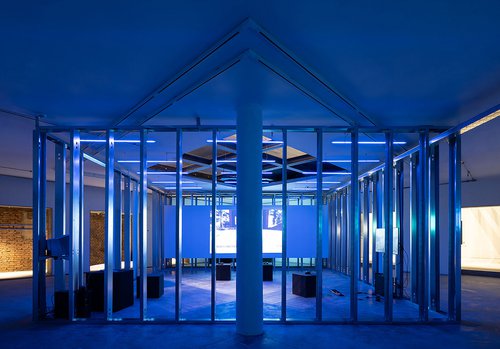
Alfredo Jaar. The End of the World, 2023–2024. 61st International Art Exhibition – La Biennale di Venezia, In Minor Keys. Photo by Luca Zambelli Bais. Courtesy of La Biennale di Venezia

Senzeni Marasela. Installation with various works. 61st International Art Exhibition – La Biennale di Venezia, In Minor Keys. Photo by Luca Zambelli Bais. Coursesy of La Biennale di Venezia
Yet the magical realism of the main exhibition has, even before the opening, collided with a political reality that has generated controversy around the national pavilions in the Giardini gardens producing a curious, and entirely predictable, counterpoint. On one side stands Kouoh’s project with its rejection of “orchestral pomp and military marches in favour of minor keys that come alive in low frequencies, in hum and in poetry.” On the other: the clamour of protest.
That the national pavilions are an anachronism has long been commonplace in discussions about the Biennale, which is why, year after year, the pavilions serve as the principal arena for institutional critique and self-critique. Participating countries frequently use their spaces to atone for the sins of colonial ambition – or to take potshots at their neighbours in the geopolitical sandpit. And wandering from pavilion to pavilion, one may very well stumble upon a protest.

Pavilion of Russia. The tree is rooted in the sky. 61st International Art Exhibition – La Biennale di Venezia, In Minor Keys. Photo by Andrea Avezzù. Coursesy of La Biennale di Venezia

Pavilion of Russia. The tree is rooted in the sky. 61st International Art Exhibition – La Biennale di Venezia, In Minor Keys. Photo by Andrea Avezzù. Coursesy of La Biennale di Venezia
It required little foresight to predict that this year genuine passions will flare around the Russian pavilion. Russia has skipped participation in the Biennale twice - in 2022 and 2024 (the first time the pavilion was closed; the second, it was given over to Bolivia and other Latin American countries) – and now presents a project titled ‘A Tree Rooted in the Sky’. Between 5 and 8 May, during the press and art industry preview, the Russian pavilion’s team presented a series of musical and poetic performances. Once the Biennale opens to the general public, however, only recordings of these performances will remain, broadcast from within the closed building. It appears that visitors will be able to see or hear something only through the windows.
On one level, this approach can be read as a tentative foray – a scenario calculated not to cause undue provocation. On another, the format of ‘limited participation’ allows the event to remain within the bounds of EU sanctions. (As the Milanese online publication ‘Open’ reports, EU regulations prohibit any form of direct collaboration with Russian state structures, and participation by Russia in the Biennale in the traditional format – which requires hiring contractors and other local-level support – is therefore now complicated.)

Be that as it may, avoiding fierce controversy proved impossible. The punk group Pussy Riot (designated extremist and banned in Russia) and a number of Ukrainian political and cultural figures came out against Russia’s participation. The European Commission made good on its threat and withdrew a €2 million grant to the Biennale – funds intended for educational programmes and film production – on account of Russia having been permitted to open its pavilion. The Biennale’s organisers, for their part, maintain that “any form of censorship” is unacceptable to them. Venice’s Mayor Luigi Brugnaro likewise underscored that his city “practises diplomacy and openness.”
The site ‘Open’ recently published the contents of emails exchanged since last summer between Biennale president Pietrangelo Buttafuoco, its director-general Andrea Del Mercato, and Russian pavilion commissioner Anastasia Karneeva. The correspondence reveals that the parties were jointly deliberating on a strategy that would allow Russia to participate without breaching any EU sanctions – which did not prevent certain outlets from presenting matters in precisely the opposite light, as an attempt to circumvent the sanctions. The Biennale’s press office stated that those responsible for the leak had “overstepped the bounds of institutional ethics and common standards of decency.”

Mikhail Shvydkoy, the Russian president’s special envoy for international cultural cooperation, remarked to ARTnews: “In our project, eternity prevails over immediate concerns, and culture prevails over politics.” Ukraine’s Ministry of Culture, meanwhile, accused the Kremlin of “using culture as an instrument of political influence.”
From the perspective of artists and theorists who have spent decades debating the difference between “making political art” and “making art politically,” matters are considerably more complex. Such discussions invariably arrive at the conclusion that any artistic statement is political – even one that aspires to be neutral, quiet, or meditative. The Biennale creates the conditions for a volatile cocktail of competing “politics”: the politics of institutions, which may permit or prohibit; the politics of artistic form (radical or traditional); and geopolitics with its dramatic backdrop. To pass categorical judgements in such a situation is to engage in hopeless oversimplification.
Russia’s presence in the Giardini is not the only subject of controversy – calls to “cancel” the Israeli pavilion have also been voiced. Around 200 artists and curators participating in the Biennale signed an open letter demanding precisely this, in solidarity with the Palestinian people. Italy’s Minister of Culture Alessandro Giuli recently announced that he will not attend the Biennale’s opening ceremony. He also initiated a search of the Biennale’s headquarters to examine financial records and other documents relating to the Russian, Israeli, and Iranian pavilions.

Pavilion of Israel. Rose of Nothingness. 61st International Art Exhibition – La Biennale di Venezia, In Minor Keys. Photo by Luca Zambelli Bais. Coursesy of La Biennale di Venezia

Pavilion of Israel. Rose of Nothingness. 61st International Art Exhibition – La Biennale di Venezia, In Minor Keys. Photo by Luca Zambelli Bais. Coursesy of La Biennale di Venezia
Cancel culture has touched other national pavilions as well. One of the most widely covered cases concerns the artist Khaled Sabsabi (b. 1965), who was selected to represent Australia, then removed (after an old work of his was found to contain a speech by Hassan Nasrallah, the late leader of Hezbollah), and subsequently reinstated following a wave of public outcry. South Africa went so far as to censor its own pavilion. The country was to be represented by artist Gabrielle Goliath (b. 1983) with the project ‘Elegy,’ dedicated to Palestinian poet Hiba Abu Nada, who was killed in an airstrike in October 2023 – however, South Africa’s Minister of Sport, Arts and Culture Gayton McKenzie deemed the work “deeply controversial” and vetoed its presentation. The artist’s attempt to challenge the decision in court was unsuccessful. The South African pavilion will remain closed, and Goliath will present ‘Elegy’ at the Venetian church of Sant'Antonin.

Pavilion of Grand Duchy of Luxembourg. La merde. 61st International Art Exhibition – La Biennale di Venezia, In Minor Keys. Photo by Marco Zorzanello. Coursesy of La Biennale di Venezia

Pavilion of Grand Duchy of Luxembourg. La merde. 61st International Art Exhibition – La Biennale di Venezia, In Minor Keys. Photo by Marco Zorzanello. Coursesy of La Biennale di Venezia

Pavilion of Grand Duchy of Luxembourg. La merde. 61st International Art Exhibition – La Biennale di Venezia, In Minor Keys. Photo by Marco Zorzanello. Coursesy of La Biennale di Venezia
Luxembourg’s Minister of Culture Eric Thill, by contrast, took a stand for absolute artistic freedom and defended artist Aline Bouvy (b. 1974) from criticism. She will present a video installation whose principal character is an anthropomorphic piece of excrement – a prospect that not all Luxembourgish politicians have greeted with enthusiasm. Denmark’s pavilion also looks set to be among the most controversial: Maja Malou Lyse’s (b. 1993) project treads the line between science fiction and pornography.

As for the parallel programme, the most eagerly anticipated events promise to be the solo exhibition of performance art legend Marina Abramović (b. 1945) at the Gallerie dell’Accademia (she is the first living female artist to be honoured with a show at this institution in its 250-year history), a presentation of Anish Kapoor’s most ambitious projects – both realised and unrealised – in Cannaregio, and a retrospective of South Korean minimalist Lee Ufan (b. 1936) at the Centro d’Arte San Marco.
This article was first published in Russian in the April 2026 issue of The Art Newspaper Russia. The updated version was posted on The Art Newspaper Russia’s website on 30 April 2026.