

Cartoons Against Modern Art: Yuri Albert’s Collection on view at MOMUS

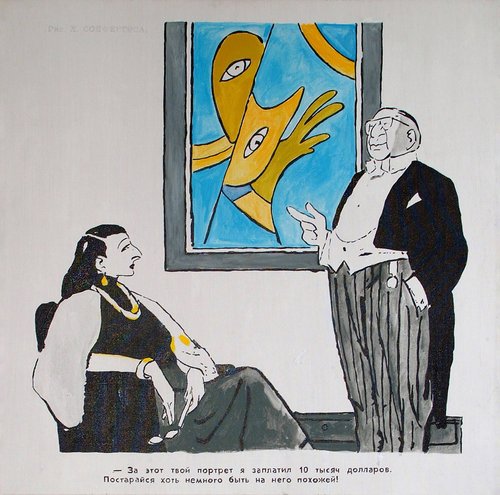
Mark Veisbord. Look how the artist managed to capture the resemblance between me and my son Jack!, 1950 (‘Krokodil’ magazine, No 29, 1950). Courtesy of Yuri Albert and Museum of Modern Art (MOMUS)
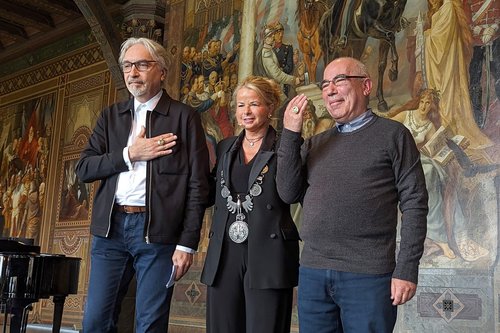
Soviet-era caricatures mocking modernist art were conceived as instruments of state propaganda. Yet, paradoxically, behind the Iron Curtain they also became some of the only images through which many people encountered the very works they were intended to discredit. A selection of thirty such caricatures from Yuri Albert’s collection is now on display at the MOMUS in Thessaloniki. For Alexander Rytov, director of the Stella Art Foundation in Moscow, attending the exhibition’s opening was like stepping back into a world he thought had long since disappeared.
Born in Moscow and now based in Cologne, artist Yuri Albert (b. 1959) presents at MOMUS not an exhibition of his own works, but a remarkable collection that offers far more than a journey into a distant era, when caricature played a central role in shaping and interpreting public reality. Albert’s collection invites a dialogue with the complexities of the present while offering a lens through which to glimpse the future. Soviet-era caricature sought to explain, ridicule and domesticate ideas perceived as alien or threatening, exposing, often inadvertently, the contradictions and failures of the socialist system in politics, economics and everyday life. At the same time, these images have themselves become invaluable historical documents, providing a unique means of exploring both the ideological battles fought through art and the broader mechanisms of authoritarianism in the Soviet Union.

In 2008, in Thessaloniki, our foundation – Stella Art – took part in the ‘Kodra’ youth festival of contemporary art, presenting audiences with an exhibition of political caricatures by Vagrich Bakhchanyan (1938–2009), accompanied by a poetry performance by the poets Evgeny Nikitin and Vasilis Amanatidis. The project was warmly received by the Thessaloniki art community and the guests of Kodra. The festival was held on the grounds of a long-closed NATO base. At that time, Bakhchanyan’s anti-Western caricatures seemed to embody a past that everyone thought had gone forever. The performance was attended by Roger Buergel and Ruth Noack, the curators of Documenta 12 in Kassel in 2007. It was they who later recommended Daniel Birnbaum to include this poetry performance in the central programme of the 53rd Venice Biennale. So, in 2008, Vagrich Bakhchanyan’s works seemed like a myth or a memory, an attempt to restate once more that the era of great enmity was in the past. Yet history once again has shown us all that monsters thought long buried have a way of returning. And those who were enemies a hundred years ago are once again settling back into the old trenches.

This is precisely why the current exhibition of caricatures, drawn from Yuri Albert’s collection, carries little sense of nostalgia or historical distance. It unfolds at a moment of profound geopolitical crisis, marked by some of the most dangerous international tensions in decades. At the same time, Russia has moved so far beyond the ideological and political paradigms of the Soviet Union that the figures inhabiting these caricatures can explain only a limited part of its actual history. A capitalist, assertive and nuclear power bears little resemblance to the Soviet state with its gerontocratic leadership, economic stagnation and ideological exhaustion. In this context, the satirical narratives of the late Soviet period can easily lead us down a false path, tempting us to draw direct parallels where they no longer apply. Yet they also contain a more enduring insight: beneath changing political systems, certain mechanisms of power, human behaviour and historical recurrence remain strikingly constant.
The caricatures targeting Modernism represent, in Albert’s view, an attempt to connect the tradition of Soviet caricature with a broader postmodern sensibility. Like Socialist Realism itself, Soviet caricature came to be dismissed as kitsch, burdened by its historical associations and overshadowed by the avant-garde, Conceptualism and other artistic movements that challenged Communist ideology. While these movements were suppressed by the Soviet authorities, they were recognised and celebrated throughout the wider art world. Yet such a view also oversimplifies history. Many leading exponents of Socialist Realism – including Gely Korzhev (1925–2012), Aleksandr Deineka (1899–1969) and Kuzma Petrov-Vodkin (1878–1939) – remain among the outstanding painters and thinkers of Russian art. The paths of artistic talent and creative insight are neither singular nor linear. Caricature, too, occupies an important place within this landscape. Rooted in irony and satire, it exposes and ridicules both social and individual failings, making it an unexpectedly natural precursor – and ultimately a comfortable fit – for the language of Conceptual art.

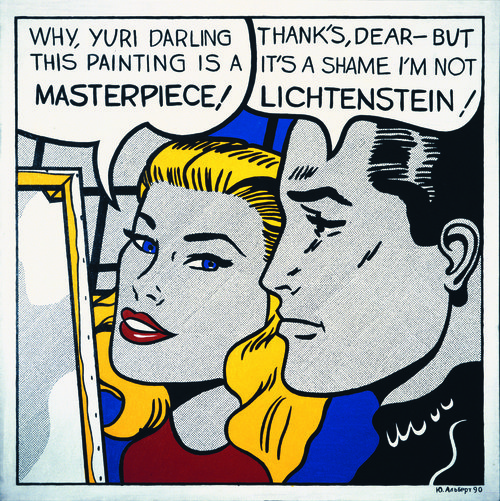
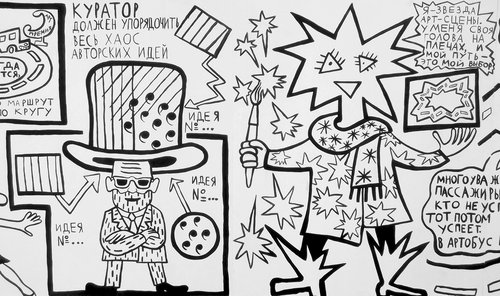
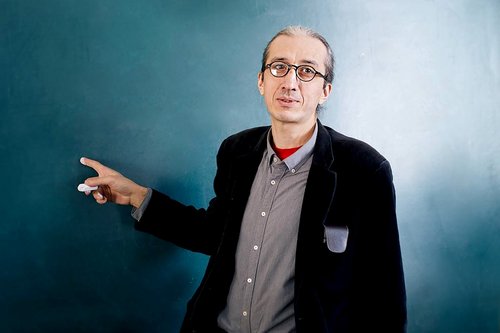
Yuri Albert explained how this remarkable collection came into being and why it was chosen for exhibition at MOMUS. He began collecting Soviet caricatures during the final years of perestroika, and from around 1992 he developed a related body of work based on the anti-Modernist caricatures he had encountered in his childhood. Enlarging these images and transferring them onto canvas, he reclaimed them as works of contemporary art, subjecting them to a distinctly Modernist transformation. It was only later that Albert discovered that some of the original caricatures could be acquired from the artists’ heirs – an opportunity he found irresistible. From the outset, however, he imposed a strict collecting principle, limiting the collection exclusively to caricatures devoted to art. As a result, it remains deliberately concise, comprising just thirty works.

Albert liked the fact that he could use them to create his own works. And later he understood that they were not merely supporting material. It is a small collection. “Soviet caricature is, in principle, a very ambivalent affair. On the one hand, it is clear that all these caricatures are part of a monstrous propaganda campaign against contemporary art – Modernist art as it then was. It is equally clear that all these caricaturists were accomplished and brilliant draughtsmen. At the same time, they participated not only in campaigns against art, but in all the persecutions, the vilification of cosmopolitans and other ‘enemies’ of the Soviet regime. In essence, they drew what they were told to draw,” says Albert.

On the other hand, these caricatures were, in the first place, very well drawn, because the majority of the artists who created them had trained either before the Revolution or at the Vkhutemas – such as the ‘Kukryniksy’ – a notorious trio of cartoonists. In a great stroke of irony, it is these very same caricatures that were one of the very few sources of information that Modern art existed at all behind the iron curtain.
There is also the question of the caricaturists themselves. Some may have retained traces of their formative years at Vkhutemas, but, in principle, they had little or no direct knowledge of the art they were commissioned to criticise. Instead, they were forced to reconstruct it from fragments of information, hearsay and official descriptions – essentially inventing the very artistic language they sought to ridicule. One example is Evgeny Shukayev (1932–1988), who depicted a painter creating an abstract composition with his feet. Shukayev had almost certainly never witnessed such a scene; he had merely heard stories about it and was tasked with condemning a phenomenon he scarcely understood. Paradoxically, this process resulted in a distinctly postmodern gesture, one that bears a striking affinity to Albert’s own artistic method. The crucial difference, of course, is that Albert's work is not driven by the anti-imperialist or anti-capitalist imperatives that shaped Soviet caricature. Yet the underlying strategy – the invention, construction and subsequent deconstruction of competing artistic models – remains remarkably close to his own practice.

Talking of his creative practice Albert says: “It seems to me that my works, like art itself, should bring something good to people. When I make a work, I give all my warmth to others. On the other hand, it is obvious that this warmth simply disappears into the void... We all generate warmth, of course, but people cannot receive it – it dissolves. And these caricatures, strangely enough, are constructed in exactly the same way. Even though the artists themselves, of course, did not invest any such meaning into the real content of their creations.”

For Yuri Albert, the fact that the exhibition is being held at MOMUS, home to the renowned Costakis Collection, is especially meaningful. Running alongside his project is an exhibition devoted to the collection of Yakov Rubinstein (1900–1983). Both Costakis and Rubinstein dedicated themselves to collecting the work of artists who had been persecuted, marginalised and suppressed by the Soviet authorities, preserving what the state sought to erase from history. Albert, by contrast, presents a collection of the very caricatures that served as one of the state's weapons against that art. It is this extraordinary historical reversal that makes the setting so compelling. As Albert reflects: “And here I am, showing a collection of caricatures – essentially one of the instruments the state used to combat the very art that Costakis and Rubinstein were collecting. That is precisely why the choice of this museum strikes me as ideal.”
Caricaturing Modernism: Soviet Cartoons on Art from the collection of Yuri Albert
Museum of Modern Art (MOMUS) – Costakis Collection
Thessaloniki, Greece
20 June 2026 – 10 January 2027