

The Spinning Top: Dziga Vertov and the Kino-Eye Revolution

Photo from the ID card of Dziga Vertov, head of the photography and cinema section of literary and instructional trains. February 1921. Private collection. Courtesy of Zotov Centre
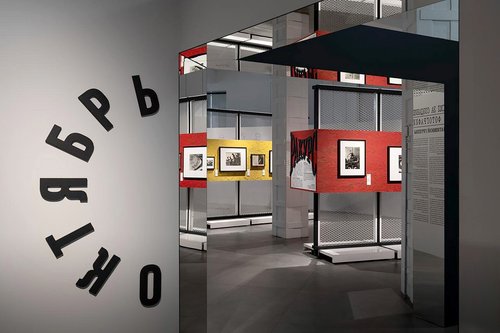
The Zotov Centre in Moscow, which specialises in Soviet art of the 1920s, has opened an exhibition entitled ‘Dziga Vertov. Kino-Eye’, marking the 130th anniversary of the avant-garde director whose films had a profound influence on international video art. Visitors can explore archival photographs, watch film excerpts, and listen to recordings of texts by one of the most important directors of his era. Film historian Maxim Semyonov reflects on Vertov and the cultural context that shaped him.
The exhibition, curated by Polina Streltsova, Polina Pribytkova and Konstantin Dudakov-Kashuro, is conceived as an immersive attraction. Alongside the standard photographs, film excerpts and documents, visitors can listen to texts written by Dziga Vertov (1896–1954) and see his photographs animated through artificial intelligence. At an editing table, they can explore the principles of montage, and they can also film a short clip on a smartphone using prompts from a bot developed specifically for the exhibition. All of this is lively, vivid and engaging; all of it will appeal to anyone who decides to visit the show, which runs until 26 July; and all of it reflects the ideas of Dziga Vertov, now arguably the best-known Soviet film director of the 1920s.

And yet the 1920s produced a remarkable number of major figures in Soviet cinema. It is enough simply to begin naming them: Sergei Eisenstein (1898–1948), Lev Kuleshov (1899–1970), Vsevolod Pudovkin (1893–1953), Alexander Dovzhenko (1894–1956), Yevgeny Chervyakov (1899–1942), Esfir Shub (1894–1959), Grigori Kozintsev (1905–1973), Leonid Trauberg (1902–1990), Abram Room (1894–1976), Boris Barnet (1902–1965), Friedrich Ermler (1898–1967), Olga Preobrazhenskaya (1881–1971), Vladimir Yerofeyev (1898–1940), Nikolai Shengelaia (1903–1943)… and the list could continue for quite some time. Yet today, for the most part, their films interest only historians and cinephiles. Such is often the fate of art: a work may endure the passage of time, but time, in the end, always prevails over the artist.

But this did not apply to Vertov, the creator of ‘Man with a Movie Camera’. In recent years, his reputation has eclipsed even that of Eisenstein. To see this, one need only consult ‘Sight & Sound’, which publishes its list of the greatest films of all time once every decade. All the more remarkable, then, that by the end of his life — Vertov died in the winter of 1954 – he could, with complete justification, have considered himself a failure. Mortally ill, reduced to editing newsreels, denounced as a “bourgeois formalist” and a “cosmopolitan”, he watched while people he had known all his life received honours and built successful careers. His own films seemed like relics of a long-abandoned past. Whereas Eisenstein’s ‘Battleship Potemkin’ or Pudovkin’s ‘Mother’ could be comfortably absorbed into the history of Stalinist Soviet cinema as early monuments to heroic revolutionary struggle, ‘Man with a Movie Camera’ – that strange documentary symphony of urban life in the 1920s – remained tonally incompatible with the ordered world of the late dictatorship, and with the way that dictatorship sought to represent both itself and the reality around it. Vertov could not know that it was precisely in those final years that European audiences were beginning to rediscover his films. In any case, before that bleak finale, an entire life had been lived.

Vertov’s biography is at once typical of a Soviet cultural figure of his generation and highly distinctive. He was born in the winter of 1896 in Białystok, into an educated Jewish family. The parents of David Kaufman, as he was named at birth, were Abel Kaufman, a bookseller, and Feiga Halpern, the daughter of a local rabbi. Two more sons were later born into the family: Moisei (later Mikhail) Kaufman (1897–1980) and Borukh (Boris) Kaufman (1906–1980), both of whom would become celebrated cameramen. Mikhail shot Vertov’s films and later directed independently the film In Spring, another masterpiece of the cinematic avant-garde, while Boris, the youngest brother, remained with his parents in Białystok – which in 1918 became part of the restored Polish state – before moving to France, where he worked with Jean Vigo (1905–1934), and then emigrating to the United States during the Second World War. In 1953, Boris won the Academy Award for On the Waterfront, starring the young Marlon Brando. But all that still lay ahead.

For the moment, the brothers were attending school, following events in the vast empire through the newspapers, discussing the latest news – for example, the Beilis affair, the sensational trial of the Kiev Jew Menachem Beilis, accused of the ritual murder of a Christian boy, a subject on which the future director would write an indignant poem – and dreaming of the future. David Kaufman was passionate about music, above all the compositions of Alexander Scriabin (1872–1915), inventor of “colour music”, and he also wrote rather feeble verses in imitation of Russian modernist poetry, especially Futurism. Before the Revolution, he found himself in St Petersburg, where he enrolled at the Psychoneurological Institute, one of the few places in the empire where a young Jewish man could gain admission with relative ease. It was probably during these same years that his pseudonym emerged – the name under which Kaufman would enter history. Dziga means a spinning top in Ukrainian; Vertov derives from the Russian verb vertet’, “to spin” or “to turn”. Together, the two suggest something nimble, cheerful, swift and elusive.

A century on, the Revolution in Russia appears as a vast historical catastrophe. Over the past twenty or thirty years, innumerable books have been written and films made about it: deranged revolutionaries seize power, culture and everyday life are destroyed, good people suffer, and bad ones prevail. Perhaps that is indeed how it was. But for the multitude of young people who had barely reached the age of twenty, the Revolution offered the chance to alter their fate completely. It was a tempting opportunity to reject the lot assigned by parents, background and the established social order, and to become someone else. To reinvent oneself, grasping whatever chances arose and relying on nothing but one’s own luck.

This is especially evident in the history of Soviet cinema in the 1920s. Almost all the leading directors of the period came to film more or less by accident. Eisenstein, for example, whom his parents had imagined as a respectable architect, managed to study Japanese translation and work in experimental theatre before finding himself on the set of his first film. Vertov was no exception. In 1918, quite by chance, he ran into his former schoolmate Moisei Fridlyand in Moscow. Fridlyand would go down in the history of Soviet journalism as Mikhail Koltsov, becoming one of the chief satirists of the Stalinist era; he would travel to Spain to report on the Civil War, only to be shot in Moscow in 1940. But at that moment Koltsov offered Vertov a job as a clerk at the newly established Moscow Cinema Committee, an organisation responsible for the production and distribution of newsreels and agitational films.

It is difficult for us to imagine that strange moment. Russian cinema before 1917 differed little from the broader European cinema of its day. Femme fatales suffered the torments of love. Society villains seduced pretty young women. The ghosts of dead lovers returned from beyond the grave to claim their would-be brides. Some characters shot themselves; others went mad. The mark of a good film was almost always an unhappy ending. Blood, love and decadence. And then, suddenly, none of it remained.
For the most part, well-known directors, producers and film stars abandoned the troubled capitals and fled south towards the sea, where the troops of the White Army – and the prospect of emigration – awaited them. The studios stood empty. An era of experimentation began. A handful of enthusiasts, among them Lev Kuleshov, debated the achievements of David Wark Griffith (1875–1948), the great American director who had perfected the technique of montage and helped transform cinema into an art form. It was montage, above all, that enabled Griffith to make what was perhaps his most celebrated film, ‘Intolerance’ – a work that wove together stories from different historical epochs into a single structure. Not all contemporaries understood Griffith’s innovations, but his cinema made an enormous impression on Kuleshov and his circle.

Reflecting on the possibilities of montage, Kuleshov formulated his celebrated “effect”, whose essence may be conveyed roughly as follows: the combination of two independent shots produces a new, third meaning. The viewer’s perception itself creates the connection between them. This discovery would underpin all the experiments of the Soviet montage school. By assembling fragments of the surrounding world, Soviet directors sought to act upon the feelings and minds of their audience, revealing the true structure of reality – naturally, from a Marxist point of view – and compelling viewers to think “dialectically”. One of the clearest examples of such montage can be found in Eisenstein’s October. There, in depicting counter-revolutionary troops advancing on revolutionary Petrograd, Eisenstein inserts the slogan “For Faith, for the Fatherland”, followed by a sequence of traditional religious images familiar to his audience: images of Christ giving way to a mosque, a Buddha and a multitude of deities drawn from ethnographic collections. In this way, the imagery deflates the pathos of the resounding slogan, though many viewers in the 1920s may well have experienced the sequence as little more than a chain of random and barely intelligible images.

All of this was taking place in narrative cinema, but analogous processes were also beginning in documentary film. At the same time as Kuleshov, Vertov was reflecting on the possibilities of cinema. He experimented with montage and sought to understand the capacities of the camera. There is a well-known story of the director jumping from the roof of a small grotto in the garden of the mansion occupied by the Cinema Committee – on that very site now stands the Russian Ministry of Culture. Those around him saw it as an odd and eccentric act, but in fact Vertov simply wanted to test the possibilities of slow-motion cinematography: the jump was being filmed by his brother Mikhail.

In 1918, long before the masterpieces of the Soviet cinematic avant-garde, Vertov made his first landmark film, ‘Anniversary of the Revolution’. Strictly speaking, however, ‘Anniversary of the Revolution’ is not quite a Vertov film in the usual sense. It is a fairly long documentary composed of numerous newsreel sequences shot by different cameramen between February 1917 and the autumn of 1918. Vertov merely selected footage recording all the principal events of the period and assembled it into a large-scale chronicle. The resulting film was intended to show the inhabitants of Bolshevik-controlled territories the main events of the Revolution: unrest in Petrograd and Moscow, changes in the countryside, and the successes of the new authorities on the fronts of the Russian Civil War. Lenin, Trotsky, and the much less prominent Stalin also appeared on screen – ironically, it is precisely those particular frames that have not survived – giving viewers the chance to see the leaders of the new society with their own eyes. This may not sound especially thrilling today, but the possibility of uniting documentary footage of disparate events into a single narrative impressed Vertov no less than Griffith’s films had impressed Lev Kuleshov.

After its screenings, ‘Anniversary of the Revolution’ was broken back down into the separate parts from which it had been assembled, and for many years the film was considered lost. The situation changed only in 2017, when the historian Svetlana Ishevskaya discovered in the archives a poster containing a complete list of the episodes included in the film. That discovery enabled Nikolai Izvolov, a noted specialist in Soviet cinema, to restore the picture to something close to its original form.
Today, ‘Anniversary of the Revolution’ is likely to interest specialists more than a general audience, but it was precisely this film that made Vertov a director. His next film, ‘History of the Civil War’, reflects his characteristic style more clearly. Alongside fairly conventional newsreel footage, Vertov used strange and expressive shots capable of startling or amusing the viewer. In one episode, for instance, we see armed soldiers running towards windmills. This fondness for observing curious vignettes of everyday life would reappear in many of Vertov’s films.

By the early 1920s, a small collective of like-minded individuals had formed around Vertov; they became known as the “Kinoks”, from “kino-oko” – that is, “Kino-Eye”. In the spirit of the times, they proclaimed the victory of the “electric eye” over the real eye. For our real eyes see only what surrounds us, whilst the “eyes of technology”, consisting of camera lenses armed with all the possibilities of montage, perceive bold new worlds of the future – and, moreover, themselves create images of a new reality.
Like other film collectives that emerged in those turbulent years, the Kinoks were fascinated by the new possibilities of cinema. But whereas others – for example, the circles that formed around Kuleshov, Eisenstein, or Kozintsev and Trauberg – reflected on the future of narrative film, which they believed needed to be purged of alien and unnecessary accretions, Vertov’s collective proclaimed the death of narrative cinema altogether. The future, they insisted, lay in the filming of real life; everything else was merely a residue of theatre and literature, remnants of the old world that had accidentally adhered to a young art form. Such a view may now seem naïve, since history has shown that narrative cinema was by no means doomed, but in the 1920s this was not yet self-evident.

Moreover, people of the most varied kinds were reflecting on the true nature of cinema. Mayakovsky, for instance, one of the greatest poets of Russian modernism, declared that cinema was ailing. The cause of its illness, he argued, was that capitalism had sealed its eyes with gold, whereas the new medium demanded new forms capable of sweeping away the established entertainment genres. In France, Louis Delluc (1890–1924) identified the “photogénie” of cinema – the peculiar expressiveness that the most diverse objects acquire on screen. The cine-camera was proclaimed a machine for poeticising reality. Meanwhile, representatives of the radical European avant-garde – among them Hans Richter (1888–1976), Viking Eggeling (1880–1925), Germaine Dulac (1882–1942), the Fischinger brothers, and others – experimented with “absolute film”, in effect a form of abstract animation. It was precisely in these years that the search for a new cinematic expressiveness took shape, a search that would later lead, in part, to the emergence of video art. In this context, Vertov and his colleagues, for all their commitment to filming reality, appear almost among the less radical.

An important source of inspiration for Vertov and his associates was the example of Lenin and the Bolshevik Party. A relatively small group had managed to seize power in an immense country, defeating parties far more popular than itself, and to launch its great experiment. Might something similar be possible in cinema? Might one seize the industry by storm and set it on a different, truly correct course? At the core of the collective that formed around Vertov were his wife, Elizaveta Svilova (1900–1975) – who today would be described as a film editor – along with the cameramen Mikhail Kaufman, Alexander Lemberg, Ivan Belyakov (1897–1967), and Ilya Kopalin (1900–1976). The last of these, many years after the dissolution of the Kinoks, would bring the USSR its first Academy Award with ‘The Defeat of the German Armies near Moscow’. The photographer Alexander Rodchenko (1891–1956) also collaborated closely with the group. Although the history of this collective has yet to be properly written, in recent years the film historian Kirill Goryachok has worked on it extensively. It should also be remembered that Elizaveta Svilova and Mikhail Kaufman, at the very least, stood behind the making of all Vertov’s major masterpieces.

Having begun with film journals – anthologies of short news items shown in cinemas, among which the celebrated ‘Kino-Pravda’ deserves pride of place – the Kinoks gradually moved on to feature-length films, which are chiefly what come to mind today when their work is discussed. Among these, ‘Kino-Eye, A Sixth Part of the World’, and, of course, ‘Man with a Movie Camera’ deserve particular mention. These three films seem the most representative. ‘Kino-Eye’ not only contrasts the “old” and the “new” life, setting drunken women against cheerful Young Pioneers, but also reveals Vertov’s fascination with the visually arresting. The film lingers, for instance, on a Chinese conjuror entertaining children in the streets of the city, and on patients with mental disorders walking in the courtyard of a specialist clinic – images that may strike a contemporary viewer as even more unsettling than the abattoir scene. ‘A Sixth Part of the World’ offers an example of poetic documentary filmmaking. Although the film is, at base, an advertisement for Gostorg, the organisation responsible for the export of Soviet goods abroad, Vertov and his collective transform this premise into a majestic epic about the Soviet Union and the multitude of peoples who inhabit it. The intertitles – the film’s explanatory captions – are particularly worthy of attention. Vertov composed them under the influence of Walt Whitman, and they remain one of the finest examples of his poetic writing.
Finally, ‘Man with a Movie Camera’ is one of the most extraordinary documentaries in the history of cinema. It was conceived as a demonstration of the absolute superiority of non-fiction film over fiction. Vertov sought to purge his masterpiece of everything he regarded as alien to cinema: it has no actors – with the partial exception of Mikhail Kaufman, who may, with some qualification, be called the film’s protagonist, the very “man with a movie camera” of the title – no script, and no coherent narrative that can be summarised. And yet the alternation of scenes of varying dynamism and intensity, the profusion of montage devices, and the ability to capture both the striking and the comic dimensions of everyday life continue to astonish even a century after the film’s release. Its innovations, however, did not impress contemporaries with quite the same force. Many were inclined to compare ‘Man with a Movie Camera’ with the “city symphonies” then in vogue, a genre whose principal representative was the German director Walter Ruttmann (1887–1941), maker of ‘Berlin: Symphony of a Great City’. Yet whereas the city symphonies recorded the rhythm of life in a particular city, ‘Man with a Movie Camera’ became a monument to urban modernity as such. It remains one of the finest and most lyrical portraits of the Roaring Twenties, and at the same time one of the most strikingly contemporary films to have come down to us from the silent era.

The Kinoks’ method rested on filming “life caught unawares” – that is, on following wherever the documentary material itself might lead. The logical consequence of this position was the ambition to make films without a preliminary script or any fixed budget. Even today, that sounds like a producer’s nightmare – let alone in Soviet cinema a century ago. And yet Vertov was convinced of the soundness of his method. ‘Man with a Movie Camera’, originally conceived as a cinematic manifesto, was shot in three cities – Moscow, Kyiv and Odessa – by no means through the authors’ own choosing. Vertov had been expelled from the Moscow film studio and forced to move to Kyiv, where he was able to continue filming. Moreover, in polemics with other filmmakers, he would sometimes accuse them of plagiarism, claiming that they were appropriating his discoveries and putting them to use in their own fiction films; Sergei Eisenstein was a particular object of his ire. The result was that by the end of the 1920s Vertov had acquired a reputation as a difficult and quarrelsome troublemaker, morbidly sensitive to the successes of others and inclined to suspect everyone of wanting, in one way or another, to diminish him. That reputation was, at least to some extent, not undeserved.
Meanwhile, the situation in the USSR and in the wider world was changing rapidly. The Great Depression shattered the Jazz Age; dictatorships were being established across Europe one after another; waves of bloody repression were sweeping through various countries, including the Soviet Union. If the 1920s had been a period of experimentation and relative freedom, the 1930s in Soviet cultural history are associated with the crushing of the avant-garde, the condemnation of “formalism” – that is, modernist art – and a turn towards forms more accessible to the mass audience. If the directors of the 1920s had dreamed of teaching their audiences to think dialectically, in the 1930s they were required instead to transmit the slogans devised by the leadership in its large, brightly lit offices. At least, that was how things were meant to work in theory.

Gradually, the guiding principle that Soviet artists were expected to follow became so-called “socialist realism” – an amorphous term denoting the union of an intelligible form, often imitating the outward features of “classical art”, with ideologically correct content, though the substance of the term could vary considerably at different stages of Soviet history. Avant-garde cinema found itself in a difficult position. On the one hand, its achievements generally left the ordinary viewer indifferent. The only real exception, perhaps, was Eisenstein’s ‘Battleship Potemkin’, which provoked a considerable response among Soviet audiences. Workers preferred comedies, melodramas and fast-paced American films; they had little desire to watch experimental cinema built on intricate montage and grotesque imagery. Peasants, often with very limited experience as cinema-goers, sometimes struggled to follow the plots even of relatively conventional films. On the other hand, whereas the other arts were compelled to draw on the experience of the nineteenth century, cinema was too young to possess any classical background of its own. Filmmakers were therefore forced to devise a new norm for themselves through further experimentation.
Then something occurred that, from the point of view of the theorists of the mid-1920s, seemed almost unthinkable: sound came to cinema, placing all the previous achievements of the montage school in jeopardy. To this must be added the strengthening of state control over film. In the 1930s, all major new releases were screened for Stalin, who responded actively to what he saw on screen – his role was not always purely destructive.
Vertov did attempt to take part in the creation of the new Soviet sound cinema of socialist realism, but it soon became clear that the language of his films was too vivid for that sombre age. The exemplary case is ‘Lullaby’. Dedicated to the happiness of Soviet women, to whom Soviet power had supposedly granted every conceivable right – while at the same time denying them the right to abortion – the film became a somewhat grotesque poem in which women from the most diverse social strata and national groups of the Soviet state all strive towards a single man: Joseph Stalin, who appears quite literally as the father of nations. Even Stalin himself found such adulation excessive, and ‘Lullaby’ was quickly shelved. There is no need to imagine that Vertov was trying to expose the mechanics of dictatorship. As a child of his time, he believed sincerely in both the Party and its leader. Yet the very language of his films proved revealing: avant-garde cinema had grown used to speaking of the masses, and it was ill-suited to speaking of a single individual in isolation.

The years that followed brought a gradual decline. The Vertov collective had long since dissolved, and he himself was once again reduced to working on newsreels. During the campaign against cosmopolitanism — in effect a large-scale state antisemitic campaign, launched almost immediately after the Second World War — Vertov became a natural target. He was reproached for having created nothing and trained no one. He appeared now as a pathetic old man living under an assumed name, in reality a Jew from the provinces. Vertov’s only consolation lay in writing poems and autobiographical notes, in which he tried to demonstrate his importance to the history of cinema. And it was precisely in those final, joyless years of his life that, in distant France, a retrospective of his films took place — a retrospective that would lay the foundations for his later fame.

What, then, can one say in conclusion? Fame is capricious and unjust, and posthumous success offers scant consolation to an artist living through the rupture of an epoch. That is true. But so is something else. A genuine attempt to create something new always leaves its mark on history. Vertov’s major films remain intelligible to audiences even without historical context; he was one of the creators of that new visual language which we continue to use to this day. Every time we film a reel on a smartphone, we are following in Vertov’s footsteps. Every time we edit a video built on the collision of shots, we become heirs to the Soviet cinematic avant-garde. Vertov would probably have been astonished by our ability to film life caught unawares anywhere and everywhere, though the achievements of narrative cinema would scarcely have inspired him with much enthusiasm.

At the Zotov Centre exhibition, among the many displays designed to entertain us or immerse us in the atmosphere of a vanished age, one stands out above all: a large chronological table linking Vertov and other cinematic experimenters, from the dawn of the medium to the present day. Yet that table is incomplete. In truth, there is room in it for each of us. For Vertov’s central idea – so easily lost amid reflections on montage and history – is ultimately this: the world around us is, above all, a profoundly interesting place. And it is worth filming. Any of us can do it. At any moment. Now.