

Painting in the Media Age: The Art of Post-Digital Storytelling

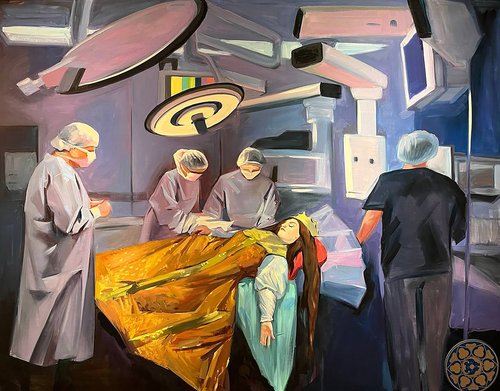
Elena Kovylina. The Chariot, 2022. Image from visit-city.art website. Courtesy of the artist
Many Russian artists from different generations use images from popular culture, such as comics, animated cartoons and sci-fi films, and weave them into complex compositions and convoluted narratives that often contain playful references to classics from the past. Is this an attempt to escape reality, a form of Aesopian language, or simply a game that has gone too far?
An exhibition by the late Aleksandra Badaksheyeva (1986–2024), titled ‘A Rabbit Hole in a Cherry Garden’ has opened at the municipal Park Gallery in Moscow. The playful title, which combines two literary classics – Lewis Carroll and Anton Chekhov – was coined by curator Olga Turchina. It aptly describes the artist’s work: Badaksheeva drew her greatest inspiration from literature, was a prolific book illustrator and effortlessly combined different literary influences to create a patchwork fairy-tale world that defies direct interpretation. Born in Buryatia, a region of Eastern Siberia in Russia close to the Mongolian border, Badaksheyeva trained at the Stroganov Academy in Moscow and later honed her skills at the Estonian Academy of Arts in Tallinn and the Muthesius University of Fine Arts and Design in Kiel, Germany. Sadly, she passed away prematurely, leaving a stellar creative journey from the depths of Asia to the European art scene unfinished. “Her visual language unites elements of a naïve, childlike perception of the world with an intellectual, analytical approach,” Turchina notes in her curatorial text for the exhibition. The childlike naivety in her art is deliberate. The curator stresses the collage-like, mosaic nature of her work. “In the context of Badaksheyeva’s practice, the aesthetics of infantilisation materialise through the mosaic-biomorphic structure of her formal language. Her use of watercolour, coloured ink, dry pastel on textured paper, and collage elements symbolises the fragmented psyche of a subject poised between reverie and reality.”

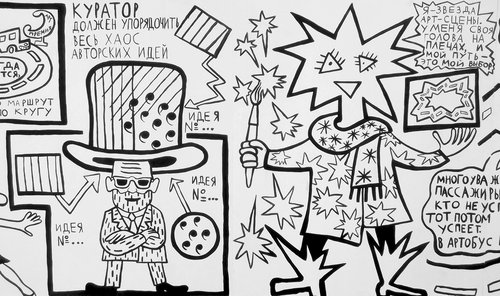
Aleksandra Badaksheyeva. A Rabbit Hole in a Cherry Garden. Exhibition view. Moscow, 2026. Courtesy of Park Gallery

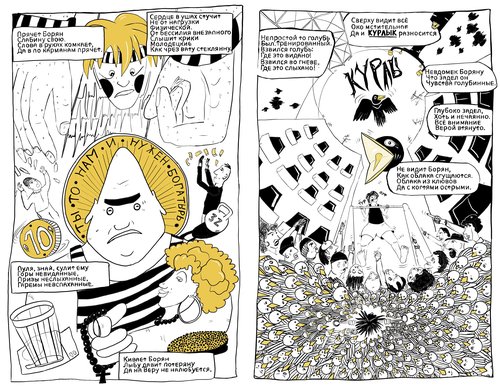
Aleksandra Badaksheyeva. A Rabbit Hole in a Cherry Garden. Exhibition view. Moscow, 2026. Courtesy of Park Gallery

Aleksandra Badaksheyeva. A Rabbit Hole in a Cherry Garden. Exhibition view. Moscow, 2026. Courtesy of Park Gallery
Artist and illustrator Ekaterina Belyavskaya (b. 1981)’s mosaic like works are heavily influenced by Art Nouveau graphics and Japanese coloured prints. She revels in intricate patterns and images of flowers and pale-skinned femme fatales, often making whimsical literary references. In her ‘Peasant Noblewoman’ series, for example, an allusion to the classic story by Alexander Pushkin, the elegantly dressed protagonist rides a cow and hugs a tractor. Thus, the artist’s work is defined by a playful tension between high cultural references and deliberate absurdity, expressed through a richly decorative visual language.


Both Badaksheeva and Belyavskaya can be seen as defining voices of “generations shaped by media content like animation, video games and television series” (to quote Turchina). However, the metamodernist approach, oscillating between irony and sincerity, is not only typical of millennials and their younger counterparts, but of older generations of artists as well. For many of these artists, it is a logical stage in a long and turbulent career. Alexander Savko (b. 1957), a native of Moldova, emerged on the Moscow art scene in the 1980s. He gained fame, and at times notoriety, for his ironic homages to Russian and European academic painting in which familiar characters were replaced by icons of Western pop culture. His approach was similar to Sots-Art, but without the political edge. Savko “smuggled” Marvel superheroes or the Simpsons into well-known academic paintings for a humorous effect. However, his seemingly harmless wit proved risky when his painting 'Sermon on the Mount', based on an engraving by the German artist Julius Schnorr von Carolsfeld, in which the figure of Christ had been replaced by Mickey Mouse, was deemed “extremist” by a Russian court in 2011. Now, instead of paying homage to past artists, he creates works with complex, whimsical narratives involving popular characters from Soviet animated cartoons, as well as international icons such as the Joker, Snow White and SpongeBob SquarePants. In his recent series, Savko addresses the most profound issues in art history in his signature ironic manner. One of his favourite topics, bordering on obsession, is the ‘war’ between figurative and abstract art. In the ‘Abstract Battles’ series, the artist envisages a fight between figuration and abstraction, with cartoon-like knights impersonating figuration and abstract forms impersonating abstraction. In ‘Suprematist Tragedies’, the boundary between figuration and abstraction is blurred as knights in Suprematist armour throw themselves into battles under Mondrian-styled banners.


Elena Kovylina (b. 1971) began her career as a performance artist in the 1990s and 2000s, shocking the art-loving public with daring and sometimes life-endangering works. She invited visitors to tea and set fire to the tablecloth, challenged both men and women to fight her in a boxing match, and invited men to waltz with her, drinking a glass of vodka after each dance. She also pinned a military decoration to her bare skin, and sailed away in a small boat into rough sea. She continues to create performance art, but since the mid-2000s, painting has become her primary medium. In ‘Elena Kovylina’s Artifacts and Gadgets’ (2022), she combines fairy-tale characters derived from classical paintings by Viktor Vasnetsov (1848–1926) with images of modern technology. This hints that all the wonders of progress were predicted in the past, or perhaps that, despite all the breakthroughs in science and engineering, our contemporary world is sinking into archaism. This series of large canvases was exhibited at the All-Russia Museum of Decorative and Applied Arts in Moscow. Despite their size and painterly craftsmanship, the images resemble enormous collages. One could not help but wonder if they had been composed on a screen before being transferred to canvas. Clearly, the age-old medium of painting continues to evolve in the digital age.


For artists who think in a collage-like way, the arrival of Adobe Photoshop was both a blessing and a curse. Sketches for paintings are now created on computers. Compositions are becoming increasingly detailed and complex, yet the integrity of the artist’s unique painting style can easily be compromised in the process. Kovylina seems to be aware of this threat. During her current exhibition, ‘Say – Sweet!’, at the Fine Art Gallery in Moscow, she is painting new works in the gallery hall in front of the visitors. Kovylina turns her creative process into a performance, demonstrating that no digital tools or human assistants are involved. The works themselves are executed in the same collage-like style, featuring images of giant fruits that resemble cut-outs glued onto painted landscapes. Have computers changed the way artists think, or merely the way we perceive art? The recent arrival of AI has tempted many painters to experiment with it. Yet although many projects are now hyped as “collaborations with AI,” it does not seem to be a game changer. One thing is clear: our minds are changing due to constant immersion in media content. Art is affected by this change, yet artists are still figuring out how to embrace it.
Alexandra Badaksheeva. A Rabbit Hole in a Cherry Garden
Moscow, Russia
14 May – 14 June 2026
Elena Kovylina. Say – Sweet!
Moscow, Russia
26 May – 5 July 2026