

Painterly Installation as Institutional Critique… and More!

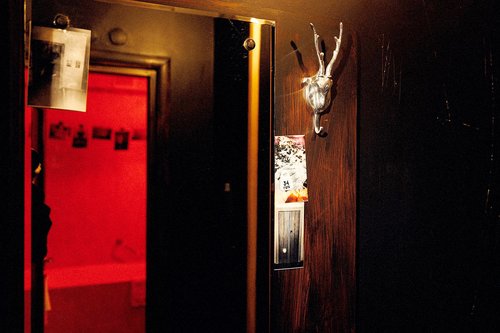
Egor Fedorichev. Morning of the Sleepless. Exhibitiob view. St Petersburg, 2025. Courtesy of MYTH Gallery
Today, almost any solo exhibition of contemporary painting conceived by artist and curator in the form of an installation is labelled a “painterly installation.” Such a designation tends to flatter artistic vanity rather than to establish meaningful conceptual boundaries around a phenomenon that emerges at the intersection of two major art forms of the twentieth century – and that differs in important ways from conventional modes of exhibition design.
Back in 2008, a leading Russian art critic of the period, Ekaterina Degot, whose position was consistently informed by a leftist ideological framework, set out two definitive positions in a series of magazine articles: one on abstraction, the other on installation. She described the late paintings of Mark Rothko (1903–1970) as nothing more than painted rectangles “radiating an unthinkable and unfounded spiritual pretension.” Total installation in the contemporary museum, meanwhile, was equated in her thinking with the role once occupied by the grand historical painting of the nineteenth century.
Judgements made almost two decades ago, these observations remain perceptive – and still valid, at least in one crucial respect. Painting and installation are both art forms in a state of crisis. In merging into the hybrid form of the “painterly installation,” they do not resolve that crisis so much as mutually defer it, each prolonging the other’s life through a shared suspension of belief.
The 2000s and 2010s marked a period in which painterly installation gained widespread currency, and the term itself became fashionable. What distinguishes it from exhibition design? Beyond the obvious point – that an exhibition conceived and executed by the artist on equal footing with individual works becomes a work in its own right – the key difference lies in the distribution of emphasis and in the balance between painterly and installation components.

Installation emerges from the void of minimalism and conceptual art: its material and primary meaning is space itself. Painting, by contrast, is an assertion of the object and stands in opposition to the void even when it seeks to evoke it. The combination of painting and installation thus represents a compromise in which installation, following postmodern logic, appropriates painting – an art form inherently bound to space and ultimately subordinate to it. It is telling that painting plays precisely such a subsidiary role in the work of the outstanding master and pioneer of total installation, Ilya Kabakov (1933–2023).
Yet, as the saying goes, minus times minus gives plus. This hybridisation opens a field of experimentation, allowing artists to deploy installation strategies to intensify exhibition dramaturgy: disrupting conventional hanging practices, introducing rhythmic breaks, and fracturing habitual modes of perception. Within the installation, the meaning and status of painting can undergo the most radical transformations, even to the point of rupture with traditional representation. A painting may be inverted, affixed to the ceiling or the floor, rendered wholly or partially inaccessible to the viewer’s gaze – or, finally, subjected to acts of deliberate vandalism.

Ilya and Emilia Kabakov. Incident at the Museum or Water Music. Exhibition view. Moscow, 2024. Photo by Daniil Annenkov. Courtesy of GES-2 House of Culture

View of the exposition of the Second Exhibition on the Dvortsovy Bridge, 1991. Garage Museum of Contemporary Art Archive, Vladislav Mamyshev-Monroe fund. Courtesy of Garage Museum of Contemporary Art

Irina Nakhova. Room No. 1, 1983. Courtesy of the artist. Image from ArtGuide website

Nikita Alekseev in his apartment during the first exhibition of the APTART gallery. Moscow, 1982. Photo by Georgy Kiesewalter. Archive of the National Center for Contemporary Art. Image from ArtGuide website
The genealogy of painterly installation may be traced back to the exhibition practices of the Dadaists and Surrealists of the 1920s, 1930s, and 1940s – most notably to the radical display strategies devised by Marcel Duchamp (1887–1968) for Art of This Century, the New York gallery of Peggy Guggenheim. Even earlier, however, the Futurists had already articulated an ambition toward a synthetic, total perception of art in the first decade of the twentieth century, anticipating later attempts to dissolve boundaries between media. Among contemporary painters working within this hybrid field of painterly installation, only Anselm Kiefer (b. 1945) achieves sustained and consistent success. In his work, painting exists in a continuous formal and semantic dialogue with sculpture and object, neither subordinated to nor eclipsed by them, but instead integrated into a unified experiential and symbolic system.
In Soviet “unofficial” art, the conscious use of installation strategies in the presentation of painting was rare. Only isolated figures – such as Irina Nakhova (b. 1955) or Mikhail Chernyshev (b. 1945) – can be cited as exceptions. Under the conditions of so-called “flat exhibitions,” the forced density of hanging paintings generally did not become an object of aesthetic reflection. A notable exception were the ‘Apt-Art’ exhibitions, organised in 1982–83 in the apartment of the artist Nikita Alekseev (1953–2021), which functioned as a temporary, domestic gallery space.
Painting also became an integral component of numerous performances by the Collective Actions group, beginning with the action ‘Tent’ (1976). As documented at the time, “twelve pastiche paintings measuring 1 × 1 metres, painted by Nikita Alekseev, were sewn into a single canvas, installed in the form of a tent, and left in a forest outside Moscow.” Here, painting was absorbed into an ephemeral spatial structure, its status as an autonomous object deliberately suspended.

One of the most striking and provocative installation gestures of the 1990s was the action Art from First Hands, or An Apology for Shyness, staged by Regina Gallery (now Ovcharenko Gallery). In this work, paintings were held by human hands protruding through slits in a false wall – an arrangement realised by the curator Oleg Kulik (b. 1961) with the participation of a platoon of soldiers. The history of the influential St Petersburg artistic movement of the late 1980s and 1990s, led by Timur Novikov (1958–2002), is likewise rich in radical examples of painterly installation. The activities of the association Novye Khudozhniki (“New Artists”) and related groups include, among others, two exhibitions held in 1991 and 1992 on the Dvortsovy Bridge, where monumental canvases were affixed directly to the bridge’s lifting wings – temporarily merging painting with urban infrastructure and performative spectacle.

Artists of the generation now approaching fifty began to employ painterly installation in St Petersburg with consistency and professional intent. Among the most significant figures are Alexander Dashevsky (b. 1980), Pyotr Shvetsov (b. 1970), and Andrei Rudyev (b. 1966). Their practices marked a transition from episodic experimentation to a sustained engagement with painterly installation as a deliberate artistic strategy. By contrast, exhibitions staged in 2025 offer only a limited number of convincing examples of total painterly installation, despite the regular recourse to this format among younger Russian artists. One notable exception is Alisa Gorelova (b. 1988), whose work is consistently focused on the theme of human anatomy. In her first solo exhibitions in St Petersburg in 2021 – ‘Closeness’, held in one of the halls of Sevkabel Port, and ‘Ex voto’, staged in the basement of the Lutheran church Peterkirche – Gorelova freely arranged canvases of a uniform, elongated format into configurations resembling a perspectival portal or a ritual dance circle. These spatial solutions reinforced the ritualistic intonations essential to her artistic language.
In her most recent project, ‘Beyond Form’ (PA Gallery, Moscow, 2025), also conceived as a total painterly installation, Gorelova experiments with new approaches to overcoming the rigid corporeal determinacy that has defined her earlier work. Yet, despite the promise implied by the project’s title, the artist does not fully succeed in expanding the semantic scope of her practice or in endowing it with the performative intensity characteristic of action painting.


‘Morning of the Sleepless’ by Egor Fedorichev (b. 1988), on view at MYTH Gallery, St Petersburg, until 15th of February, is conceived, according to the artist, as an attempt to convey – through expressive painting – the impression of a winter, snow-covered field following a bloody hunt. Drawing on his extensive theatrical experience as a playwright and scenographer, Fedorichev does not create a total painterly installation for the first time; rather, he consciously imports into the exhibition space an arsenal of devices borrowed from theatre. In ‘Morning of the Sleepless’, the artist paints not on traditional canvas but on floor-cleaning rags, alternates a figurative idiom with abstraction, and employs dripping techniques interspersed with recognisable images of deer. The installation unites pictorial zones that differ markedly in character, density, and intensity. The painted surfaces are suspended end to end across the full height of the gallery’s two halls; through folds, knots, and deliberate distortions of the material, Fedorichev introduces additional volume, rupturing the pictorial plane and establishing an autonomous internal rhythm.
As a result, the work operates simultaneously across several visual and semantic registers: as painting and as sculpture, as monumental-decorative composition and as a tactile, materially immersive environment. Painting here does not merely occupy space but actively organises it, asserting itself as both image and physical presence.

Ivan Novikov (b. 1990), long engaged with abstraction, is formally close to the pure painterliness of Mark Rothko, yet his work is consistently charged with political meaning. The ongoing project ‘Blue’, initiated in 2022, emerged from the artist’s decision to respond to unfolding events through paintings executed exclusively within a blue chromatic range – blue signifying, first and foremost, a peaceful sky. The expressive capacity of this colour has proved unexpectedly expansive, encompassing a spectrum that extends from collective catastrophe to deeply personal loss. The first presentation of ‘Blue’ at pop/off/art gallery (Moscow, 2025), comprising approximately fifteen canvases freely arranged on easels throughout the exhibition space, foregrounded the position of the artist and the role of abstract painting within the context of an ongoing military conflict. By contrast, the subsequent exhibition ‘Fruits of Oblivion’, on view at Anna Nova Art Gallery until 22 March, shifts the emphasis toward memory and its mutability. At the centre of the installation lies a large blue canvas placed horizontally and supported along its entire length by chairs, resembling a communal table and transforming the painting into a site of collective contemplation. Across all iterations of the ‘Blue’ project, the paintings materialise a question that acquires specificity only through the act of being posed. In this sense, Novikov’s work represents a rare instance in which the oft-invoked epithet “conceptual” is not merely rhetorical but fully warranted, grounded in a rigorous correspondence between idea, form, and spatial articulation.

Owing to the disproportion between the large number of painters seeking visibility within the contemporary art scene and the limited capacity of Russia’s artistic infrastructure, any turn by younger artists toward installation forms inevitably acquires the character of institutional critique. Total painterly installation only rarely – and with considerable difficulty – finds a place within the private or museum collections for which it is ostensibly conceived; once the exhibition ends, it is most often preserved solely in the form of documentation. Yet despite this structural incompatibility, younger artists continue to regard painterly installation not as a marginal or provisional strategy, but as a necessary and natural mode of artistic articulation.
Egor Fedorichev. Morning of the Sleepless
St Petersburg, Russia
13 December 2025 – 15 February 2026
Ivan Novikov. Fruits of Oblivion
St Petersburg, Russia
31 January – 22 March 2026