

Compelled Minimalism

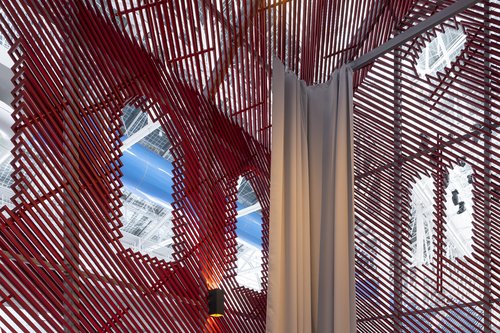
Leonid Kostin. leo vs. leo. Exhibition view. Futuro Gallery's booth at the Port Art Fair. St. Petersburg, 2026. Photo by Evgenia Senina. Courtesy of Futuro Gallery
As audiences are drowning in digital noise and endless content, a quiet counter-movement is taking shape on the Russian contemporary art scene. Art critic Sergey Guskov examines how several artists are reinventing minimalism – sometimes fusing it with its apparent opposite.
In ‘Quiet Hour’ an exhibition of new work by Anna Komarova (b. 1997) at XL Gallery this Spring, the cavernous space was divided by a wall to impose a strict navigational logic for visitors who were nudged along a prescribed route. The key waypoints were marked by three evenly spaced pairs of 3D printed, opaque white boots. The walls were hung with two layers of fabric of varying transparency from a dense veil to a fine tulle mesh. Across them drifted occasional wandering lights, and at intervals projections would flicker past – shadows in the form of a galloping or walking horse, rising crows, flying arrows, or barely visible tree silhouettes. On the front desk hung the text accompanying the project: a blank sheet of paper.

Komarova, who has a background as a theatre designer, constructed a flawless piece of scenography, leading gallery visitors on a drift through a near empty hall. The exhibition was stripped back to the point of extreme minimalism – yet, through this artificially engineered scarcity of the visual, the viewer’s senses were sharpened rather than dulled. Paradoxically, the show turned out to be packed with a vast quantity of imagistic information, even if that information manifested itself as hints and reflections on a wall – much like Plato’s proverbial cave.
At XL Gallery last autumn there was an exhibition by Igor Samolet (b. 1984) called ‘Choice’. Four barrier gates were installed in the large space of the gallery arranged to form a square enclosure. From time to time their arms would rise in a complex sequence. Visitors were invited to climb a viewing platform and look down upon this mechanical ballet. Some months prior to this, gallery stsena/szena staged ‘Canon’, another Samolet exhibition. The display was equally spartan: four stands fitted with metal fists gripping taxidermied birds; a rose on the floor facing down, its stem pointing up; the word zvonít (“it’s ringing” in Russian) written twice on the wall, with a nod to the correct grammatical stress and its common mispronunciation. Both exhibitions featured a sound component that gave the minimal displays a meditative dimension – hardly surprisingly, since both projects resembled a kind of rebus demanding long and attentive contemplation.


It is worth noting that both exhibitions marked a new chapter in Samolet’s career. For many years, his practice had been altogether different: his earlier works were built upon an accumulation of visual noise drawn from social media feeds and online correspondence, transforming grotesquely enlarged screenshots of digital chatter into dense, immersive compositions. Yet by the mid 2020s, the artist had radically reconsidered his approach, becoming, almost overnight, a minimalist of a distinctly unconventional kind.
Komarova and Samolet are far from alone in adopting this approach to the organisation of exhibitions and large-scale artistic projects. Simply repeating the strategies already canonised by Western minimalism – and later by post-minimalism – would serve little purpose. Instead, many contemporary Russian artists are, in a sense, reinventing the language of minimalism from first principles, often in remarkably sophisticated ways by grafting it onto ideas and aesthetic traditions that appear fundamentally at odds with it.

Such is the case with artist and collector Leonid Kostin (b. 1988), founder of gallery___gallery. While studying at the Design Academy Eindhoven, he came to realise that what had come to be understood in the Netherlands as speculative design belonged, in the Russian context, more naturally to the realm of contemporary art. Returning to Moscow, he consequently enrolled at the Institut Baza, where he began to develop his own artistic practice alongside his work as a collector and gallerist.
Kostin’s long-running project SPAS, begun in 2024 and still ongoing, was inspired by Russian icons – “Spas” meaning “The Saviour” in medieval Russian. In it, the artist turns to one of the primary sources of the country’s visual culture, taking church painting as his foundation not as sacred practice, but as a formal and technical toolkit; not for its meaning or symbolism, but above all for its forms. The project was launched in an exhibition of the same name at the independent gallery Spas Setun. Within a few months, Kostin developed the theme further in Futuro Gallery’s solo booth at the St Petersburg fair 1703, and then, in 2025, at Cosmoscow in Moscow, again with a Futuro solo presentation. If the first iteration was exploratory – an attempt to understand how one might approach forms and materials rooted in centuries of tradition – the fair presentations were more fundamental in scope. There, the artist laid out the elementary particles he had uncovered, tracing deep connections between them and attempting to establish a zero degree of this specific sign system. This is not archaeology, however, but an attempt to locate a primary seed from which an alternative path for Russian visual culture might grow: a way of replaying the history of art.

Kostin produced a series of levkas – wooden gesso panels – painted in a range of colours. In some installations, the entire display consisted of snow-white objects. The panels varied in shape and scale, yet they shared one defining characteristic: they bore no image. Their material presence evoked the visual language of the icon, while remaining resolutely something other than icons themselves.
In May this year, at the Port Art Fair in St Petersburg, Kostin presented ‘leo vs. leo’ – again a solo booth with Futuro Gallery – which was officially crowned as the fair’s best presentation. Using a 3D printer, he produced sculptural self-portraits in identical grey, differing only in scale. They depict the artist in shorts, beer bottle in hand, with a protruding belly. Kostin described the project as “skuf art”, referring to the Russian internet slang skuf, a term that has gained widespread currency in recent years to describe a rather unkempt, middle-aged man, typically complete with a beer belly. Yet the reference to an internet meme is not the work’s essential point. In both SPAS and Leo vs. Leo, Kostin fuses minimalism with Pop Art, doing so with such natural assurance that the two traditions cease to appear oppositional, instead strengthening one another.

The renewed appeal of a minimalist aesthetic at this particular moment is unlikely to be accidental. Speaking through simple, economical forms corresponds to the spirit of the age. Audiences have grown weary of information overload, of the endless stream of AI-generated content, of increasingly elaborate spectacles, and of the incessant layers of commentary that accumulate around every image and event. Many artists have responded by deliberately exercising restraint, reducing the quantity of objects, text, and visual information introduced into the exhibition space. The result is not impoverishment but concentration: the less there is, the more precise – and ultimately the more powerful – the work becomes.