Small Art, Serious Buyers at Moscow’s |catalog| Fair

|catalog|. Triumph Gallery booth. Exhibition view. Moscow, 2026. Courtesy of Triumph Gallery
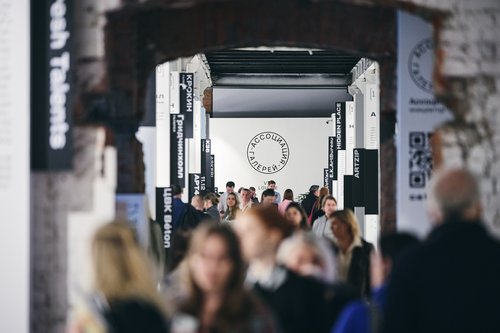
Held in the underground shopping arcade of Moscow’s luxury Zolotoy residential complex, the autumn edition of contemporary art fair |catalog| runs until 22 November. With its abundance of small, affordable works, the fair has something of the feel of a New Year’s market. Yet despite a subdued opening, red dots signalling sales began appearing by lunchtime, and by evening the galleries were filling with serious buyers.
The autumn edition of the biannual contemporary art fair |catalog| opened on a surprisingly subdued note. The familiar midday crowds of fashionably dressed young women clutching Chanel bags were noticeably thinner, while the art itself offered little sense of novelty or discovery. Perhaps collectors were still digesting the sheer abundance of works on offer at the rival Cosmoscow fair, held in September?
At midday on Thursday, the underground shopping arcade of Zolotoy, a luxury residential complex in central Moscow hosting the fair for the third time, was notably quiet. Largely vacant for years, the retail space now houses art galleries in units originally designed as boutiques. Yet what works for handbags and coats is not necessarily suited to art, particularly contemporary art. With low ceilings and an average floor area of just 15 square metres, often subdivided into smaller sections, the spaces leave little room for artworks to breathe. Visitors, too, must navigate the cramped interiors, frequently at risk of bumping into one another. Most galleries have little opportunity to exhibit larger works, despite their commercial appeal and generally higher prices. Instead, the fair is dominated by small-format pieces and modestly sized sculptures, typically priced between $400 and $2,000.

|catalog|. pop/off/art gallery booth. Exhibition view. Moscow, 2026. Courtesy of pop/off/art gallery
There were, however, some notable exceptions. Near the entrance, the booth of Ovcharenko, one of Russia’s most established contemporary art galleries, immediately caught the eye of visitors making their way to the cloakroom with its large, bold canvases. Occupying the equivalent of four standard booths, the gallery had ample space to present works by established figures in Russian contemporary art, including Pavel Pepperstein (b. 1966), Alexey Kallima (b. 1969) and Victor Alimpiev (b. 1973), alongside those of a younger generation. Among them were Dmitry Aske (b. 1985), known for his distinctive wooden mosaics, priced from $14,000, and Krasil Makar, an artist working under a pseudonym whose visual language combines naïve art with geometric abstraction, with works starting at $6,000.
Opposite, another veteran of the Russian art scene, Triumph, one of the fair’s principal organisers, occupies a spacious booth of its own. Rather than showcasing large-scale works, the gallery has opted for a refined presentation reminiscent of the aesthetic of legendary art dealer and interior designer Axel Vervoordt. Against dark walls, a carefully arranged selection of Russian and Japanese contemporary art sits alongside antique furniture. The generous space, complete with an alcove, features delicate works on paper by Keito Yamaguchi (b. 1990), priced from $1,200; manga-inspired paintings by Yuya Hashizume (b. 1983), starting at $25,000; porcelain objects by Maria Efremenko, from $4,000; and an expressive self-portrait by Denmark-based artist Artem Alekseev (b. 1972), a recent addition to the gallery’s roster, priced at $9,500.

Triumph’s stand was also one of the few places at the fair where international art could still be found. Elsewhere, a–s–t–r–a gallery presented salon-style works by Chinese artist Zhang Jinwei (b. 1989), priced at $7,000, while Askeri Gallery displayed an inflatable chair by South Korean artist Seungjin Yang (b. 1986). A more intriguing selection of international art appeared in a section curated by collector Andrey Malakhov, featuring works by Darren Bader (b. 1978), Gavin Turk (b. 1967), David Shrigley (b. 1968) and Ai Weiwei (b. 1957), among others. There was, however, a catch: the display was strictly non-commercial. As a sign at the entrance made clear, ‘None of these pieces are for sale!’
Given the relatively modest prices, the fair could almost be mistaken for a New Year’s market, an impression reinforced by the festive atmosphere already taking hold of Moscow. Since early November, the city centre has been decked out with Christmas trees, garlands and seasonal illuminations. Perhaps, then, the young women with Chanel handbags are simply getting ahead with their Christmas shopping, rather than treating art fairs as another form of fashionable social entertainment.

There is certainly no shortage of potential gifts, with something for almost every generation. Grandparents might appreciate nostalgic limited-edition prints by celebrated Soviet photographers such as Boris Ignatovich (1899–1976), Yakov Khalip (1908–1980) and Naum Granovsky (1910–1984), offered by Lumiere Gallery. Teenagers, meanwhile, might be drawn to the whimsical, endearing papier-mâché and ceramic figurines presented by SSSKh & ‘XX–XXI’ Lab. Their booth, appropriately decorated for the winter holidays, won the fair’s ‘Best Booth’ award. The prize entitles the Community of Contemporary Siberian Artists (SSSKh) to a 50% discount on participation in the next edition, along with coverage in the fair’s partner media.
Elsewhere, galleries offer an abundance of intriguing small-format works. Grabar Gallery presents charming New Year-themed drawings by Darya Barybina (b. 1988), priced from $200, while Evgeny Shutko Gallery showcases intricate beadwork by Olga Soldatova (b. 1965), starting at $2,000. St Petersburg’s Parazit Gallery brings together pop art-inspired lithographs by Stas Kazimov (b. 1979), priced from $400, and objects carved from aerated concrete by Kolya Sadovnik (b. 1984). Resembling ancient gravestones, Sadovnik’s works bear cryptic inscriptions in Latin letters, lending these contemporary artefacts an archaeological air. At by newnow, Alexandra Pavlovskaya’s series ‘The Ability to Stay Together’ explores philosophical questions through sculptural compositions in wood and metal, priced from $900. DiDi Gallery presents witty assemblages by Pavel Pletnev (b. 1981), starting at $400, alongside surreal drawings by Vika Bodrova (b. 1996), from $700. Meanwhile, Arka Gallery, from the far eastern city of Vladivostok, offers atmospheric, metaphysical landscapes in mixed media by Mikhail Chuvakin (b. 1990), with prices starting at $350.

By lunchtime, the telltale red dots signalling sales had begun to appear beside artworks, and a small queue had even formed at the packing station. By evening, the galleries were bustling, although the atmosphere was decidedly more businesslike than the festive social whirl usually associated with art fair openings. Several gallerists suggested that the organisers had successfully filtered out casual visitors and socialites, attracting instead a more focused audience of prospective buyers. Seasoned dealers, meanwhile, knew how to mobilise their loyal collectors. Sergey Popov, founder of pop/off/art gallery, personally invited around a hundred collectors and, by the end of the preview day, had recorded sales exceeding 10 million roubles (approximately $120,000). The strongest demand at his stand was for works by established figures of Russian contemporary art, including Yury Zlotnikov (1930–2016), Yevgeny Mikhnov-Voitenko (1932–1988) and Georgy Puzenkov (George Cohen, b. 1953).