

|catalog| Art Fair, Lower Prices and Missing Galleries

Triumph Gallery booth. Exhibition view. Moscow, 2026. Courtesy of |catalog|art fair
Staged once again in the half-empty luxury arcade beneath Moscow’s Zolotoy complex, the fifth edition of |catalog| opened with a broader regional footprint but without several of the Russian art scene’s most prominent galleries. As lower price points, younger artists and decorative objects dominate the booths, the fair appears to reflect less the condition of the market as a whole than |catalog|’s own changing status within it.
Judging by the booths on display and an average transaction value of around 250,000 roubles – approximately $3,300 – the fair appears to have slipped downmarket, edging closer to the level of Moscow’s other fair, the young art platform ‘blazar’. This reflects both reduced purchasing power and the absence of several important galleries.
It seems that the concept of an underground shopping gallery within Zolotoy, the elite residential complex in central Moscow, has not been an obvious commercial success: for years, its boutiques have stood empty. Now, for the second year in a row, these vacant spaces have been repurposed as the venue for the contemporary art fair |catalog|. In a sense, the fair is beginning to resemble its setting – less a marketplace of discovery than a curated retail environment, almost boutique in character. In its fifth edition, |catalog| has lost several key galleries, even as it draws fifty-five participants and extends its geographical reach. This year’s line-up includes galleries from Moscow, St Petersburg, Kazan, Nizhny Novgorod, Voronezh, Kaluga, Ufa, and Vladivostok.
As several sources told Art Focus Now, the withdrawal of a number of dealers stems partly from disappointing results at the previous edition and partly from weak purchasing power in the upper tier of the Russian art market, where works by the most sought-after young and established contemporary artists typically begin at around $10,000. At the same time, there have reportedly been repeated internal disagreements within the Gallery Association, the structure behind |catalog|.

Notably absent from this year’s fair are two veterans of the Russian gallery scene: Vladimir Ovcharenko, owner of Ovcharenko Gallery and the Vladey auction house, and Elena Selina, founder of XL Gallery. Both are well known internationally for their participation in fairs across Europe and the United States. Also missing are Ruarts, the gallery founded by collector and philanthropist Marianna Sardarova, and Syntax Gallery, another prominent supporter of street art. Iragui Gallery, which recently opened a space in Paris, is absent as well. Still, as the Russian saying goes, no sacred place remains empty for long.
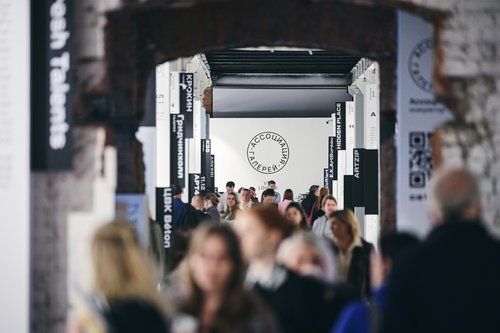
The preview opened early in the morning, and by the time the noon press conference began, the underground corridors were already crowded. The overriding impression was one of stasis. Little seemed to have changed since last year: the same long passageways lined with open doors on either side, temporarily occupied by contemporary art galleries for four days; the same shortage of air and natural light; the same clusters of affluent women drifting through the space in guided groups, led by fair mediators.

The main news from the organisers – and a surprise to many observers – was, in fact, the timing of the fair. For several years now, April on the Russian art calendar has belonged to Art Moscow, which opens next week. Although that fair has shifted from a contemporary focus towards a far more omnivorous format incorporating antique dealers and jewellers it still attracts contemporary galleries. The current appetite for eclecticism, it seems, has fully reached Russia.
The first event at |catalog| was the announcement of the winner in the ‘Best Booth’ category, selected by the participating galleries themselves in a secret ballot. The prize includes a 50 per cent discount on participation in the next edition, priority choice of booth, and coverage across the Gallery Association’s platforms and partner media. The winner was – somewhat unexpectedly – Triumph Gallery, the fair’s principal organiser. Its booth is indeed striking, conceived in the spirit of a wunderkammer, and one of the few to feature works by international contemporary artists, including the French artist Elsa Guillaume (b. 1989) and the Korean artist Gyeonsu Ahn (b. 1975). In a generous gesture, the gallery donated its discount for the next edition to the Pole Art Residency Foundation.


This season, young artists are the most visible presence across the booths. Not because they are producing especially radical statements or exceptional works, but because they remain comparatively affordable and therefore easier to sell quickly. SISTEMA Gallery, for instance, is offering canvases by Georgy Khomich (b. 1999) for $2,000. At 3L Gallery, abstract works by Evgenia Tut (b. 1982) are priced at $3,600, while mystical canvases by Alexander Lemish (b. 1982) at Hidden Place Gallery start at $1,900.
Ceramic and glass sculpture has emerged as one of this year’s clearest trends, appearing at what feels like every other stand. Tōmo Gallery is showing glass plaques with zoomorphic motifs by Kirill Klokov (b. 1996) from $650; Shmukler Gallery is offering ceramics with figurative scenes from everyday life by Vera Latysheva from $390; and a–s–t–r–a gallery presents conceptual “bleeding” dishes by Sergey Sonin (b. 1968) and Elena Samorodova (b. 1973) from $900. There are also more substantial works within this material turn. Krokin Gallery, for example, is offering ‘Venus of the New Paleolithic’ by Alexey Dyakov (b. 1976) – a series of impressive sculptures in coloured Murano glass produced at the renowned Berengo Studio priced at €21,000 each.

The booths naturally also include established names from the canon of contemporary art. Grabar Gallery is showing two large graphic works by Pavel Pepperstein ($9,000–12,000). Olga Chernysheva (b. 1962), winner of the Fondation Guerlain’s Prix de Dessin, is represented by drawings from her ‘Metro’ series at pop/off/art (€8,500). Pogodina Gallery is offering a Cubist work by Igor Makarevich (b. 1943) from last year ($50,000), alongside two historical works by Alexander Yulikov (from $65,000). E.K.ArtBureau, meanwhile, is presenting the installation ‘Perspectives of Conceptualism’ by Andrei Filippov (1959–2022), shown in the artist’s final retrospective during his lifetime, for $100,000.

My own informal prize for elegance and rarity would go to the Moscow interior design gallery Heritage for its monographic presentation, ‘Anna Andreeva. Soviet Op Art. Experimental Design of the 1960s’. The gallery not only showed the renowned textile artist’s remarkable geometric abstractions on paper (€12,000–22,000) – works by an artist also represented in MoMA’s collection in New York – but also clad the walls in replica fabric samples, creating one of the fair’s most visually coherent displays.