

Art Moscow Turns 30: From Radical Beginnings to a Showcase of Eclectic Taste

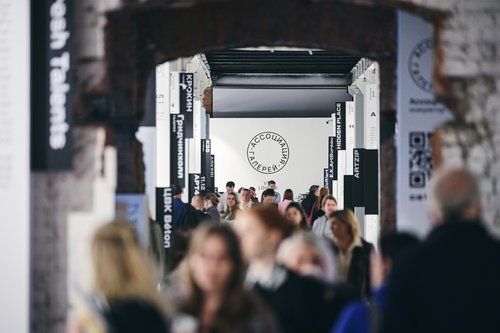
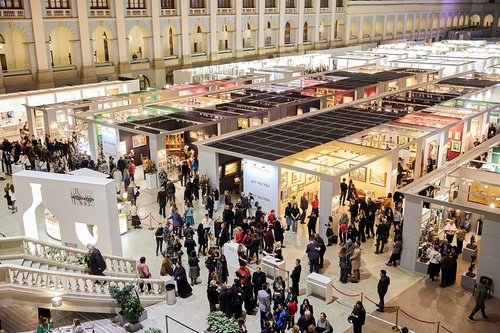
Art Moscow. Exhibition view. Moscow, 2026. Courtesy of Art Moscow art fair
On its thirtieth anniversary, Art Moscow presents itself as a fair shaped as much by memory as by market necessity. Once associated with the freedoms and artistic daring of the post-Soviet 1990s, it now offers a more conventional and markedly eclectic spectacle, in which antiques, decoration and cautious commerce often overshadow works of real artistic distinction.
This year Art Moscow celebrates its 30th anniversary. Over the decades, the fair has matured, undergone repeated transformations, and even vanished from the calendar for several years, only to re-emerge in yet another guise. By the time it has reached this milestone, it has come to resemble a fairly conventional showcase of widely differing artistic tendencies, making this year’s theme, ‘Multilayered’, feel less like a curatorial statement than a polite euphemism for eclecticism.

It is difficult to forget the first Art Moscow fair, held in 1996 at the Central House of Artists, or indeed many of the editions that followed in those early years, when Moscow saw the emergence of its first independent art galleries and the beginning of a new era for contemporary art in post-Soviet Russia. Looking back, many recall the intoxicating sense of freedom, the absence of censorship, and the bold performances and actions of radical artists. These exceptional years were evoked, albeit cautiously, at the opening of this year’s fair by both the organisers and the three art dealers from that period who remain active today: Vladimir Ovcharenko, formerly of Regina and now head of the gallery that bears his own name; Elena Kuprina-Lyakhovich, owner of E.K.ArtBureau; and Mikhail Krokin of Krokin Gallery. Ovcharenko Gallery’s vast stand occupied a central position within the fair, beside a glittering avenue of Russian jewellers, a placement that reflected the enduring stature of this patriarch of the Russian art scene. True to form, Ovcharenko spared no effort: among the works on view were several large-format canvases by Valery Koshlyakov, a major artist who has long lived in France (from €200,000), and abstract paintings by the fashionable St Petersburg artist Leonid Tskhe, whose works are already held in collections such as the Tretyakov Gallery and the M HKA Museum of Contemporary Art in Antwerp (from €30,000).

For the fourth time since the Art Moscow brand was revived in 2023, the fair is being held at the historic Gostiny Dvor, just steps from Red Square and the Kremlin. Designed by the celebrated architect Giacomo Quarenghi, one of the great planners of St Petersburg, the building was transformed in the 2000s when its courtyard was enclosed beneath a vast glass dome, giving it something of the character of Moscow’s own Grand Palais. Like its Parisian counterpart, it is capable of accommodating more than two hundred exhibitors. Today, the fair is divided into four principal sections: antiques, jewellery, contemporary art and design – very much in that order of significance.
Antique dealers are very much given pride of place: their stands open the fair and occupy more than half of its total floor space. Locals joke that there are in fact two antique salons in Moscow – the Russian Antique Salon, held in the same venue each November, and Art Moscow, which has merely changed its name. There is some truth in the remark, since the core list of participants at both fairs is broadly similar, although the Salon usually includes smaller dealers and can at times resemble a flea market, with piles of Soviet badges, crystal, Christmas tree decorations and other vintage objects.
The real question, however, is how much art of genuine interest is on view. According to several collectors who spoke to Art Focus Now, the answer was: very little. “What are we to do?” one of them asked in frustration. “Russians are not allowed to buy at Western auctions, and European dealers are extremely cautious in their dealings with buyers because everyone is afraid of sanctions. And bringing artworks into Russia is itself a difficult task.”

Mikhail Suslov, one of Russia’s leading antique dealers, is presenting an impressive roster of canonical names at his stand, from Vasily Perov and Ivan Aivazovsky to Boris Kustodiev and Natalia Goncharova, though none of the works on view would seem to qualify as museum-level examples (prices throughout on request). A group of dealers and collectors sharing a stand under the banner Art Lovers’ Club is showing, among other works, Arkhip Kuindzhi’s ‘Moonlit Night’ of 1889, offered at $2.5 million - a sizeable canvas which nevertheless feels far removed from the hypnotic intensity of the artist’s finest paintings in Russian museum collections.


The centrepiece of the Private Collection stand, which is offering works by Old Masters from the distinguished collection of Valeria and Konstantin Mauerhaus, is Luca Giordano’s ‘King David Reproached by the Prophet Gad’. In 2016, the painting sold at Dorotheum in Vienna for €42,500; today, it is being offered here for €250,000.
Collector’s Club Gallery, for its part, is offering, among other things, a characteristic still life by the classic non-conformist Dmitry Krasnopevtsev, ‘Amphora Among Stones’ (1969), priced at $130,000. Yet despite the renewed attention brought by the artist’s centenary last year - marked by several exhibitions and the publication at Moscow’s AZ Museum of a monumental monograph cataloguing all his known works, including this one – the painting has so far failed to find a buyer.

That said, even if little here rises to true museum level, there remains no shortage of respectable home décor, as the crowds at the opening readily demonstrated. Among the more appealing examples are a 1918 impressionist painting by Konstantin Korovin (1861–1939) called ‘The Garden’ at First Names Gallery, and a vibrant floral still life by Vera Rockline (1896–1934), a representative of the École de Paris, at Moscow Gallery. Russian Manor is offering a rare early 20th century steel inkwell by Tula craftsmen, fitted with a kinetic mechanism in the form of a globe for $10,000, as well as an 18th century German bone figurine crowned with an eye-shaped finial, inside which is concealed a small folder of portrait miniatures at around $20,000. Meanwhile, Inna Khegay’s entire booth is dedicated to of one of the most commercially successful Russian sculptors working today, Dashi Namdakov (b. 1967): his mystical abstractions on parchment are priced from $11,000, while small and medium-scale sculptures range from $25,000 to $130,000.