

Ustyugov’s ‘Alphabet of Life’ in St Petersburg

Portrait of Gennady Ustyugov. Photo courtesy of Yuri Molodkovets
An exhibition at the Russian Museum titled Alphabet of Life presents the work of octogenarian artist Gennady Ustyugov, who, despite living with severe disability in a neuropsychiatric institution, continues to create art of rare painterly brilliance.
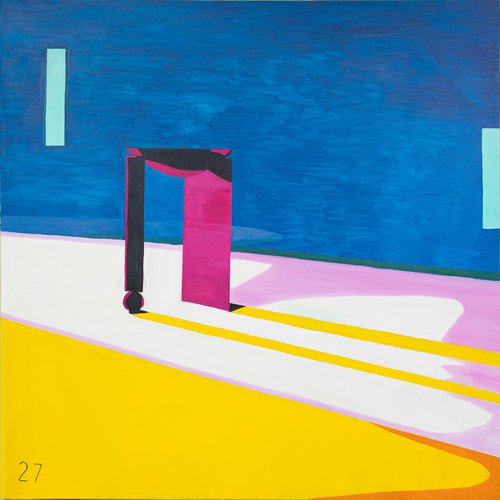
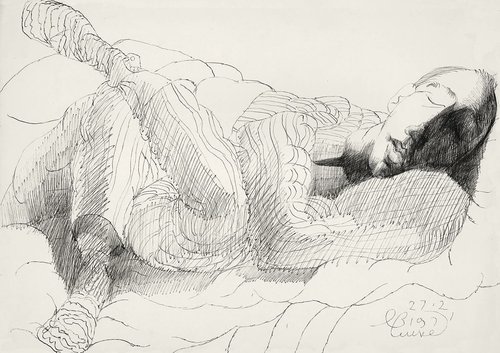
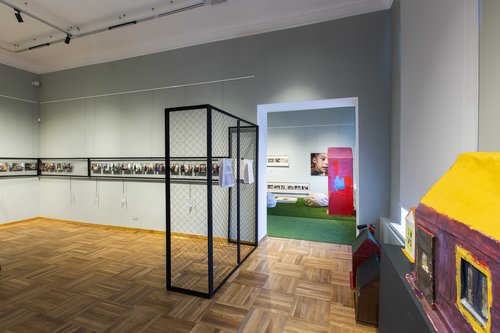
The opening of Gennady Ustyugov’s (b. 1937) exhibition Alphabet of Life at the Russian Museum has attracted considerable interest in St Petersburg. Now eighty-eight, the artist lives with severe disability in a neuropsychiatric institution, where he continues to create art. His works from the 1970s to the 1990s are today regarded as rare examples of pure painterliness. The exhibition, spread across two substantial spaces in the museum’s educational department rather than the main building, brings together Ustyugov’s earlier works from private collections with paintings and drawings he has produced in recent years.

Ustyugov was born in Soviet Kirgizia, today the Republic of Kyrgyzstan; his father was a carpenter and his mother a laundress. In 1950 his family moved to a village near Leningrad (now St Petersburg), which later became part of the city. In 1955 he became a student at the Secondary Art School in the Academy of Arts, but three years later was expelled “for enthusiasm for Impressionism”, which was not approved of in the USSR at that time. From the late 1950s he worked as a locksmith, welder, painter, loader, and general labourer, continuing to paint pictures in his free time. In 1963 Ustyugov developed a mental illness, was admitted to a clinic and received a diagnosis of schizophrenia. His works from the 1960s have hardly survived; most were destroyed by him while in a state of mental derangement. It is worth remembering that the psychiatry of those years was characterised by cruelty to patients, especially in the USSR, where it served as part of the repressive mechanism, so one can barely imagine the severity of what Ustyugov endured. Among Russian artists of the same generation and similar fate, was Muscovite outsider artist Vladimir Yakovlev (1934–1998). Between periods of illness Ustyugov continued to make art and joined the unofficial artistic movement.

In 1974 he took part in the first exhibition of Leningrad nonconformists at the I. Gaz Palace of Culture and joined the artists’ association “Society of Experimental Exhibitions” (TEV, later TEII – “Society of Experimental Visual Art”). Ustyugov’s work fits organically into the social and artistic context of “uncouth” painting by “unrecognised” artists, a milieu that fostered a vital sense of dialogue. Warm, informal exchange linked him in particular with the artist and poet Oleg Grigoryev (1943–1992). Ustyugov himself also wrote poetry, whose simplicity and rhythm recall classical Japanese verse; several small volumes, illustrated with his own drawings, have been published.
Ustyugov’s first solo exhibition did not take place until 1990. That same year, his painting ‘In the Shadow of the Red Wall’ was chosen as the title image and poster for the group show ‘Keepers of the Flame: Unofficial Artists of Leningrad’, organised at the University of Southern California in Los Angeles and subsequently shown on both the East and West coasts by 1992. The Zimmerli Art Museum in New Jersey today holds around forty of his works in painting and on paper, primarily from the 1980s.

In 2007, Ustyugov’s work was included in the exhibition ‘Russia’, curated by Julie Sylvester as part of Art Basel Miami. On this occasion, however, it was not his paintings that were displayed, but collages made from found materials such as cigarette and milk packaging. Created in the early 2000s, when the artist had been deprived of the opportunity to paint, these works nonetheless reveal clear traces of his compositional flair and plastic sensitivity.
Ustyugov’s art is often described as timeless, and this is more than a poetic epithet: for him, time simply does not exist, and in this sense his artistic world takes on the qualities of a kind of paradise. His canvases are frequently populated by rather anodyne young women lost in thought, mirroring the quiet, suspended state of the world around them. Overall, Ustyugov belongs to a long and rich tradition of spiritual art that originates in ancient Russian icon painting and continues through the painterly symbolism of such diverse figures as Viktor Borisov-Musatov (1870–1905), Pavel Kuznetsov (1878–1968), Mikhail Matyushin (1861–1934) and his pupils, Kazimir Malevich (1879–1935), and the ‘Painterly-Plastic Realism’ group, including Vladimir Sterligov (1904–1973) and Pavel Basmanov (1906–1993).

Among Western influences one might trace echoes of Pablo Picasso (1881–1973), Henri Matisse (1869–1954), and the figurative art of the 1960s in France, Britain and Italy, although Ustyugov is unlikely to know the latter in any great detail. He never received a full formal art education, yet he cannot be regarded simply as an autodidact; rather, his work reflects a broad visual sensitivity and a deeply personal reworking of a vast range of artistic impressions, among which we might even detect Pierre Soulages (1919–2022) and Georg Baselitz (b. 1938). Nonetheless, lists of names drawn from superficial formal similarities do little to illuminate the true nature of Ustyugov’s talent.
Originally, his work was not associated with art brut; only the pieces created in recent decades can be viewed in this vein. This part of Ustyugov’s legacy was first widely presented at the ‘New Ustyugov’ exhibition at the artist-run space Invalid House in St Petersburg in 2021, and it occupies a significant place in the current show as well.

As Viktor Chuvashev, head of the art studio who has consistently supported the artist, explains, Ustyugov has lived since 2021 in the so-called “House of Social Communication” – a neuropsychiatric institution in the resort suburb of Zelenogorsk near St Petersburg. Despite communication difficulties and the fact that he now uses a wheelchair, he remains remarkably productive, often creating five to ten drawings a day. His artistic manner, though greatly transformed by illness, remains unmistakably his own
To place Ustyugov’s work entirely within the conceptual framework proposed a century ago by psychiatrists Hans Prinzhorn – author of ‘Artistry of the Mentally Ill’ (1922) in Germany – and Pavel Karpov, who wrote ‘The Creativity of the Mentally Ill and Its Influence on the Development of Science, Art and Technology’ (1926) in the USSR, is to diminish it considerably. It is clear that the earlier Ustyugov – an independent artist and participant in the unofficial Leningrad art scene – is separated from the present-day patient of neuropsychiatric institutions by an unbridgeable gulf of illness, even if the curators of the Russian Museum exhibition would argue otherwise.

Riding the broader wave of interest in the art of neurodiverse individuals and excluded communities, the museum has created a Department of Inclusive Programmes. As its staff member Natalya Petukhova notes, “This exhibition is an attempt to see Gennady Ustyugov’s creativity as a single continuous path, devoid of rigid periodisation, and to assess his contribution to the visual language of his time. Perhaps the viewer has yet to accept the artistic value of these works on a par with earlier ones that have already entered art history.”
Ustyugov’s paintings from the late 20th and early 21st century, now recognised as indisputable treasures of Russian art, have long attracted the close attention of collectors – among them the renowned St Petersburg photographer Yuri Molodkovets (b. 1963), who for many years has provided the artist with practical help and personal support. The trajectory of Ustyugov’s life and fate can only be accepted as it is, while doing everything possible to protect and care for the person himself. Yet the superiority of the “mature Ustyugov” over the works of his later years seems evident. A new and more precise definition is still needed for this recent phase of his artistic activity, one that would clearly distinguish it from the history of Russian unofficial art, within which Ustyugov rightfully occupies a chapter of his own.

Gennady Ustyugov. Sunset, evening, 1995. BoyArt Gallery Collection. Courtesy of State Russian Museum
Gennady Ustyugov. The Alphabet of Life
St Petersburg, Russia
24 November – 17 December 2025