

The Western Outpost of the Soviet Underground: Tarasov’s Collection in Vilnius

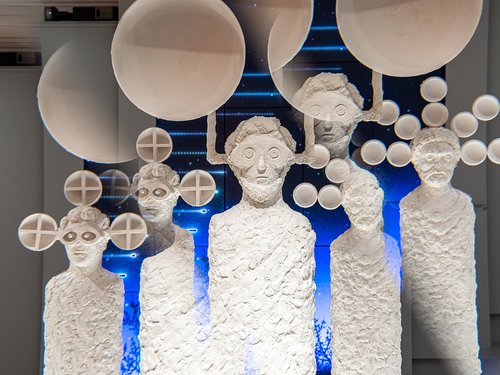
Ilya Kabakov, Vladimir Tarasov. Performance. Luigi Pecci Center for Contemporary Art, Prato, 1990. Photo by Natalya Nikitina. Courtesy of Lithuanian National Museum of Art
When jazz musician Vladimir Tarasov began collecting art in the 1970s, he had no plan to build a collection – it simply grew around him. Between concerts, Moscow kitchens and Vilnius studios, what took shape was a circle of friendship that would later crystallize into one of the most personal collections of unofficial Soviet art. Today, a selection of works from his ‘Museum of Friends’ forms the permanent exhibition ‘Protest Art: The Rebels of the Soviet Era’ at the Radvila Palace Museum of Art in the capital of Lithuania.
Stepping into the exhibition ‘Protest Art: The Rebels of the Soviet Era’ at the Radvila Palace, one immediately senses its spirit of vitality and warmth. Next to the curatorial wall text hangs ‘Dinner’ by Eduard Gorokhovsky (1929–2004), where you might recognize the smiling faces of jazz musician Vladimir Tarasov and artist Ilya Kabakov (1933–2023). From first glance, it feels less like an institutional display and more like a personal narrative – a collection shaped by friendships.
Curated by Arūnas Gelūnas, the exhibition brings together leading figures of unofficial Soviet art – from Ilya Kabakov and Erik Bulatov (1933–2025) to Linas Leonas Katinas (1941–2020) and Raul Meel (b. 1941) – uniting diverse artistic movements from Russia, Lithuania, Latvia, Estonia, Ukraine and other countries. Letters, samizdat, photographs and even Brezhnev’s red dinner menu appear among paintings and drawings, blurring the line between art and memory. In 2020, Tarasov’s collection moved into a new permanent home at the Radvila Palace.

Vladimir Tarasov, world-renowned percussionist, artist, and one of the key figures of Soviet and Lithuanian jazz, calls himself not a collector, but a custodian of art. “This collection never had a purpose – many of my friends just happened to be artists,” he says. What started half a century ago in studios, kitchens and concert halls around the world has now grown into nearly six hundred works. “I have wonderful friends, not a wonderful collection,” Tarasov smiles.
The story began in his hometown of Arkhangelsk, in the north of Russia, where he spent a lot of time among artists. When he moved to Vilnius in 1967, he brought their works with him. Joining the Lithuanian Philharmonic Big Band, later the Radio Orchestra and finally the legendary Ganelin–Tarasov–Chekasin Trio, he shaped one of the most vibrant jazz scenes in the Soviet Union. Lithuania, he recalls, “felt different – the air itself carried the scent of freedom.”

Touring across the USSR and abroad, Tarasov met the artists who would become his lifelong friends: Ivan Chuikov (1935–2020), Yuri Sobolev (1928–2002), Ilya Kabakov, Erik Bulatov, Eduard Gorokhovsky, Dmitri Prigov (1940–2007), Lev Rubinstein (1947–2024), and others. He remembers one evening in Moscow, when a concert hall employee remarked: “Here come the ‘nonconformists’ again! If they were all arrested now, culture in this country would disappear.” Tarasov laughs: “I just played the drums, Dima Prigov read his poems, and Ilya Kabakov made his art. Everything has its time – and that was ours.”


Unlike many private collections that emerged in the 1990s and 2000s, shaped by prestige or investment, Tarasov’s grew differently – out of friendship. In the early 1970s he moved between concert stages and artists’ studios, sharing meals, conversations, and nights on makeshift beds. “When I visited, an artist might say: ‘Volodya, do you like something here? Take it!’” he recalls. These encounters, rather than any plan, became the true impulse behind the collection. “I stayed at Kabakov’s place, sometimes at Ivan Chuikov’s or Erik Bulatov’s,” he says. “In Kabakov’s studio on Sretensky Boulevard, I slept in the room that is now at the Centre Pompidou as ‘The Man Who Flew into Space from His Apartment’.”
The collection is full of such moments, where art and life were inseparable. Leonid Sokov’s (1941–2018) ‘Mausoleum’ (1997), now on view at the museum, also has its story. After a concert in New York, Tarasov tried to lift his percussion bag and found it unusually heavy. “Lenya, I’m exhausted, I can’t pick it up!” he laughed. “Yes,” Sokov smiled, “I slipped a gift inside. It’s a mausoleum – and it’s very heavy.”

Tarasov’s collection, which first took shape in his Vilnius apartment, became known informally as the Museum of Friends. “It was a museum of friends for friends,” he recalls. “I only invited those I knew personally. But in truth, the artists hardly needed invitations – everyone already knew each other.” What began as a local circle soon grew into a network linking Moscow, Vilnius, Tallinn and beyond. “At that time there were no nationalities, no borders,” Tarasov insists. Baltic artists travelled to Moscow, Muscovites came to Vilnius, and the circle expanded almost naturally. Tarasov shared phone numbers so visitors could meet Erik Bulatov, Ilya Kabakov, Yuri Sobolev or Ivan Chuikov in Moscow, and Yuri Dyshlenko (1936–1995), Gleb Bogomolov (1933–2016) and Anatoly Belkin (b. 1953) in Leningrad. He also brought his friends “materials from abroad”: brushes, paints, paper, whatever they lacked. His Vilnius apartment not only kept these underground circles connected but also became, “the westernmost outpost of the Soviet avant-garde.” “This was Vilnius,” he says. “At that time, nobody in Europe knew these artists.”

These various artistic encounters are arranged by the museum’s curatorial team across four zones, three of which trace the “protest directions” of unofficial art through nearly 120 works from Tarasov’s collection. The first space focuses on Moscow Conceptualism and “ideas and protest expressed through altered narrative.” Visitors encounter works by Ivan Chuikov, Grisha Bruskin (b. 1945), Eduard Gorokhovsky, Igor (b. 1954) and Svetlana (b. 1950) Kopystiansky, Yuri Sobolev, and Leonid Sokov, alongside Erik Bulatov’s drawings ‘I Live – I See’ (1986) and ‘Sky–Sea’ (1987), and Ilya Kabakov’s works on paper for the album ‘The Flying Komarov’ (1973–81). Among them are Kabakov’s ironic pieces ‘Fly with Stools!’ (1986) and ‘Will You Be Tenderizing Meat?’ (1982), and a specially designed display case, styled as a “storage section,” presents the works on paper including Kabakov’s notorious ‘obscene series.’ “I have over a hundred of Ilya’s works,” Tarasov notes. “I’m probably the only person who has the full series with swear words!”


The next room, called ‘Neo-Suprematists: Protest through Form,’ traces the influence of Suprematism on unofficial art. As Arūnas Gelūnas notes, the term “neo-suprematists” was never formally applied to these artists, yet the legacy of Kazimir Malevich (1879–1935) remains deeply felt. The section brings together works by Eduard Steinberg (1937–2012), Leonid Borisov (1943–2013), Oleg Vassiliev (1931–2013), Vladlen Gavrilchik (1929–2017), and Ilya Kabakov, alongside Estonians Sirje Runge (b. 1950), Raul Meel, and Ene Kull (b. 1953), as well as Lithuanians Eugenijus Antanas Cukermanas (b. 1935) and Marija Teresė Rožanskaitė (1933–2007), known for their spatial compositions.


The following chapter, ‘The Silent Modernists of Lithuania and the Rebels of St Petersburg,’ shifts from geometric explorations to expressionism and dark humour. The Lithuanian “silents” – Valentinas Antanavičius (1936–2024), Vincas Kisarauskas (1934–1998), Linas Leonas Katinas (1941–2020), and Raimundas Sližys (1952–2008) – voiced dissent through metaphor and irony, while the St Petersburg circle, including Vladlen Gavrilchik and Yuri Dyshlenko, turned the absurdities of Soviet life into surreal poetic acts. With its open spaces and interlinked corridors, the exhibition architecture, designed by Petras Išora and Ona Lozuraitytė, amplifies this dialogue, bringing air and movement that mirrors the artists’ own interconnected worlds.

The final room brings together “artifacts of the epoch”: letters, sketches, photographs, video documentation, and archival notes. In one of the cabinet drawers lies an unexpected relic: Brezhnev’s red dinner menu. “My journalist friend once stole it from a reception and gave it to me,” Tarasov laughs. “It looks like art, but it only became art later – as history itself.” The most recent addition, Hamlet Zynkovskyi’s (b. 1986) ‘Everything Else Doesn’t Matter’ (2015), brings a contemporary echo: a gift from the Ukrainian artist after a concert in Paris. Many works in the exhibition bear warm inscriptions to Tarasov – a quiet testimony to the story behind the collection.


Tarasov knew the collection needed to be seen. “Something needed to be done. It’s not twenty works, but almost six hundred museum quality pieces,” he recalls. “Selling them was out of the question: that would have meant betraying those friendships.” When he met Arūnas Gelūnas, director of the Lithuanian National Museum of Art, the idea of a permanent exhibition at the Radvila Palace took shape. “He saw the works and said right away: ‘Oh, that’s Kabakov! And this one – Bulatov!’ He understood everything instantly, and I was incredibly happy.” There was also interest from Russian institutions, but Tarasov declined: “This collection belongs to Vilnius. It had to stay here.”
Tarasov did not interfere much in the process trusting the museum’s curatorial vision and expressing gratitude for its professionalism. They have created an active curatorial and research environment around the collection. Catalogues with essays by Arūnas Gelūnas, Jean-Hubert Martin, Daniel Muzyczuk, Skaidra Trilupaitytė and others expand its reach, while new collaborations and educational projects continue to grow from it.

The warmth and energy with which Tarasov speaks about artistic life show that, for him, creation has never been bound to a single form. Moving fluidly between sound and image, he speaks of his long friendship with Ilya Kabakov as a lasting source of inspiration for his pioneering installations. “Ilya is an absolute genius – a true artist-concept,” he says.
Together they created several landmark works merging sound, image and conceptual play. Their first collaboration, ‘The Red Wagon’ (1991) – dedicated to victims who perished in the Gulag – featured Tarasov’s record ‘ATTO III Drumtheatre’ which was placed inside the wagon itself. The installation was first shown at Kunsthalle Düsseldorf in 1991 and later at the Museum für Angewandte Kunst in Vienna in 1994. This was followed by ‘Concert for a Fly’ at the Château d’Oiron in France and the ‘Red Pavilion’ for the Venice Biennale in 1993, sketches of which are now on view at the Radvila Palace. Later in the same decade was ‘C’est ici que nous vivons’ at the Centre Georges Pompidou and ‘Music on the Water’ at Schloss Salzau, Kiel.

Many of Tarasov and Kabakov’s collaborations grew out of everyday life. Once at Tarasov’s dacha after the rain, where they often spent time together, the rhythm of water dripping onto a bench beneath the apple trees sparked an idea which became ‘Incident at the Museum or Water Music’ (1992). “We first discussed it in Düsseldorf,” Tarasov recalls, “and later in 1992, in New York at Ronald Feldman’s gallery, we brought it to life.” The installation combined his sound composition with Kabakov’s fictional story of a provincial copyist, Koshelev, repainting Socialist Realist scenes across the museum walls as real water dripped from above. “It was Ilya Kabakov’s brilliant idea – to turn the viewer into a listener. I arranged the pots and tuned the rhythm and melody of the falling drops: it became a musical panorama, a symphony of water,” Tarasov recalls. “Water is a wonderful musician.” Exhibited in seven museums worldwide, the work is now held by the V–A–C Foundation in Moscow – though the Foundation’s official description does not list Tarasov as co-author, a matter he is still discussing with the institution.

Ilya Kabakov. Sitting-in-the-Closet Primakov, 1974. From Vladimir Tarasov's collection. Courtesy of Lithuanian National Museum of Art

Ilya Kabakov. Sitting-in-the-Closet Primakov, 1974. From Vladimir Tarasov's collection. Courtesy of Lithuanian National Museum of Art

Ilya Kabakov. Sitting-in-the-Closet Primakov, 1974. From Vladimir Tarasov's collection. Courtesy of Lithuanian National Museum of Art

Ilya Kabakov. Printing board for a series of linocuts 'The Shower', 1974. From Vladimir Tarasov's collection. Courtesy of Lithuanian National Museum of Art
Today, Tarasov continues to tour internationally while working from his Vilnius studio – composing, experimenting, and developing his “sound games,” a space where music, image, and concept converge. “When I step from the stage into a museum hall, I hear what I create. When I return to the stage, I see what I play,” he says. Over the years, he has produced around thirty installations and taken part in more than ninety exhibitions worldwide.

For him, the exhibition at the Radvila Palace is not only about preserving the past but also about sparking new creativity. Tarasov follows contemporary art with keen curiosity and remembers a student once telling him: “Your collection is so inspiring!” That moment, he says, confirmed it had been the right decision to share it with the visitors of the future. “Every artist on these walls was a personality; nobody copied anyone,” he adds. “I’m happy that people are coming to see it and I even envy them a little, because they are seeing it for the first time.”

Protest Art: The Rebels of Soviet Era. From the Collection of Vladimir Tarasov
Vilnius, Lithuania