

The Mitki Have Become Orphaned: Vladimir Shinkarev Has Died

Portrait of Vladimir Shinkarev. Photo by Vladimir Mikhailutsa. Courtesy of Vladimir Mikhailutsa
In St. Petersburg, the artist and writer Vladimir Shinkarev, one of the founders of the legendary art group Mitki, has passed away.
Works by Vladimir Shinkarev (1954–2026) are held in some of the most distinguished large state institutions in Russia and abroad – the Tretyakov Gallery, the Russian Museum, the Hermitage Museum, the Museum of the History of St. Petersburg, and the Victoria and Albert Museum, as well as in private collections across Russia and Europe – although he began his creative career as a writer. In one of his last interviews, Shinkarev said: “Why do I paint? Because I can’t really do anything else properly. I used to write books, but it turned out that painting is a far more important pursuit – the most mysterious and esoteric of the arts.”

A gifted writer and an original painter, Shinkarev became known throughout Leningrad in 1984 as the author of the Mitki Manifesto. This text marked the beginning of one of the most distinctive and vibrant artistic movements of its time. Very quickly, a large community – a kind of subculture – formed around the group of artists that included Dmitry Shagin, Alexander Florensky, and Shinkarev himself. Its adherents addressed one another as “brothers and sisters,” caused harm to no one under any circumstances, and ignored officialdom in all its forms.
From the late 1970s onwards, paintings by Vladimir Shinkarev were exhibited in numerous solo and group shows in Leningrad, Moscow, Rio de Janeiro, Vienna, Paris, London, Los Angeles, New York, Berlin, and other cities. In 1981 he became a member of the Association of Experimental Fine Art, and in 1991 joined the International Federation of Artists. From 1993 he belonged to the St. Petersburg society A-Ya, and in 1994 he became a member of the Union of Artists of Russia.


Between 1997 and 1999, Shinkarev worked on a project called World Literature, creating paintings dedicated to renowned literary masterpieces: Iliad, Divine Comedy, The Sorrows of Young Werther, Eugene Onegin, The Metamorphosis, and Red Cavalry. In 2007 he received the Art Awards Artist of the Year prize for achievements in the visual arts, and in 2008 he was awarded the Joseph Brodsky Prize.
The distinctive artistic idiom of the Mitki was instantly recognizable. Among its most characteristic works – alongside Alexander Florensky’s illustrations for Shinkarev’s books – are the works of Dmitry Shagin and, of course, Shinkarev’s own paintings: Universal Demobilization, In Memory of the Mitki, and The Lads Returning from Sketching Trips.

Fellow travellers and kindred spirits of the artists’ group included many St. Petersburg musicians, poets, and photographers such as Alexei Khvostenko, Boris Grebenshchikov (designated a “foreign agent” by the Russian Ministry of Justice), Viktor Tsoi, Mike Naumenko, Yuri Shevchuk, Sergey Chigrakov, Oleg Grigoriev, and Boris Smelov. Together with St. Petersburg musicians, the Mitki recorded several musical albums in the mid-1990s; on the fourth, Mitkovskie Tantsy (“Mitki Dances”), Dmitry Shagin performed songs set to lyrics by Vladimir Shinkarev.
“I first encountered Shinkarev as a writer whose work I greatly admired – especially Maxim and Fyodor; the others simply had not yet been written,” recalled Alexander Florensky, a member of the Mitki group. “Later, other books appeared, all of which, incidentally, I illustrated. Over the years, Vladimir matured tremendously as an artist and became an outstanding painter. It also matters to me that he possessed a subtle and discerning understanding of painting - something rare even among artists. His texts and his paintings will not be forgotten, although he was not a particularly public person, which I personally appreciated.”

Vladimir Shinkarev was born in 1954 in Leningrad. In 1977 he graduated from the Faculty of Geology at Leningrad State University; at the same time, alongside his university studies, he attended courses at the Mukhina Higher School of Art and Industry and the Repin Institute of Painting Sculpture and Architecture.
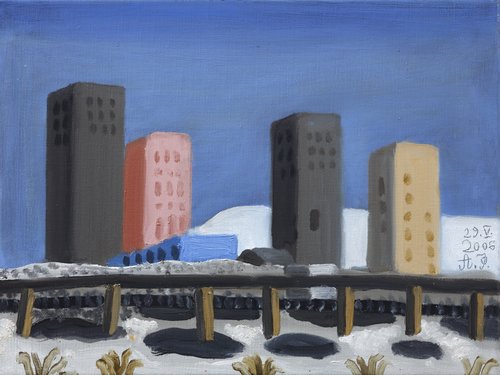
A distinctive feature of Vladimir Shinkarev’s painterly manner was his particular handling of light and shadow, as well as the subdued, at times even somber, palette of his works. Responding to questions about why his paintings contain so much darkness, and what the sharp, contrasting patches emerging from near-total blackness – reminiscent of black-and-white photographs – are meant to convey, Shinkarev said in one interview:
“Contemporaneity is associated with bright color – the vivid aniline hues of advertising that have stuck to the body of the real world as if draining it of all its natural colors. Now the real world is best depicted in muted tones like mine. Not exactly gray but restrained. It is, in a way, the colour of resistance to this garish modernity.”


“Not everyone yet understands the significance Volodya had for our city and for the country,” says Dmitry Shagin. “Those remarkable books he created – Maxim and Fyodor, Mitki, Papuan from Honduras – will be studied for a long time to come. He played a very important role in the history of art in Leningrad then St. Petersburg. Yes, he had been ill for a long time, but he still had so much energy, he was constantly drawing! Recently, at the beginning of April, an exhibition dedicated to the musketeers and cold weapons opened at the Athos Gallery, where his works are on display. An exhibition of his paintings in Nizhny Novgorod was also planned. There were many plans, and I hope they will happen – so we are not saying goodbye to him.”

This article was first published in Russian on the website of The Art Newspaper Russia on 20 April 2026.