

Petr Shvetsov: Painting the Swamp Between Nature and Abstraction

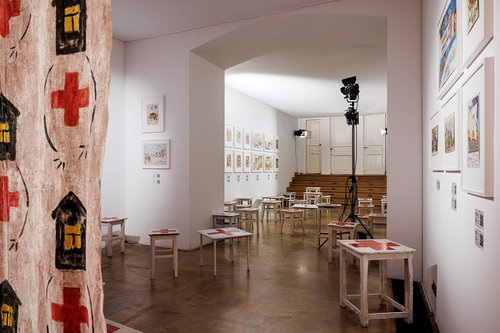
Petr Shvetsov. No. 14. Exhibition view. St Petersburg, 2026. Courtesy of Marina Gisich Gallery
St Petersburg-based artist Petr Shvetsov has spent the past fifteen years returning, with obsessive consistency, to the swamp – at once concept, symbol and painterly problem. In his hands, this murky, resistant matter becomes a kind of fermentation: a chromatic, neo-expressionist language that is unmistakably his own. His new solo exhibition, No. 14, at Marina Gisich Gallery presents the latest iteration of this seemingly inexhaustible motif.
Petr Shvetsov (b. 1970) belongs to the generation that came to prominence in the 1990s, and his work has since become a fixture of the St Petersburg art scene. Since 2005 he has collaborated with leading local galleries, though his commercial breakthrough came only in the past decade. Working across drawing, printmaking, painting, sculpture, objects and installation, Shvetsov brings a singular, resolute artistic will to each medium. It may be for this reason that the Dionysian tends to prevail over the Apollonian in his practice: transgression is valued exceptionally highly, and painterly affect consistently takes precedence over harmonic coherence.


Shvetsov does not give interviews and, as a matter of principle, declines to comment on his own art, leaving that task to exhibition curators and critics. Over the course of his career he has realised around forty solo projects. One of the few exceptions is a video interview from 2020, in which he says:
“My head is a very dark and dusty room. In its various corners there are things that are hard to make out, and it is generally safer not to go poking about in those corners, because something might leap out and it would be very, very frightening. Roughly speaking, I think of art as an activity based on a remarkable glitch in the human mind. An animal perceives a painting for what it is – a piece of fabric stretched over a piece of wood and covered with several layers of pigment, nothing more. There are no women in it, no swamps, no pelts – those exist only within us, they are a product of our minds, their strange and wild games.”

He continues: “What matters most to me is the emotional and intellectual impact on the viewer. That is far more important than any meaning I personally wish to put into a painting.”
Like many of his contemporaries, Shvetsov entered the profession at a moment of political openness and renewed international exchange. He took part in artist residencies in Denmark and the United Kingdom and, over several decades, spent extended periods in Vermont, immersing himself in the local artistic community. For this generation, contemporary art revealed itself for the first time not as a dead museum commodity, but as a living, mutable practice – one that demanded active engagement. Shvetsov and his peers approached it with a naturalness and ease that remained rare within the Russian artistic milieu of the time.

Shvetsov graduated from the Secondary School of Art attached to the Academy of Arts and developed professionally within the circle of the Union of Artists’ lithography workshop – an institution that, under various names, has existed in Leningrad/St Petersburg since 1933. It functioned as a site of direct transmission not only of graphic mastery and a distinctive tradition, but, above all, of a free creative spirit. Shvetsov first gained renown as a draughtsman and master lithographer. He experimented with techniques and materials, and in exhibition contexts he has not hesitated to adopt installation strategies; over time, however, his focus has increasingly shifted toward painting. He works in large cycles that unfold gradually over many years. Among the subjects that have absorbed him are the female nude and boxing, aviation and the navy, biology and archaeology – all ultimately subordinated to a primary aim: the resolution of formal problems as he develops his own artistic language.

Shvetsov’s new exhibition at Marina Gisich Gallery, which is on view until 21 April, a venue with which he has worked consistently since the late 2010s – returns to a subject that has preoccupied him for some fifteen years: swamps. The motif entered his practice as an extension of a longer-standing fascination with living and dead nature, following such solo projects as ‘Columbarium’ at the St Petersburg Museum of Geological Exploration (2002) and ‘The Living and the Dead’ at Anna Nova Gallery (2007). Together with other exhibitions, these projects amounted to a declaration of Shvetsov’s affinity for the natural history museum and the Wunderkammer – along with the animal illustrations found in the books of Alfred Brehm and John James Audubon. A second-hand 1926 publication, ‘Swamps: Their Formation, Development and Properties’, became a key tool in developing the theme. Working from the blurred typographic reproductions of black-and-white photographs, Shvetsov translated them into graphic sheets and mixed-media canvases. The sense of the swamp is conveyed through a brutal neo-expressionist idiom, with recurring allusions to Anselm Kiefer (b. 1945).

He continues this painterly trajectory in his current exhibition, titled ‘No. 14’. Shvetsov does not disclose the meaning of the number, yet its stark enumeration inevitably recalls the vocabulary of abstraction. In the new canvases he turns more directly to the procedures of expressive abstraction – most obviously in a register associated with Gerhard Richter (b. 1932). The reception of these works has also been indirectly shaped by two recent St Petersburg exhibitions devoted to masters of Russian landscape painting: Fyodor Vasilyev (1850–1873) and Arkhip Kuindzhi (1842–1910). Both nineteenth-century artists sought solutions to pictorial problems that exceeded the conventional limits of landscape – and in doing so, they prised the genre open. Shvetsov’s latest paintings, with their scale and chromatic intensity, suggest affinities not only with German neo-expressionism but, more compellingly, with Claude Monet’s water lilies panels at the Musée de l’Orangerie. Notably, the exhibition has already shifted: the day after the opening, part of the hang was changed after the abstract triptych ‘Eclipse’ (200 × 460 cm) – priced on the gallery’s website at €35,000 – was reserved by a client.

Over the years of Shvetsov’s preoccupation with swamps, the motif has undergone a marked transformation. In St Petersburg – founded, in the Dutch manner, on a coastal lowland – the word “swamp” functions less as literal description than as trope, a kind of synecdoche. In political vocabulary, too, the “swamp” has been in circulation for more than two centuries, since the emergence of the first European parliaments. The term “quagmire”, naming the swamp’s defining property and inner core, has in recent years come to describe not so much a natural condition as a social one. As a state of matter, the swamp also evokes the phenomena of organic life – slime and mould – which have accrued a quasi-philosophical status and become fashionable cultural subjects. The point is registered as readily in the popularity of kombucha as in Ben Woodard’s ‘Slime Dynamics’, with its fascination for “dark vitalism”. This constellation of associations Shvetsov translates into painterly terms through drips – runs of paint deployed as a deliberate technical device.

Shvetsov is by no means a naturalist painter; rather, his practice corresponds fully to the logic of post-mediality. In depicting swamps he draws on photographic material – imagery that has also been incorporated into the gallery’s design for the present exhibition. The paintings produced in recent years adopt an intonation familiar from mass culture, recalling scenes – and, in particular, the climactic final sequences – of film and television in the register of the mystical detective thriller.

From a cultural point of view, the swamp is a complex, almost illegible natural text: a vivid example of nature prevailing over every attempt to impose order on an unordered whole. Shvetsov sets out to translate this integral language of nature into the analytical language of art. Captivated by a problem that is, in essence, insoluble, he scarcely registers the inevitability of failure – because in pursuing it he continually generates a host of technical and formal challenges that are genuinely compelling to a painter. When the artist yields to the will of nature, the picture plane becomes a site of semi-automatic mark-making, a free unfolding of painterly improvisation. Yet amid the strands of bottom-dwelling silt and the tangles of roots, the eye still searches for ornament and begins to detect pattern. Shvetsov works within the tradition of landscape painting, but in these new canvases he subjects it to a kind of fermentation: in a caustic chromatic solution, pictorial form – and with it the artist’s intention – softens toward putrefaction, losing its distinct outline and stable shape.