

Painter Klara Golitsyna Turns 100

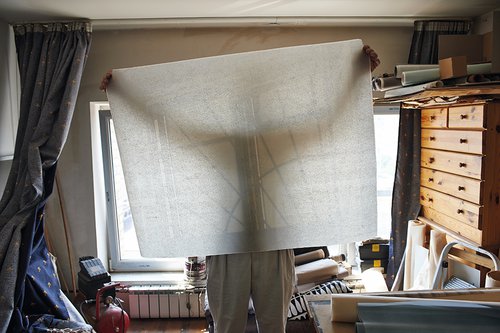
Klara Golitsyna. Two. Courtesy of the artist
Moscow artist Klara Golitsyna has just celebrated her centenary. Although her journey onto the art scene has been long and complex, she has become a symbol of devotion to art, optimism and resilience for several generations of Russian art lovers, and an artist that Art Focus Now’s Ekaterina Wagner has long admired.
Time seems to work differently for Klara Golitsyna (b. 1925) than it does for the rest of us. She started exhibiting her work during Perestroika when she was in her sixties. When I interviewed her for a now-defunct art magazine at the age of ninety, she was painting two or three works every day and had three solo exhibitions concurrently. Now, at 100, she is still alert and active, although her hearing is not what it was and she now communicates with the world through messaging apps on her smartphone. When I recently reached out to her, she was working through an avalanche of ‘Happy Birthdays’, replying to each one individually. We chatted briefly about the latest news. “I am happy that Trump wants to end the war. You know which one”, she texted me. Golitsyna is a tiny woman who looks so fragile that you can’t help but wonder where her strength comes from. It is this strength that has allowed her to survive the numerous twists and turns of Russia’s turbulent history over the last hundred years, as well as many personal crises.


As a teenager, Klara Golitsyna had no ambition to become an artist. She found herself studying at the Moscow Polygraphic Institute almost by chance. During World War II, like many Muscovites, she fled the city in 1941. When she came back two years later to enroll on the Physics and Mathematics course at Moscow State University, the application period had already closed. As groceries were rationed at the time, she had to find somewhere else to get her food coupons. She had enjoyed drawing from an early age, so she chose what was called the ‘Polygraph’. Her mentor in drawing at the university, artist Nikolai Vysheslavtsev (1890–1952), sparked off her interest in art. Two years after graduating, she married the actor Ivan Golitsyn who was twenty-three years her senior. An amateur artist himself, he supported her artistic endeavours. The couple filled the gaps in their formal Soviet education by exploring art from different eras and styles. 'We would buy books and albums, tear out the illustrations, spread them out on the floor and pick the ones we liked and the ones we didn’t. We tried to understand what made some better than others.” They analysed compositions and trained their eyes to recognise tonality by drawing white on white and black on black. Golitsyn supported her decision to quit her job and dedicate herself entirely to art for ten years – a rare luxury in Soviet society, where the concept of a ‘housewife’ was almost non-existent, and most married women had to work full-time to make ends meet. It was only in 1962, when he retired from the theatre, that Klara Golitsyna went to work in a design bureau, since his government pension was too small for them both to live on. Yet she dedicated all her free time to making art. With her characteristic optimism, Golitsyna said that, however tedious her day job was, it did not interfere with her artistic practice. Meanwhile, many of her peers who worked as book designers or illustrators in publishing houses had to waste their creative energies on state sanctioned projects


Following her husband’s death in 1980, Golitsyna became interested in the vibrant young underground cultural scene of the time. “My home became a gathering place for young people: hippies, punks, musicians, poets, and artists. I was around 60 years old, and they were aged between 18 and 37. Eighteen-year-old Gosha Ostretsov would come, and Anatoly Zverev would drop in every once in a while. I once made a drawing of Zverev when he fell asleep in my kitchen after drinking too much.” From the late 1980s onwards, when censorship restrictions were lifted at the height of Gorbachev’s perestroika, she took part in numerous exhibitions in the USSR and abroad. These took place in locations ranging from Slovakia and France to Portland, Oregon. She made tourist trips abroad and all over Russia, and the albums she filled with photographs taken during these travels served as a source of inspiration in her work for many years.


Golitsyna’s early art was clearly influenced by international modernism, which Soviet artists began to discover in the late 1950s. Her generation saw works by Henri Matisse (1869–1954) and Pablo Picasso (1881–1973) that had been unearthed from the storage of the State Pushkin Museum and displayed in its halls after the death of Stalin, before they discovered Kazimir Malevich (1879–1935) and Wassily Kandinsky (1866–1944). She experimented with different styles and techniques and could never definitively choose between figurative and abstract painting. Like Rembrandt van Rijn (1606–1669) she never tired of creating self-portraits, experimenting with new methods of expression using the most familiar and readily available subject: herself.


It took her several decades to develop her own distinctive style, amidst circumstances that bring to mind the cliché, what doesn't kill us makes us stronger. “My hearing started to deteriorate in the late 1990s,” Golitsyna once explained to me. “It faded at different degrees on different frequencies. I could still talk to people using my hearing aid, but I could not listen to music; the melody would get distorted.” For an avid music lover like Golitsyna, this was a tragedy. “I could not live without it. Yet my body has found an alternative, replacing music with the rhythm of lines,” she recalls. When drawing from nature or photographs, she identifies the key points in an image, marks them with dots, and connects these dots with lines. Thus, Golitsyna reveals a hidden geometric structure of reality, conquering the chaos of visual impressions and turning them into something meaningful: a rigid, organised network of lines. From that moment on, the distinction between figuration and abstraction became insignificant. She would often start a picture with a figurative motif and then reduce it to an abstract composition creating an interplay of pure forms. Her choice of materials was no less ingenious.

She started painting on semi-transparent synthetic fabrics used in construction. These lightweight paintings could be viewed from both sides, and curators would often hang them in the middle of an exhibition space rather than on the wall. Golitsyna’s works are held in the collections of the State Tretyakov Gallery, the State Russian Museum in St. Petersburg, and the Moscow Museum of Modern Art. I have long admired her work and I keep a small felt-tip drawing by Golitsyna on my shelf. It is probably one of her many self-portraits, depicting a woman in a red hat in a semi-abstract manner. I even like to think of it as my own portrait. When I recently looked at it, I realized that it is not her awe-inspiring longevity that I envy the most. It is her unstoppable optimism, which can turn tragedies into victories.