

Masha Sha’s Alphabet: Drawing as Bodily Confrontation

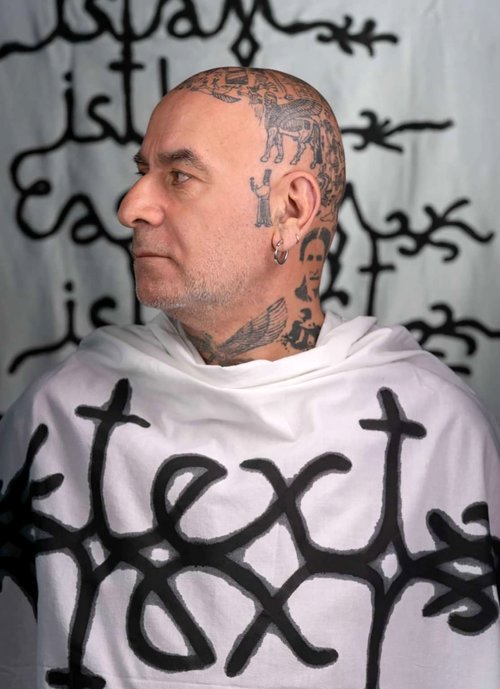
Artist Masha Sha with her work. Courtesy of The RAiR Foundation
Masha Sha’s exhibition ‘August’ at Galleria Jessica in St Petersburg brings together recent large-format drawings, earlier graphic works and video pieces, tracing two decades of the Russian-American artist’s evolution from body-based performance towards an idiosyncratic calligraphic language entirely of her own invention.
Masha Sha (b. 1982) occupies a curious position between two artistic worlds. Now based in Roswell, New Mexico, she describes herself simply as “a Russian artist living and working in the United States” – a formulation that has followed her through an increasingly visible American career. Over the past several years, residencies across the American Southwest and beyond have led to a succession of solo and group exhibitions, among them ‘Unsaid’ at the Roswell Museum (2021), ‘OUTTHERE’ at Wrong Gallery in Marfa (2021), ‘Fall’ at Warehouse 1–10 Art Space in Magdalena (2022), and ‘So What’ at the Galveston Art Residency Gallery (2024).


Sha was born in Chukotka, north of the Arctic Circle, and later moved to St Petersburg, where her studies culminated in the contemporary art programme ‘School for Young Artists’ at the Pro Arte Institute. In 2007, she was awarded a Fulbright Fellowship in Media Studies and moved to the United States. She received her MFA from the University at Buffalo in 2010, before continuing her studies at the Selznick School of Film Preservation at George Eastman House in Rochester. Around this time, she shortened her Tatar surname, Sharafutdinova, to Sha, which became her artistic pseudonym.
The artist began working with video performance in 2005, exploring the limits of corporeality in early works that brought her initial recognition and reveal a clear debt to Viennese Actionism. In the early 2010s, she turned to drawing for the first time, despite having no formal training in the medium. From the outset, Sha developed a distinctive technique and set of working habits that would establish drawing as the medium that defines her practice today. She works on thin, translucent supports – sheets and rolls of tracing paper, the first of which came from her grandfather’s stores – using graphite, black or coloured pencil, and occasionally wax crayon. Above all, she prizes old and found materials, whose histories become part of the work itself.
Every drawing by Masha Sha is a direct embodiment of the time and labour she has invested in it. The act of drawing carries the same corporeality and transgressiveness as her early video performances – she works with total physical commitment, covering the studio floor with paper, adding and extending sheets as the drawing develops, often leaving tears in the surface with her pencil that resemble wounds or scars. Among the associations such a method inevitably evokes ‘Pencil Mask’ a 1972 performance piece by Rebecca Horn (1944–2024).


After a tragic fire in her studio her practice underwent a marked shift, and for the past decade she has been preoccupied with text and language, developing what amounts to an alternative, personal calligraphy. In recent years, thanks to her work at artist residencies, large-format pieces spanning several metres have become more frequent. One is tempted to call Masha Sha’s letterforms a “prepared script,” in the spirit of John Cage’s prepared piano. “The complexity and unease bound up in unlocking the meanings of words and phrases occupy a central place in my thinking,” is how the artist puts it.
It was through drawing that Masha Sha began her return to the Russian art scene. Her first works were shown in 2014 in ‘The Other Capital’ at the Museum of Moscow and ‘Contemporary Drawing’ at the Russian Museum, followed by two solo exhibitions at Name Gallery in St Petersburg: ‘Approaching the Monster’ in 2015 and ‘I Am Far Away’ in 2020. More recently, she has developed an ongoing collaboration with Jessica Gallery, a young gallery associated with the Limonov Art Foundation, established by Sergei Limonov, one of the more prominent collectors of Russia’s new generation. Jessica presented Sha’s work at Cosmoscow in 2024, followed this year by |catalog| in Moscow and Contour in Nizhny Novgorod. ‘August’, currently on view at the gallery, brings together her most recent drawings with earlier works on paper and several video pieces, offering a broader view of the development of her practice.


Speaking after the opening, Masha Sha described her art in these terms: “For me, every drawing is a confrontation with the present. My drawing is chaos, and wonder, and surprise – a chance encounter with something, somewhere.” Her works, which could be classed within the tradition of Lettrism, establish clear ties with predecessors and peers across art history. The Futurist and Dadaist experiments with the typographic case, the lettering of Expressionist-era magazines and posters, and the inscriptions and texts found in Art Brut all find an original and organic continuation in her drawing – shaped by the size of the sheet, the quality of the paper, and the length of the pencil lead, but above all by the artist’s emotional investment. “I know when a work ‘stands on its own feet’ or not and I have sharpened that instinct over time. I still do not believe an artist improves simply by spending more hours in the studio. Everything develops over years, through life experience, through some inner sense. Depending on your mood, your state of mind, your age, certain phrases catch your attention, and you notice them. Of course you come to trust your own judgement, and now I trust myself more than I used to – and that brings with it a kind of freedom and joy” she says.

Like painting, these drawings operate across several optical and semantic registers: letters crowd and curve across the surface of the sheet, gradually resolving into words and phrases while retaining the qualities of ornament. Up close, the surface and texture of the drawing become active, with countless strokes running in different directions holding the space of the sheet together and giving it its ‘air’. As curator Aaron Wilder observes: “The word emerges not through direct inscription, but through negative space carved out of dense fields of mark-making. In this sense, language is not simply written but excavated, revealed through absence as much as presence.”
The synthetic quality of Masha Sha’s art is expressed through the drawing itself and through her handling of techniques and materials: her works have an almost architectural relationship with space, particularly evident in the larger-format sheets. As the artist explains, “There is a physical evolution in how freely I handle the sheet. My first texts were drawn from one edge to the other. Then, gradually, I started to leave certain edges unfinished, an evolution that has taken years. The real freedom with text, the moment I realise I have not finished a drawing, did not come to me straight away either. How much stays finished, how much stays unfinished – that is an interesting space.”


In one work from ‘August’, the Russian words «Будущее будет» (“The future will be”) tumble into the right-hand corner of the sheet and press against its raggedly torn edge, their entire physical arrangement conveying both the sense of the words and a broader feeling about the future. In her text-based works on paper, Masha Sha engages with what the Russian Formalists called the “material and formal parts of the word” (that is, what a word denotes and what it is lexically), foregrounding the “shape of the word” in their sense – her works enact what Yuri Tynyanov described in his 1924 study ‘The Problem of Verse Language:’ “the wavering markers of meaning come alive within the word.” The artist follows the advice of another 20th century Russian writer, the celebrated absurdist Daniil Kharms, whose prose and poetry she has also drawn on: “To the remark, ‘You’ve made a spelling mistake,’ reply, ‘That is simply how it looks in my handwriting’.” In many works she plays with bilingualism, combining languages such as English and Russian, or English and Spanish, so that an American audience grasps only half the meaning: a large sheet of tracing paper, composed in a manner close to poster design, is filled with the English word ‘Wolf’ and the Russian ‘Волк’, partially overlaid on on top of the other. Some works she presents as a single double-sided object – seen with light shone through it the drawings on the front and back merge into a complex interweaving of different letters and alphabets, creating further obstacles to reading and slowing the viewer's grasp of meaning. “I work differently now than when I first began working with text. How do I find what to write? I read a book, and suddenly, ‘Ah! That’s what I must write.’ A thought in my head, or a sentence in a text takes on a life of its own and I find myself inside it, because I am thinking about the same thing,” she says.

In her most recent works, the expressive tension seems to have found a different kind of harmony: after the initial manifestation of the graphic mark, each stroke asserting its right to exist outward into the world, the emphasis shifts to the plastic relationships within the sheet itself. Dense fields of colour – the blackness of graphite, the silver of pencil, the shimmer of coloured moiré – now spread across the sheet and settle onto its surface with the organic quality of creeping plants or electromagnetic fields. Perhaps these new formal moves carry something of the desert landscape of New Mexico and the town of Roswell, known above all as the site of a supposed UFO crash?
The projects Sha has made in recent years, in both America and Russia, are marked by a precise sense of tone suited to each exhibition. Among the list of images and associations noted in her sketchbook for ‘August’, tied to the calendar month, is one that seems to capture something that many different people feel today: “Hope for hope.”