Konovalova-Infante’s Shadow Play

Daria Konovalova-Infante. The Secret Life of Things, 2026. Courtesy of the artist
At Moscow’s Cube Art Centre, Daria Konovalova-Infante presents ‘The Secret Life of Letters’, an exhibition at Artmag gallery bringing together five hundred works from her best-known project, ‘The Secret Life of Things’, an epic series of playful watercolours exploring the unexpected relationships between objects and their shadows.
How can one relatively small room accommodate five hundred works of art, and why should it? In the case of Daria Konovalova-Infante (b. 1978), there is a straightforward answer: the artist wanted, at last, to see her ongoing project, developed over some fourteen years, in its entirety and to share it with the public. ‘The Secret Life of Letters’, curated by Artmag’s owner Elena Krylova, is essentially a catalogue spread across four walls. With the exception of a new series of thirty-three drawings dedicated to the Russian alphabet, the exhibition consists of printed reproductions rather than original works. A traditional book catalogue is also in preparation, with the artist overseeing the layout herself. After so many years working on this project, she has decided to revisit its beginnings.

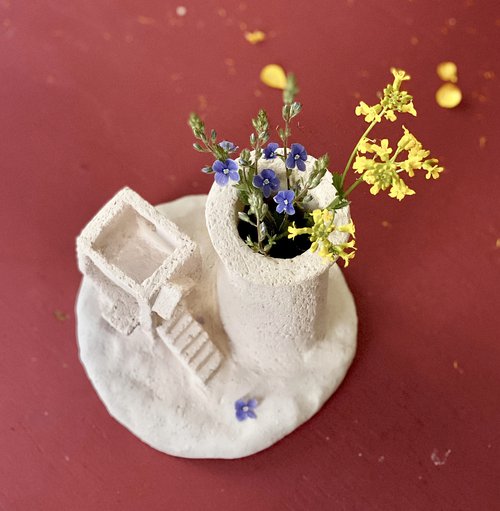
Daria Konovalova was born into a family of artists, photographers, and actors, so her choice of profession was more or less predestined. She enrolled at the Moscow Academic Art Lyceum of the Russian Academy of Arts at the age of eleven, and later took a ceramics course at the Stroganov Academy of Design and Applied Art. She married into a well-known and prolific artistic family: her husband, Platon Infante (b. 1978), is an installation artist and the son of the renowned Russian non-conformist, Francisco Infante-Arana (b. 1943). For many years, abstract ceramic sculpture was her preferred medium. However, her most significant and popular project to date is a series of drawings united by one motif: an object and its shadow that resemble something entirely different.

According to an ancient legend, the origins of art as we know it lie in a shadow. Pliny the Elder recounts the story in his ‘Natural History’, describing how the world’s first portrait came into being: the daughter of a potter named Butades of Sicyon is said to have traced the shadow of her lover on a wall as he prepared to depart for war. Later artists transformed the legend into a popular iconographic subject known as ‘The Birth of Painting’. Yet they seem to have overlooked the story’s ending: in Pliny’s account, it is not simply about painting, but about sculpture – or, more precisely, both. The potter pressed clay over the outline drawn by his daughter, creating a relief. In modern terms, the shadow became the starting point for the world’s first multimedia art project. The story of Konovalova-Infante’s ‘The Secret Life of Things’, by contrast, unfolded in reverse: from three-dimensional form to flat surface.


In 2016, for an exhibition at MMOMA, she created an installation titled ‘Forest’: a wooden block casting a shadow in the form of a video projection of a living tree. Then, in 2020, reality fractured, and the world fell under the ominous shadow of an unknown threat. As the pandemic forced museums to close, large-scale exhibition projects ground to a halt. Yet, unexpectedly, online art sales flourished on Facebook, whose parent company, Meta, was later designated an extremist organisation by the Russian authorities. The group ‘Shar i Krest’ [The Ball and the Cross], founded by gallerist Maxim Boxer, became a lifeline for many, offering respite from the stress of enforced isolation and the relentless stream of disturbing news. For artists, it also provided an opportunity to earn a living – sometimes their only one – during that strange period when the world suddenly shrank to the size of a computer screen.

Konovalova-Infante posted watercolour sketches for an installation in the group, and they sold out within hours. Encouraged, she decided to continue. “I always dreamed of making works on paper, but never had the time,” she recalls. Her trademark became witty visual puns in which the shadow of one object transforms into another, and an image becomes its opposite. During the first year of the pandemic, she produced almost three hundred such works, collectively titled ‘The Secret Life of Things’.
Despite its success on Shar i Krest, ‘The Secret Life of Things’ cannot be regarded simply as a product of pandemic anxiety. The roots of the project reach back to the artist’s childhood and her years at art school. “I absolutely loathed drawing because it was all so grey and dull,” she recalls. “My dad started setting up still lifes for me with contrasting colours and black shadows.” She traces the series itself back to 2012, when she created its first watercolour. It has since grown to encompass seven hundred works on paper, all now in private collections. With many of the originals difficult or impossible to trace, five hundred reproductions were made for the exhibition – as many as the space could accommodate – allowing the public to see almost the entire project together for the first time. The series has also inspired a painterly offshoot: vibrant acrylic canvases measuring one metre square. Following the end of lockdown, the artist returned to creating shadow installations. Although these fall outside the series, they remain closely connected to it in spirit. Is this not multimedia in the spirit of Pliny’s ancient tale?

From Hans Christian Andersen to the twentieth-century Russian playwright Evgeny Shvarts, literature is full of stories in which a shadow abandons its master, takes on a life of its own or even begins to dictate its master’s actions. Something similar has happened with ‘The Secret Life of Things’. Konovalova-Infante admits that the series has begun to shape the way she perceives everyday reality: “It has somehow got under my skin.” She now sees suggestive shadows everywhere. The effect has proved contagious: admirers of her work have joined in, with collectors sending her photographs of shadows that “look like something”. Some even commission drawings, proposing subjects of their own.

Yet beneath this seemingly playful visual game lies a more serious idea: that reality has a hidden dimension, and that there is more to any object or human being than meets the eye. The artist’s perception of the world is shaped by a yin-yang duality: look closely enough at anything, and the shadow of its opposite begins to emerge. In Konovalova-Infante’s drawings, objects and their shadows can readily exchange places, as though in a dream or fairy tale. A Kremlin tower can become the shadow of London’s Big Ben, and vice versa. The shadow thus becomes a metaphor for those aspects of the world, and of ourselves, that remain unseen or are deliberately ignored. It is a metaphor that has long fascinated philosophers and thinkers, not least Carl Jung, with his concept of the shadow self.

Yet Konovalova-Infante does not confine her work to this theoretical framework. She continues to explore new forms of shadow play, taking the project in unexpected directions. In the ‘Big History of Art’ subseries, for example, she draws surprising connections between masterpieces from different periods and artistic traditions. For the exhibition ‘The Secret Life of Letters’, she created an alphabet of shadows comprising thirty-three drawings representing the letters of the Russian alphabet. Here, she turns the traditional concept of a children’s alphabet book on its head: the letter is “real”, while the object it represents exists only as a shadow. It is a warning that feels particularly timely in an age of fake news and post-truth, when our perception of reality is increasingly shaped by the media.

Daria Konovalova-Infante. The Secret Life of Letters
Moscow, Russia
7 November – 6 December 2026