

Growing Wild: Dmitry Bulnygin

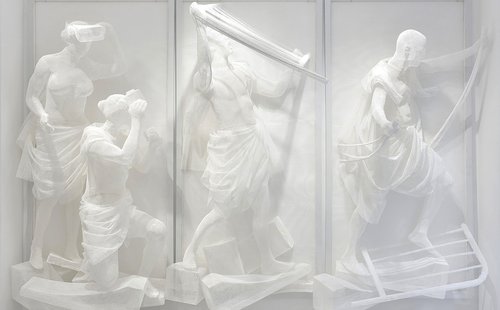
Dmitry Bulnygin. Temples, 2012-2013. Courtesy of the artist
Born in Russia and today living in France Dmitry Bulnygin is best known as a pioneer in the nascent video art scene in his home country but now he works mostly in sculpture. From the industrial wastelands of Siberia to a repurposed French factory on the edge of an enchanted forest, he makes art from bones, wire, and rubbish finding an unlikely eloquence in discarded materials that video alone could never quite contain.
Originally from the Siberian industrial city of Novosibirsk, Dmitry Bulnygin (b. 1965) now lives in France, about an hour outside Paris. His studio occupies a repurposed factory shared with a collective of artists, on the edge of the protected Sainte-Assise Forest. The setting is strikingly reminiscent of the Zone in Andrei Tarkovsky's ‘Stalker’: a surreal borderland where the rusting relics of the industrial age are slowly being reclaimed by the quiet, relentless advance of nature.
The artists share a sprawling old factory at the former Radio France transmission site, surrounded by the rusted skeletons of the services that once operated here. In this overgrown landscape, Bulnygin hunts for mushrooms and the visual DNA of his sculptures: specimens of flora and fauna that seem to watch him from behind every tree. The factory floor now produces works of art instead of industrial parts; his finished art works stand clustered like new cars outside an automobile plant, waiting for the curators and collectors brave enough to make the pilgrimage from Paris to claim them.


Among these sculptures are several by Bulnygin. He now creates images of animals and plants, both real and fantastical, using sheet metal and wire, pieces of wood, papier-mâché, animal bones, empty plastic bottles, everything that some would call rubbish and others “deliberately poor materials.”
The word “rubbish” does not scare him: “French garbage dumps are wonderful, like a shop for an artist: you can find everything you need.” A sculpture he assembled from empty plastic bottles sits in the grass in front of the building. It used to stand upright and looked like the trees from his series ‘Banyan’ (2023). The sculpture could not cope with the rain; as the bottles filled with water, the added weight caused the structure to collapse, shifting the work from a vertical piece to a horizontal one. It reminds me of his video ‘Soyuz-11,’ where a multi-story structure of sugar cubes dissolves in water, its form and construction shifting by the second.


In Russia, when asked what Dmitry Bulnygin is best known for, curators invariably point to his videos – short works that combine playfulness with a striking degree of abstraction. He arrived in Moscow from Novosibirsk as one of the leading representatives of the Siberian video art scene, now most closely associated with the Blue Noses group. Bulnygin knew its founders well: Vyacheslav Mizin (b. 1962), who graduated from the same institute in Novosibirsk, and Alexander Shaburov (b. 1965). The group, celebrated for what they termed “Siberian ironic conceptualism,” first attracted attention through the action Shelter Beyond Time, in which a group of artists sealed themselves inside a disused bomb shelter for three days, imagining the conditions of artistic life after the apocalypse. Bulnygin participated in the making of the video work ‘In Bunker’ (1999), filmed during this three-day experiment in information deprivation. Yet he has always maintained a certain distance from the Blue Noses, gently correcting those who attempt to attach the group’s now-iconic blue bottle-cap nose to his own artistic identity. Their comic, Sots Art-inflected practice – which repeatedly brought them into conflict with the Russian authorities – has never fully reflected Bulnygin’s own concerns. Whether featuring human figures or purely abstract forms, his videos pursue a quieter, more contemplative and distinctly more abstract visual language.

Dmitry Bulnygin. Datura, from the ‘Weeds’ project, 2025. Courtesy of the artist

Dmitry Bulnygin. Unknown, from the ‘Weeds’ project, 2026. Courtesy of the artist

Dmitry Bulnygin. Hemp sprout, from the ‘Weeds’ project, 2025. Courtesy of the artist

Dmitry Bulnygin. Burdock, from the ‘Weeds’ project, 2025. Courtesy of the artist
Shot on camera or edited on a computer, his precisely timed works are extremely short, yet so concentrated that they can be harder to watch than a three-hour film. They are strikingly diverse and revel in their lack of meaning or any obvious purpose. They are flashes of consciousness, memories of the past and the future, games with movement and color.
In ‘Why, Lord?’ (2001), Bulnygin tells the story of a dog dreaming of its owner’s pure and unconditional love, only to watch, through canine tears, a sexual encounter involving its beloved master. In ‘Lola’ (2000), the artist performs naked in an ecstatic dance to a song by Marlene Dietrich from the film The Blue Angel. Then there is ‘Oi, ne-ne, ne-ne!’ (2009), a frenetic dance to the music of a Roma orchestra performing at a feast hosted by Zurab Tsereteli, attended by Joseph Backstein, director of the Institute of Contemporary Art Problems. Filmed with the casual immediacy of a home video, it could just as easily have been the work of a hired cameraman. ‘Untitled/Tennis’ (2007), meanwhile, seems almost deliberately designed to appeal to voyeuristic curiosity. These are just a handful of the dozens of videos available online and through Bulnygin's own archive, each revealing a different facet of his singular artistic imagination.


Watching Bulnygin's videos one after another, one is left with the impression that he has never sought to cultivate a single, easily recognisable authorial style. If such a style exists, it lies in the subtle threads connecting the works - in the way a narrative, motif or formal device quietly reappears and evolves from one piece to the next. At the Extra Short Film Festival (ESFF), which Bulnygin founded in 2000, many of these films could easily have been mistaken for the work of entirely different artists. Organised by Bulnygin himself, the festival ran successfully for thirteen years before coming to an end. “Too much trouble and zero support,” he explains.
He also expresses frustration with the increasingly demanding technical requirements of contemporary video art: “I am very intolerant of excesses, of anything unnecessary. When the technology and requirements keep constantly growing, the work turns into torture.” Yet he has not abandoned the medium. From time to time he produces video mixes set to music, alongside video sculptures created through projection mapping onto sculptural forms of his own making. These sculptures become integral elements of his exhibitions and frequently reappear within the videos themselves, as in ‘Monument’ (2013).

Having graduated from the Novosibirsk Architectural Institute, he knows how to work with both material and space. He masters classical drawing and the language of architectural models; he was trained in works on paper, painting, and sculpture, as in the USSR architects were taught “the classical way.” An ironic reflection on this background appears in works like ‘Supplies’ (2011), with growing and collapsing sugar skyscrapers, and even more clearly in his models of temples of both known and imagined religions such as in ‘Temples,’ (2012–2013), made from children’s blocks and coloured vegetables, with minarets from red peppers and an Orthodox dome modelled from a beetroot.
Now, in the outskirts of Paris in the forest of Sainte Assise, having left behind large cities and their aggressive architecture, he creates works more closely tied to nature, in the environment where he lives. “I describe what I see, what comes into my head where I am living. I keep a diary of interesting observations, both around and inside me.”
Like a true architect, he reconstructs the load-bearing structures of ferns and grasses in his sculptures from the series ‘Winter Herbariums’ and ‘Weeds Between the Pages.’ “I would like to express my admiration for the diversity of weed forms and their vitality, which they demonstrate while existing outside the advantages of civilization,” he explains. He studies plants not as the proponents of “architectural bionics” did in the 1980s, designing buildings after broccoli or bamboo. He prefers to act as a faithful copyist of nature, though he uses entirely non-natural, post-industrial materials, such as scraps of wire, braiding, reinforcing rods, roofing tin, and aluminum from cans. Without concealing the roughness of the material, he strives for maximum resemblance and character.


His works perhaps recall the classical botany of Albrecht Dürer (1471–1528), the same attention to plant architecture, the same readiness to endow it with character, even to introduce fantastical details when needed. The material, however, is not drawing, gouache, or watercolour, but iron. He is trained in drawing, yet he “grows” form from iron without sketches or plans, as nature itself does. One of his botanical sculptures stands by the outer wall of the studio building; slightly rusted after a damp spring, from afar it looks like an ordinary bush.
Paradoxically, even the smell of iron reminds him of his childhood in Novosibirsk. “My father was the director of a metalworks. I have known the smell of iron and welding since I was a kid. In the past I used the material to make structures; now, it has become a main focus in its own right.”
Another material he uses today is animal bones. He deconstructs the skeletons of animals or birds, recovers the bones, and uses them to create new structures, like a child taking apart a Meccano set to assemble something new, like a sculptural tree he has made from 125 bones from a chicken. His works, incorporating elements of real life in the spirit of Doctor Frankenstein, combine metal parts, down, feathers, bones, and shells, from which new, non-existent creatures emerge, still retaining a direct connection to nature.
The use of bones suggests a kind of collaboration with insects. “I just need to bury a skull in an anthill for half a year to get it ready for me to use,” Bulnygin explains. He also describes the constant presence of wood-boring insects in his wooden sculpture made from a fungus-covered birch trunk. These invisible co-authors make themselves known through the wood dust accumulating on the floor beneath the piece. Wood is of course a natural material for an artist living in the forest. His series ‘Suckling Pigs’ is carved out of logs. As we talk in his studio by the stove, he shows me several logs and reveals that in winter he has to decide what to do with each piece, a dilemma familiar from Pinocchio: to burn it for warmth or to make a new soldier for his piglet army. The series develops, and one of the latest works is a piglet carrying on its back the iron frame of a Gothic cathedral, a piece both strikingly contemporary and traditional.


For those lamenting Bulnygin’s latest chapter in which he appears to have abandonned the medium of video, at sixty, he is surely far from the end of his career. There is, of course, the inevitable tension between commercial viability and experimental practice. In the era of grants, video and installations flourished; now he turns to more collectible formats and techniques, sculptures better suited to galleries and museums than to festivals.
But the works he produces today are no less compelling, preserving that same punk spirit of negation: the use of discarded materials, and a raw rhythm that manifests not in a soundtrack, but in the strike of a hammer or the whir of a drill in his forest workshop. There is just as much fire in the welding machine and the ceramic kiln. His identically carved piglets, his termite-like structures devouring furniture and encroaching on space, his iron plants growing as if in the wild, all form a poetics of decay and posthumous reassembly as powerful and as free as his earlier videos.

And just like his enigmatic short videos, his works do not demand explanations, just that we quietly observe and describe them. They simply accumulate in the grass, by the wall, in the studio, gradually changing: rusting, settling, sometimes breaking, sometimes seeming to continue growing. And if one looks closely, there is no artistic gesture here, no attempt to prove anything, only a quiet observation of how new forms of life can emerge from the materials anyone can find in the middle of an enchanted forest.