

Garunov and Aladdin’s Magic Carpet

Aladdin Garunov. Total Prayer. Courtesy of Moscow Museum of Modern Art
The Moscow Museum of Modern Art is showing a long overdue retrospective of Dagestan-born artist Aladdin Garunov who turns seventy this year. Art critic and curator Mikhail Sidlin reflects on the artist’s multi-faceted practice and the phenomenon of post-religious art.
Aladdin Garunov (b. 1956) is an artist from Dagestan, a predominantly Muslim region of Russia tucked in the mountains of North Caucasus, who has lived in Moscow for several decades. His solo exhibition at the Moscow Museum of Modern Art (MMOMA) brings together around one hundred works spanning four decades from the late 1980s to the 2020s: abstraction and figuration, sculpture and installation. Several of the works on show come from both public and major private collections including MMOMA itself, Shalva Breus, and the Sepherot Foundation based in Switzerland.

Aladdin Garunov. Way. Form. Image. Exhibition view. Moscow, 2026. Courtesy of Moscow Museum of Modern Art

Aladdin Garunov. Way. Form. Image. Exhibition view. Moscow, 2026. Courtesy of Moscow Museum of Modern Art

Aladdin Garunov. Way. Form. Image. Exhibition view. Moscow, 2026. Courtesy of Moscow Museum of Modern Art
At the far end of a long corridor on the third floor of a grand old mansion on Petrovka street, a large square hangs on the wall, covered in black artificial fur and crossed horizontally by a wide copper strip. Aladdin Garunov’s assemblage ‘Imitation of the Kaaba No. 5’ functions not only as an architectonic metaphor for one of the world’s most celebrated shrines but also opens the way for metaphysical interpretation: the gleam of sheet copper is set against the depth of black, like the brilliance of light emanating from the “sacred house.”
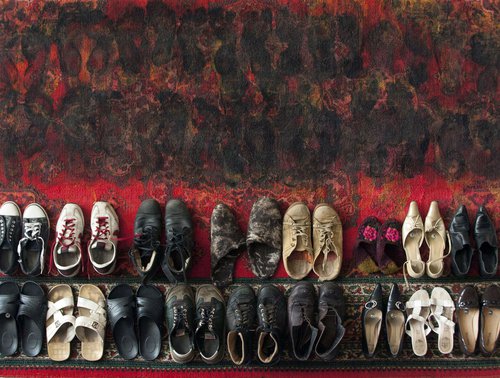
As one approaches the artist's own “Kaaba,” the calls of muezzins and the voices of imams mingle with the noise of European streets. The video installation ‘Total Prayer’ examines the visual presence of Islam in our contemporary world. Along the wall to the right of the entrance, five large screens loop through various scenes: from classic footage of the Hajj in Mecca to the story of a taxi driver who has spread his prayer mat across the bonnet of his car. Opposite the screens, along the left-hand wall, these actual prayer mats are on display, with shoes fixed permanently to them – the series ‘Five Daily Prayers’ (2017). Arguably Garunov’s best-known work, it is the one in which nitro paint on rubber renders the imprints of bare heels, knees, palms, and foreheads above a row of worn, random footwear. This visual image of namaz is perhaps the most powerful work of post-religious art in contemporary Russia.

Garunov’s project reached the final of the coveted Kandinsky Prize in 2012 but was not selected as ‘Project of the Year’, possibly owing to ideological reservations. The ambivalent reception of Garunov within Moscow’s art world is bound up with understandable anxieties about political Islam. But Aladdin presents himself as an investigator rather than an apologist. For in making the religious and the ethnic his subject matter, the artist inevitably places himself – as a subject – outside it. This is less contemporary islamic art than new art about Islam. And that is precisely why it is made in Moscow, at a remove from the geographical zone of tradition. The distinction between religious art and post-religious art lies in exactly this: the former is created from within a tradition, whilst the latter takes tradition itself as its subject.
The “Dagestani” is a recurring figure in Garunov’s artistic universe. Throughout his work, unexpected encounters between old and new materials – antique and technological, ethnic and cosmopolitan – generate a distinctive expressive tension. As the artist explains of his Ethno-Techno series, which greets visitors to the exhibition: “Materials such as rubber, tarpaulin and tar come together and clash with fragments of prayer rugs from Moscow mosques, pieces of fabric, fur and silk, creating a unity and conflict of opposites.”

Garunov frequently employs materials more commonly associated with an automobile workshop than an artist’s studio: thick sheets of rubber recalling punctured tyres, metallic paints suggestive of bodywork repairs, and industrial surfaces marked by wear and use. Alongside these are elements seemingly borrowed from a furrier’s atelier, most notably artificial fur, as well as sheets of copper that might have come directly from a builder’s merchant. In Garunov’s hands, these disparate materials are transformed into a visual language that speaks simultaneously of tradition and modernity, locality and globalisation, memory and technological change.
In Garunov’s dialectic, synthesis is achieved through geometry. In his 2016 ‘Suprematism’ assemblage, rubber strips cover a background of torn vintage kilim glued onto a wooden support – an oval antique table-top, painted bright red. The principal geometric structures with which Garunov works are simple: plane and line, straight and curved, oval and rectangle. Thanks to the heterogeneous materials and textures, geometric forms lose their abstraction, acquiring a tactile warmth. His language is a rhizomatic metaphysics of the geometric avant-garde which, as it proliferates, draws in disparate fields of meaning. The world of Euclid and Malevich, told in the language of an Eastern fairy tale.

Aladdin Garunov. Way. Form. Image. Exhibition view. Moscow, 2026. Courtesy of Moscow Museum of Modern Art

Aladdin Garunov. Way. Form. Image. Exhibition view. Moscow, 2026. Courtesy of Moscow Museum of Modern Art

Aladdin Garunov. Way. Form. Image. Exhibition view. Moscow, 2026. Courtesy of Moscow Museum of Modern Art
The Oriental becomes the meaning-maker in his works, whilst the Modernist furnishes form. Aladdin speaks of the Dagestani in the language of European geometric abstraction and American color-field painting. Garunov’s Islamic post-Suprematism proceeds from foundations common to both the carpet and Malevich – abstraction and the square. Synthesis takes place on the terrain of postmodernism. In ‘Ethno-Techno Suprematism’ (2025), a black square of rubber is set against a piece of industrially manufactured rug on a fluorescent red field: in such a pairing, the black square reveals itself as the proto-form of all forms, whilst the rug becomes an ornament that has blossomed alongside the body of the black square. Works of this kind establish an artist´s mature and recognisable visual language.
The title of his work ‘In the Beginning Was the Rug’ (2015) seems to paraphrase the opening line of the Gospel of John. For Garunov, the carpet is the visual unconscious of Dagestan: whatever he looks at, a rug somehow shows through. This is post-ironic art, in which irony is so thoroughly mixed with pathos that one cannot be separated from the other.