

Anna Jermolaewa in Berlin: A Life in Exile, Reassembled

Anna Jermolaewa. You Can Count on Me. Exhibition view. Berlin, 2026. Courtesy of Molitor Gallery
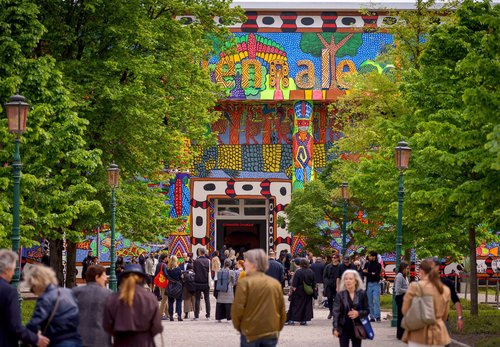
Molitor Gallery is presenting its first solo exhibition by Anna Jermolaewa, the Leningrad-born, Vienna-based artist. Until 18 April, its striking three-storey space on Frobenstraße in Berlin – with its raw concrete walls and internal metal scaffolding – provides the setting for a compact retrospective spanning decades and a wide range of media.
The large wall to the left of the entrance features a site-specific watercolour installation titled ‘Last Seen Since 1970’ (2025–ongoing), with each image representing a species believed to have become extinct since the date referenced in the title. This unsettling coexistence with endangered birds, reptiles, and mammals forms part of a broader thread running through the artist’s practice: a call for empathy and for a better chance for those unable to defend themselves. That appeal may speak equally to animals and to human refugees – like the artist herself earlier in life.

Jermolaewa (b. 1970), a native of Leningrad, fled the Soviet Union in 1989. Two years earlier, she had become one of the first members of Democratic Union, the country’s first opposition party, which called for the “liquidation of the totalitarian state.” Together with her husband at the time the Ukrainian poet Vladimir Yaremenko, and Artem Gadasik, she published ‘Democratic Opposition’, the party’s weekly newspaper, producing it by photographic copying in a bathroom converted into a makeshift laboratory. In 1989, criminal proceedings were opened against them. Although the regime was already beginning to loosen, the accused still faced a real risk of imprisonment; according to information on the artist’s website, the KGB interrogated around three hundred people and carried out more than a dozen searches, confiscating manuscripts.
Anna and Vladimir managed to flee via Lviv, in western Ukraine, after obtaining an invitation through Poland’s Solidarność to visit Kraków. The invitation had been issued in the name of a woman they had never met, Aleksandra Wysokińska, who hosted them for a week on their arrival and then arranged the next stage of their escape by placing them on a Polish shopping coach to Vienna. Twenty years later, Jermolaewa found Aleksandra again in order to thank her for her generosity, and they were reunited once more in 2024. It was from these encounters that the video installation ‘Aleksandra Wysokińska / 20 Years Later / 35 Years Later’ (2009/2024) emerged, exhibited at Phileas / The Austrian Office for Contemporary Art in 2024.

Back in 1989, after reaching Vienna, the fugitive couple spent several nights sleeping on benches at Westbahnhof station, then a month in the refugee camp at Traiskirchen, followed by several months in refugee accommodation in southern Austria before finally being granted political asylum. Anna has lived in Austria ever since, while continuing to travel extensively.
Now, at Molitor, in front of the watercolours, a text burns in bright neon: “Please continue. The experiment requires that you continue”, and so on. It belongs to one of the newest works in the exhibition, ‘Please Continue (after Stanley Milgram)’ (2026). The conformity of human beings who are not necessarily cruel in themselves, but remain susceptible to manipulation, forms a striking visual and conceptual rhyme with the wall of extinction.

In the 1990s, Jermolaewa applied five times in succession to the Academy of Fine Arts and was rejected each time. The experience led her to reassess the original paintings she had been making, which she later described as “quite bad”. On her official website, only one work from that period is listed. The other large-scale canvases she cut into puzzle-like fragments, collectively titled ‘Painting Fragments’ (1992–1996). Suddenly, they could all fit into a single bag.
She eventually graduated in 1998 from the University of Vienna, where she studied art history, and in 2002 from the Academy of Fine Arts Vienna in Painting, Graphic Art, and New Media. It was at this point that her life began to turn decisively for the better. In 1998 she produced ‘Hendl Triptych’, a work that attracted the attention of the renowned curator Harald Szeemann. ‘Hendl’ is the Austrian German word for “chicken”. The piece consists of three looped videos showing chickens rotating in grill ovens at different stages of readiness. Its deadpan treatment of food as a kind of everyday spectacle struck a nerve.
In an interview with Erka Shalari for ‘Les Nouveaux Riches’ magazine in 2024, Jermolaewa recalled: “I have very great memories of working with Harald Szeemann. Back then, I was in the class of Peter Kogler at the Academy of Fine Arts Vienna and Szeemann was invited to curate the year-end exhibition. He came across my work when he was looking over students’ works. He chose to show ‘Hendl Triptych’, one of my first video works, for the exhibition. One year later, he invited me to participate in Venice with the same work. I remember very well when the fax he sent arrived at the academy’s porter, addressed to me. The work was shown in Arsenale as a three-channel video installation.”

For the 48th Biennale di Venezia in 1999, Szeemann wrote of the piece: “The rotisseries spin and spin. Nothing is manipulated. Everyday processes geared toward the satisfaction of basic needs as if recorded by Dziga Vertov. The woman with a camera documents roasted chickens on a skewer, in a lined-up formation, sometimes more or less pressed, golden and already a bit roasted. Not that one becomes a chicken and suffers from watching this for a long time, not that one’s mouth waters – that would be too banal – but this unembellished performance awakens the idea of victims of our consumption and progress, of inventions for penning-up and mass annihilation.”
Around this time, Jermolaewa developed a broader interest in cheesy mass-market production, as in ‘Pissing Boy’ (1999), as well as in rubbish itself, as in ‘Trash’ (1998). Videos made with toys became an important medium for her during this period. These works could be arranged as multi-channel installations on television screens, as in ’Quartet’ (1999), or projected onto walls, acquiring an additional expressive force when enlarged to gargantuan scale. Repetition, too, clearly became one of her preferred devices.
It was in this context that ‘You Can Count on Me’ (2000) was made, a work currently on view at Molitor on the lower ground floor. There, a solitary monitor placed on the concrete floor in a corner shows a bemused-looking toy sheep being repeatedly and somewhat violently dropped, while uttering the short phrase that also gives the exhibition its title.

This period was brought together in the exhibition ‘Playing Along with Anna’ at Moscow’s XL Gallery in 2008. All the works were presented as three-channel projections across the gallery’s double-height walls. With the help of toys, Jermolaewa probes human relationships and the broader human condition; seen in close-up, these seemingly innocent objects become distinctly menacing. In ‘Crashtest’ (2002), a toy car repeatedly crashes into the camera – and thus into the viewer – producing a genuinely alarming effect as it swells on impact to the scale of the wall. In ‘Trying to Survive’ (2000), a group of roly-poly figures begins to sway this way and that, as if aboard a ship in a storm. As the amplitude steadily increases, they start to fall out of frame, until none remain.
From 2006 onwards, alongside her artistic practice, Anna Jermolaewa also became increasingly active as a teacher. Between 2006 and 2011, she was Professor of Media Art at the Staatliche Hochschule für Gestaltung / ZKM in Karlsruhe, Germany. In 2016–17, she served as Guest Professor of Art in Contemporary Context at Kunsthochschule Kassel. Since 2018, she has held the position of Professor of Experimental Design at the University of Art and Design Linz in Austria.
Around this time, her work also became ever more socially focused. In 2006, she made ‘Research for Sleeping Positions’, a work that revisits her own refugee past. As Hedwig Saxenhuber explains on Jermolaewa’s website: “The artist, filmed by her own camera as she tries to sleep, is restless. She tries out many variations. Contorts herself to try and find a halfway suitable position on the anti-homeless street furniture, which is hardly possible. The Marxist urban theorist Mike Davis had at the end of the 1980s, already brought attention to the restriction of furniture in public squares in Los Angeles and pointed out that the benches were intentionally designed so nobody could use them to sleep on. In 1989, the Vienna railhead station at the end of western Europe still provided an opportunity to get through the night with some degree of protection. Today, even in Eastern Europe, stations are surrounded by commercial zones protected by private security from the homeless and people with little money and have lost sight of their actual function as public transport hubs”.


A later work exploring the same theme is ‘Hostile Architecture’ (2019/2022), a six-minute slide projection showing, as the artist’s website puts it, “public structures constructed or altered to keep people from using them in ways the owner does not intend. It is most often used to deter the homeless from loitering or sleeping on the structure, with anti-homeless spikes and studs installed on otherwise flat surfaces. ‘Hostile Architecture’ shows the physical effects of sitting on such ‘defensive urban design’ elements found littered throughout London.” More specifically, the work presents literal trios of images: the spikes themselves, a person sitting on them, and then the same person’s bare buttocks marked red by the attempt.
By this stage, Jermolaewa was already working across a wide range of media. Video and photography still account for a large part of her oeuvre, often marked by a deadpan, non-invasive approach, an attention to repeating patterns, and the use of loops and other deliberately simple devices. Such is ‘The Way Up’ (2008), which shows rats in a tank at a market in Mexico, deprived of oxygen and scrambling over one another in an effort to reach a small ventilation opening. In ‘Untitled (Kino-Eye Moves Time Backwards / after Dziga Vertov)’ (2010), footage of a bullfight is played in reverse, so that the bloodied carcass of the bull appears to move backwards through time and become once more a fiery, prancing animal.
An important milestone in the artist’s career came with her solo project for the Austrian Pavilion at the 2024 Venice Biennale. That year’s theme was ‘Stranieri Ovunque – Foreigners Everywhere’. In an interview with Erka Shalari for ‘Les Nouveaux Riches’, Jermolaewa remarked: “I had already been announced as the selection to exhibit in the Austrian pavilion when the Biennale’s title and theme were released to the public. As the first immigrant chosen to represent Austria in the pavilion, the first thing I thought was, ‘Wow, I think I have some work that can add to this discussion.’”
Curated by Gabriele Spindler, the project brought together works from different periods. Among them was ‘Penultimate’ (2017), an installation of flowers. Writing in her portfolio text for ‘Eikon’, Vanessa Joan Müller notes: “... Jermolaewa presented a series of bouquets: carnations, roses, orange branches, cedars, tulips, cornflowers, lotuses, saffron crocuses and jasmine <...> Each of these plants is a colour-symbol of a ‘revolution’. Beginning with the military putsch against the dictatorship in 1974, which the population welcomed with red carnations, flowers with positive connotations and an identifying color represent a regime change initiated by the people and usually running peacefully. The Carnation Revolution was followed in 2003 by the Rose Revolution in Georgia, in 2004 by the Orange Revolution in Ukraine, in 2005 by the Cedar Revolution in Lebanon and the Tulip Revolution in Kyrgyzstan and in 2007 the (unsuccessful) Cornflower Revolution in Belorussia.”

Some of the most important works, however, were produced especially for the Biennale in 2024. These included ‘Rehearsal for Swan Lake (with Oksana Serheieva)’, a 4K video accompanied by objects – a barre and a mirror – as well as a performance. Oksana Serheieva is a ballet teacher who fled the war in Ukraine in 2022 and eventually arrived in Vienna. As for ‘Swan Lake’ itself, it carries a particular resonance in the post-Soviet imagination: it was famously broadcast on Soviet television at moments of political crisis, including the deaths of state leaders.
Another new work by Jermolaewa was ‘Ribs’, records cut onto X-ray plates in the manner of the improvised recordings once produced in the late Soviet Union. It is now also on display at Molitor, in the basement, where the gallery staff can place one of these records on a turntable and a Beatles song begins ricocheting off the walls.

Another notable work in Venice highlighted Jermolaewa’s fascination with ready-made objects charged with historical memory. For ‘Untitled’ (2024), she brought six actual Austrian telephone booths and installed them in the Giardini. In an interview with Alexandra Markl for ‘collectorsagenda.com’, she explained: “They are from the Traiskirchen refugee camp. It is said that the most calls abroad in Austria were made from these six phones. I used one of these exact booths to phone my family after I arrived there in 1989. They are covered in graffiti of many different languages. They are like capsules of hope … but also despair. They represent hundreds of thousands of people in transit. The refugee center scheduled them for removal and I asked if I could have them. In the Austrian pavilion they’re experiencing a new life.”

Finally, the new body of work also shown at Molitor is titled ‘The Smart Gift Series’. These are relatively small objects installed in the office space on the first floor. ‘Panda-Diplomatie’ (2026) is a stuffed toy displayed in a glass case, referring to China’s well-known use of panda loans as a means of fostering diplomatic ties – even though all pandas remain the property of the Chinese state. ‘The Thing’ (2026) is a wooden replica of the US Great Seal presented in Moscow in the 1940s to the American ambassador by a delegation of children from the Young Pioneer Organization. Only years later was it discovered that the object concealed a listening device ingeniously designed by Lev Termen, the inventor of the theremin. In German, the word ‘Gift’ means “poison”, so the title of the series becomes a pointed pun.