

Zatulovskaya’s Triple-layered Palimpsests on Show in Berlin

Irina Zatulovskaya. Three Figures in Red Shirts, 2007. Courtesy of Galerie Volker Diehl, Berlin
Located on Niebuhrstraße in Berlin’s Charlottenburg district, the exhibition space of Galerie Volker Diehl presents a focused yet comprehensive selection of small- to mid-scale works by Irina Zatulovskaya, spanning several decades of her practice and encompassing all of her principal media.
Moscow-based artist Irina Zatulovskaya (b.1954) previously participated in the Galerie Volker Diehl’s 2024 group exhibition ‘Common Threads – Part II’, alongside Ritzi Jacobi (1941–2022), Christa Jeitner (b. 1935), Christiane Möbus (b. 1947), Jolanta Owidzka (1927–2020), Sheila Hicks (b. 1934), and Mariette Rousseau-Vermette (1926–2006). As the title suggests, the exhibition represented the second instalment of a project bringing together female artists from different generations whose practices engage with textile-based media.
For Zatulovskaya, cloth and embroidery rank among her most recognizable media, alongside stone, wood, bent sheets of iron, and other found materials and objects that often function as her canvas. She is widely recognised for the pronounced materiality of her work – what art critic Sergey Khachaturov has described as a “handicrafted vision” in his article for Art Focus Now. In an interview with The Art Newspaper Russia, journalist Dmitry Smolev quoted Zatulovskaya as explaining: “My works have three levels. The first is the material, which is not always obvious and often departs from standard supports such as high-quality canvas. The second level is the image itself. And the third is the word or title, which is also important. Ideally, all of this should be read together.”


This new exhibition at Galerie Volker Diehl presents a broad spectrum of Irina Zatulovskaya’s recurring subjects, including animals and fruit, a clock, a portrait of Fyodor Dostoyevsky (from her series devoted to revered artists, writers, and poets), a landscape, and several embroideries with evangelical themes. Her characteristic paintings on stone fragments and iron sheets are also prominently represented.
The artist has admitted that she has long harboured “a dream of a fresco.” Writing in a column for Russia’s Kommersant Weekend, she explained: “I have been painting on small stones for a very long time, because I have no wall to paint on, and stones replace it for me. I think that iron surfaces are also part of a wall. It was probably a subconscious choice – a dream of a fresco.”


The most striking work near the entrance depicts a procession of three figures in red garments carrying mushrooms, painted on a steel sheet. Another notable piece features a koromyslo (a traditional water-carrying yoke) alongside its painted representation, which may be read as a playful reference to Joseph Kosuth. Yet Zatulovskaya generally resists overt stylisation.
The only entirely new work in the exhibition is constructed from wood and a length of cord. Titled ‘Shadow of the Future’ (2025), it may be perceived either as a wall-mounted abstraction or as a minimalist landscape, subtly recalling the work of Andrey Krasulin, another Russian artist represented by Volker Diehl. The piece has also lent its title to the exhibition as a whole.


The sum of parts looks like a retrospective in miniature. But what sets this new gallery show in Berlin apart?
Over the past quarter-century, Irina Zatulovskaya has enjoyed an ever-expanding presence within major museum institutions. Her principal solo exhibitions in Russia amount to a veritable museum grand slam. As a mid-career artist, she presented ‘Experiences’ at the Russian Museum in St Petersburg in 2003. This was followed by ‘Reverse Perspective’ at the State Tretyakov Gallery in 2016 – an exhibition that offered nothing less than her own interpretation of the history of Russian art.

In March 2022, she presented ‘Flight into Egypt’ at the Pushkin State Museum of Fine Arts, a project conceived well in advance and rooted in her long-standing engagement with ancient Egyptian art, including the Fayum portraits. The exhibition’s timing and location inevitably suggested biblical resonances; however, in an interview with The Art Newspaper Russia, Zatulovskaya remarked: “It’s more like humour, which is always present in me, but only in an implicit form. I try to avoid the obvious, the things that are right in front of me. And ‘Flight into Egypt’ – well, yes, sometimes I really want to escape somewhere in my thoughts.”
Most recently, a retrospective comprising approximately 300 works was presented at the Moscow Museum of Modern Art (MMOMA) in the autumn of 2025. Titled ‘Life’, the exhibition encompassed all the major visual and technical motifs that define Irina Zatulovskaya’s practice.

On a more intimate scale, her official website is likewise conceived as a metaphor for life, structured into sections such as the living room, kitchen, bedroom, studio, and children’s room, alongside biographical information and contacts. Each section combines critical commentary with excerpts from the artist’s own interviews. This overarching structure loosely echoes the layout of her 1995 exhibition ‘Irka’s Home’, held at the Roza Azora Gallery in Moscow.
The artist states that she has held more than fifty solo exhibitions in Russia and internationally, with her works represented in the collections of over thirty museums. Like many artists deemed “unconventional enough,” Irina Zatulovskaya only began exhibiting in earnest during the years of Perestroika, around 1986 – despite coming from a family deeply rooted in the artistic establishment across several generations.

International interest emerged early on: during the 1990s she presented more solo exhibitions abroad than in Russia, including several shows at Galerie Forsblom in Helsinki. This sustained international presence continued into the 2000s, notably with the exhibition ‘Song of Songs’ (2009) at Milan’s Galleria Nina Lumer (now Nina Due), among other projects.
As the local gallery infrastructure in Russia developed, Zatulovskaya increasingly collaborated with a wide range of Moscow-based galleries, including Roza Azora Gallery, PROUN Gallery, Totibadze Gallery (2023), and most recently WHO I AM Gallery, which has also initiated a fashion-brand collaboration with the artist.

Under current conditions, the movement of artworks and the transfer of payments between Europe and Russia have become virtually impossible. For a Moscow-based artist, this effectively means that no new works can realistically enter the Western art scene unless the artist relocates and works abroad. As a result, it is unlikely that we will see new exhibitions by Irina Zatulovskaya on this side of the border in the near future.

Zatulovskaya’s position is fundamentally pan-humanistic: her values are universal, and she consistently refrains from explicit political alignment. Broadly speaking, her work may be described as neo-primitivist, often bordering on the naïve – yet only superficially so. In reality, it operates in the opposite register. Art critic Mikhail Sidlin has characterised her stance as one of “refined asceticism” in his article for Art Focus Now. Her practice reflects a highly educated approach to reduction of means: a deliberate, disciplined pursuit of simplicity, arguably the most difficult artistic goal to achieve.
As critic and curator Ekaterina Dyogot has written in Kommersant, “Irina Zatulovskaya’s works are always subtly refined in their laconic simplicity …”.

Zatulovskaya’s reluctance to speak in overtly conceptual terms has made her a favourite with a broad audience – an artistic ambassador of sorts. Yet there is sufficient subterranean intellectual rigor in her work for her to be equally regarded as a critics’ darling. Thus Anna Tolsova, writing for Kommersant, reflects on one of the artist’s series – playing on the fact that in Russian the word пространство (“space”) consists of twelve letters:
“The entire series of ‘spaces’ is based on a discovery made by Irina Zatulovskaya in 2020: the word ‘space’ has twelve letters, which means they fit perfectly onto a clock face instead of the banal numbers. Perhaps no one else – neither the avant-garde, who dreamed of conquering the fourth dimension, nor conceptual art, which measured its progress against Joseph Kosuth’s ‘Three Clocks’ – has managed to transform space into time so simply and elegantly.”.

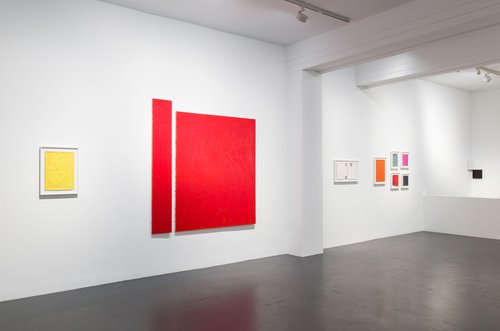
Irina Zatulovskaya. Shadow of the Future. Exhibition view. Berlin, 2026. Photo by Marcus Schneider. Courtesy of Galerie Volker Diehl, Berlin

Irina Zatulovskaya. Shadow of the Future. Exhibition view. Berlin, 2026. Photo by Marcus Schneider. Courtesy of Galerie Volker Diehl, Berlin

Irina Zatulovskaya. Shadow of the Future. Exhibition view. Berlin, 2026. Photo by Marcus Schneider. Courtesy of Galerie Volker Diehl, Berlin