

Weak Forces, Human Wavelengths and Clouds of the Apocalypse

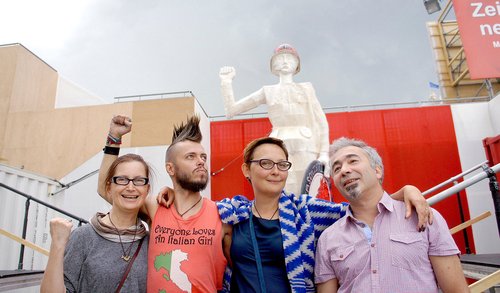
Chto Delat International. Songs of Hope and Despair, 2025. Video still. Courtesy of Chto Delat International
Two video installations by Chto Delat International, shown in Berlin this autumn, turn the road movie into a journey through apocalypse, exile and uncertainty. Blending performance, fairy tale and political reflection, both works search for something increasingly elusive: the possibility of hope – or even a miracle – in a world that seems to be coming apart.
During and around Berlin Art Week in September, the collective Chto Delat International presented two new projects. One, a three-channel video installation created in collaboration with ZIP Group, is on view at the Jewish Museum Berlin. Entitled ‘A Comprehensive Self-Organized Amateur Expedition in Search of Losses and Discoveries’ (40 mins., 2026), it forms part of ‘The Opposite of Now’, a major exhibition marking the museum’s 25th anniversary. Opening alongside projects by eleven other artists and collectives, the exhibition drew a large crowd and was inaugurated with considerable ceremony and speeches from officials. It runs until 10th of January 2027.
The other is a single-channel video, ‘Songs of Hope and Despair’ (80 mins., 2025), presented as part of the solo exhibition and multimedia installation ‘Fell Down – Get Up’ at After the Butcher, a non-profit space in Berlin’s Lichtenberg district devoted to contemporary art and social issues, just beyond Ostkreuz. The exhibition runs until 18th of October and is open on event days and by appointment.

The settings may be very different, but the two works are closely related. Both are directed by Tsaplya (Olga Egorova), with choreography by Vera Shchelkina, although in certain respects they stand in deliberate opposition to one another.
Describing itself as “an international workgroup of artists, critics, philosophers and writers from St Petersburg, Moscow, Nizhny Novgorod and Berlin, with the goal of merging political theory, art and activism”, the collective has remained active ever since, with a consistent emphasis on collaboration, networks and left-wing thought. This is hardly surprising given its name, borrowed from Nikolay Chernyshevsky’s 1863 novel ‘What Is to Be Done?’, a work famous for setting out an entire programme of social and political transformation.

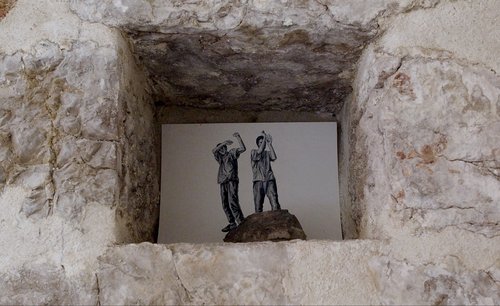
Chto Delat International. A Comprehensive Self-Organized Amateur Expedition in Search of Losses and Discoveries, 2026. Video still. Courtesy of Chto Delat International

Chto Delat International. A Comprehensive Self-Organized Amateur Expedition in Search of Losses and Discoveries, 2026. Exhibition view. Berlin, 2026. Photo by Dmitry Vilensky. Courtesy of Chto Delat International
Over the years, the group has produced films, published newspapers and academic texts, organised discussions and worked across a wide range of other media. There is also a characteristically deadpan element of wordplay in the name itself, something that recurs throughout the group’s practice.
Following the forced emigration of most of its members in 2022, the collective adopted the name Chto Delat International. The St Petersburg chapter had effectively closed, the context had shifted, and the new name also introduced a neat reference to the Situationist International, where “International” functions not as an adjective but as a noun. In this sense, Chto Delat can also be situated within a broader lineage of participatory and socially engaged practice, with affinities to the Situationists and to the relational aesthetics associated with Rirkrit Tiravanija (b. 1961).

In Berlin, the group runs the Emergency Project Room, which hosts window exhibitions and periodic Mad Tea Parties: public events led by invited Masters of Ceremony and open to anyone wishing to take part. Chto Delat International is also represented in the city by the like-minded KOW gallery.
The collective operates in a deliberately decentralised way. Its members also pursue independent practices, while any three participants can initiate and realise a project under the name Chto Delat International. In the case of these two video works, the participating members were Tsaplya (Olga Egorova, b. 1968), Dmitry Vilensky (b. 1964) and Nikolay Oleynikov (b. 1976).

Both films – as the artists call them for the sake of simplicity – are structured as sequences of performative episodes. Taken together, they become journeys in search of a miracle amid an apocalyptic reality. As Vilensky explains, it is important that both works take the form of fairy tales. He and his colleagues find themselves in a situation in which they can no longer, and do not wish to, produce straightforward activist or documentary statements. The fairy-tale form creates a degree of distance while allowing them to address a remarkably broad range of subjects. It also gives the artists greater freedom to work with ideas that are at once highly abstract and intensely concrete.
A ’Comprehensive Self-Organized Amateur Expedition in Search of Losses and Discoveries’ centres on a community of people with migrant backgrounds gathered in a radio studio in Hamburg. Together they listen to the cryptic military “doomsday radio”, also known as the “Buzzer”, which broadcasts a stream of coded and undeciphered messages. The signal becomes an ominous oracle: a transmission onto which fears of war and an increasingly uncertain future are projected.

But the film also treats people as bearers of their own unique frequencies. As Dmitry Vilensky explains, “Each participant is a radio station, represented by jingles. For Radio Care or Justice?, the refrain is: 'How many are you prepared to kill for the sake of justice?' Radio Alerta asks, 'Who is next?', while listing political prisoners from different countries. Radio Deserter chants, 'One, two, three, four, all soldiers fled the war'; Radio Repair offers 'Step by Step'; and there is also Radio Love." At the same time, these are not merely symbolic stations but specific individuals, asking the oracle questions about their own lives and about our shared future.
The filmed performances are linked by sequences representing a search across radio wavelengths, visualised through Chinese jump rope, the familiar children’s game. At one point, Radio of the Ancestors, hosted by the Nigerian artist David Odiase, reveals a piece of forgotten knowledge: an Oracle exists high on Mount Aragats in Armenia, in the form of a giant unfinished Soviet-era radio telescope. The participants teleport there in search of answers, fittingly enough, since they have already become, in part, radio waves themselves.

ZIP Group, represented here by the Berlin-based Stepan and Vasily Subbotin, born in 1987 and 1991 respectively, created the installation. Wooden beams, their preferred reusable material, support the screens and the seating placed opposite them. Originally from Krasnodar and now geographically dispersed, ZIP Group shares Chto Delat’s commitment to collective practice, communal structures and forms of relational art. The two groups are also longstanding friends and collaborators.
The other film, ‘Songs of Hope and Despair’, opens with Werner Tübke’s monumental panorama Early Bourgeois Revolution in Germany. Painted by the celebrated GDR artist between 1976 and 1987, the work measures around 123 by 14 metres and contains some 3,000 figures. It is housed in a museum built specifically for it in Bad Frankenhausen. Amid the vast clash of political, military and religious forces, Tübke also makes room for strange, almost surreal presences. These “weak forces” are embodied in the film by a cast of performers: Boot, Fish, Humpback Rainbow, Fox Tail, Dead Drummer, Muse-Leaving-Germany and others. Together, they travel with a cart carrying the clouds of the Apocalypse, searching for a miracle and losing some members of their troupe along the way.

The film unfolds partly as a road movie and partly as a tabletop game, with the magician Manuel Muerte casting the dice and determining the course of events. The projection itself forms only one element of the larger installation. It is accompanied by Oxana Timofeeva’s video lecture What if an Apocalypse Is the New Normal?, which reflects on Tübke’s panorama, and by the video performance Some Blind Encounters on the Way to Niklashausen, based on a film by Rainer Werner Fassbinder.
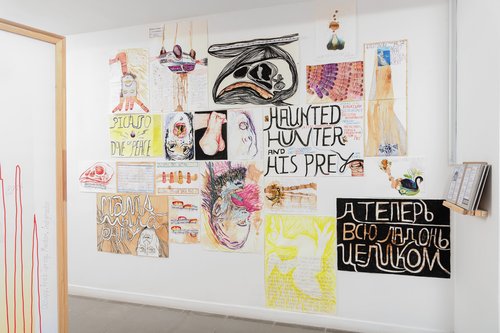
The walls are lined with collages corresponding to individual episodes from Songs of Hope and Despair, while the tabletop game itself and other objects from the project are also incorporated into the exhibition. Together, these elements extend the film beyond the screen, turning it into a broader environment of images, props, references and possible routes through catastrophe.

Discussing the production of both films, Vilensky describes the collective’s working method as relatively straightforward: “Tsaplya and I come up with the main plot – what the film is about, where it is set, the institutional framework – and then we call on our friends and present them with a protocol. For example, you might take a fragment from Tübke’s painting, or choose a radio station. Then, together with the music director, Maria Markina, and the choreographer, we develop the visual concept – sound and movement – before working on the interactions between participants in groups, or choirs, and so on.”
There is, however, a particular tension running through these two exhibitions. Chto Delat has long been closely associated with left-wing political thought, yet one of its current projects is being shown at the Jewish Museum Berlin, an institution whose anniversary exhibition explicitly engages with Jewish experience while also asking how a better collective future might be imagined.

That tension becomes more explicit in Songs of Hope and Despair. One of its characters, Muse-Leaving-Germany, performed by Nikolay Oleynikov as a bearded figure in a sparkling dress, accuses Germany of once again being “on the wrong side of history” because of its support for Israel. The character draws on the controversy surrounding Nan Goldin’s speech at the opening of her retrospective at the Neue Nationalgalerie in November 2024, when her statements on Israel and Gaza were followed by protests and a public response from museum director Klaus Biesenbach. He made clear that he disagreed with Goldin while defending her right to express her views, and reiterated the museum’s support for Israel’s right to exist alongside its concern for civilian suffering in Gaza and Lebanon.
Chto Delat is deliberately entering this fraught terrain rather than attempting to resolve it. The group insists on the right to question the policies of states, including Israel, while leaving room for irony, doubt and contradiction. Perhaps this also clarifies what “the left” means within its practice. It is less a matter of declaring allegiance to a particular national or political camp than of maintaining an internationalist position and directing attention towards those who are vulnerable, displaced or caught between much larger political forces.

The troop of “weak forces” eventually abandons both the migrant Fox Tail and the Muse. It is not so much a political position as Chto Delat’s image of the state of things.
Still, there seems to be no way forward except through the Apocalypse, with its heavy clouds dragging behind. And, as the protagonists of the Amateur Expedition discover, there is at least one frequency worth tuning in to: “Keep my heart from growing dark.”
The Opposite of Now
Berlin, Germany
4 September 2026 – 10 January 2027
Fell Down – Get Up
Berlin, Germany
10 September – 18 October 2026