

Waiting for the Thaw

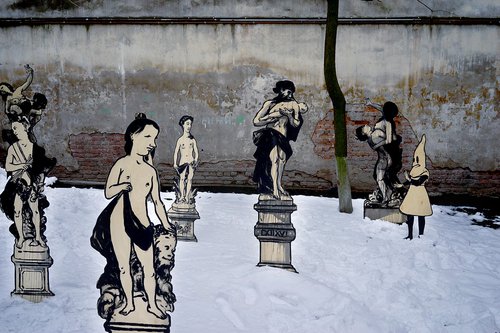
Yuri Palmin. Zholtovsky’s Refrigerator, 2025. Commissioned and produced by GES-2 House of Culture. Courtesy of GES-2 House of Culture
GES-2 in Moscow has unveiled an exhibition inspired by the concept of cold. Titled ‘Eternity Formulae’, the exhibition brings together seemingly unrelated topics, ranging from a Soviet industrial refrigerator to the insoluble conundrums of astronomy. However, upon closer inspection, it can be interpreted as a commentary on current cultural trends and the state of Russian society in general.
The timing of the show turned out to be perfect. Winter in Moscow has been exceptionally cold this year, with towering piles of snow lining the streets and temperatures plummeting 10 degrees Celsius below average. The moral and political climate in Russia remains harsh, too. The recent closure of the Gulag Museum in Moscow, which is set to be replaced by the Museum of Memory dedicated to the “genocide of the Russian people” during World War II, is a typical example of current trends in Russia’s cultural landscape. The title alludes to Hans Christian Andersen’s popular tale ‘The Snow Queen’, in which the character Kai tries to put together the word ‘Eternity’ from shards of ice. According to the show’s co-curator, Yaroslav Alyoshin, the idea emerged as a reaction to the somewhat overused concept of “exhibitions about a hat” – a term coined by art critic Ekaterina Degot in which works of art are rather supeficially assembled together based on purely formal simularities. Such exhibitions have become commonplace in Russian museums nowadays, with GES-2 itself contributing to the trend with an ambitious ‘Square and Space’ show in 2024, inspired by Malevich’s ‘Black Square’. This time, the curators Alyoshin, Anastasia Proshutinskaya and Artem Timonov therefore chose the most abstract topic they could come up with and adopted a “metaphysical approach”.

The exhibition is divided into three sections: ‘Refrigerator’, which is dedicated to the industrial cold-storage plant project of Soviet architect Ivan Zholtovsky (1867–1959) and its metamorphoses; ‘Winterreise’ (The Winter Journey), which features works on loan from major museums showing how the Old Masters attempted to convey the sensation of cold in their paintings and sculptures; and finally ‘Relic Radiation’, which explores the eternal void of the universe, where temperatures remain close to absolute zero – the theoretical limit of cold. On the surface, the exhibition approaches the topic of cold from three historical perspectives: architectural, artistic and natural. Looking deeper, however, it gently mocks the most common exhibition tropes in Russia today. The first hall (the Refrigerator) ridicules nostalgia for the Soviet era. The second hall (Winterreise) satirises the current trend of combining masterpieces from the past with contemporary art to illustrate random concepts. The third hall (Relic Radiation) is an obvious nod to the numerous expensive art and science projects that have little to do with either art or science.


The ‘Refrigerator’ section tells the story of a naive dream about beauty gradually becoming distorted by ugly reality. Whilst this story is pretty commonplace, the subject here is delightfully absurd: the bizarre fantasy of an ageing architect whose design for a modest, fully functional building has been inspired by the Doge’s Palace in Venice. However, during construction, the building is stripped of all its ornaments, not due to budget constraints, but because the government has adopted a new aesthetic: the Stalinist Empire Style is replaced by Khrushchev-era minimalism. Thus, the evolution of the project inadvertently mirrored the fate of Soviet utopia itself, with its grandeur and pathos eventually turning into something far less glamorous: endless rows of bland ‘Khrushchevka’ residential blocks all over the country. In the corner, there is an actual glass fridge containing an ice sculpture of a throne by young artist Daria Arbuzova (b. 2001). This seat of power, which looks sturdy enough to befit a Snow Queen or a Warcraft villain, will melt as soon as the fridge is switched off. “We do not know what will happen to it throughout the six months of this exhibition,” Alyoshin admitted. “Some say the ice will gradually evaporate, revealing the supporting structure – an AI-designed skeleton of a chair”. He finds it fascinating that “something that seems solid and immutable” could eventually disappear within hours. This dystopian ice throne in a fridge is juxtaposed with Zholtovsky’s very imposing, throne-like chair, where the octogenarian architect used to sit while overseeing the work of his youthful subordinates. This display brings to mind Khrushchev’s Thaw, the period during which Zholtovsky’s project was completed, and even the inevitable collapse of every dictatorship.


In the Winterreise hall, it feels as if we are stepping inside a fridge. The walls of the space are lined with frilly white blinds, a staple in Russian museums since Soviet times. According to Sasha Kim, the designer of the exhibition, they resemble frost in a freezer. The sterile, climate-controlled museum is depicted as a refrigerator where masterpieces from times gone by are stored. Snowy landscapes by Nikolai Roerich (1874–1947) and Rockwell Kent (1882–1971), festive scenes from the Dutch Golden Age and allegorical sculptures are brought together, as is Anton Raphael Mengs’ (1728–1779) ‘Judgement of Paris,’ – the latter according to the curators has a visually cold neoclassical style. This is a playful confirmation that the cold cannot be seen or depicted. However, there is a gentle reminder on the walls around the hall that you cannot hide from today’s reality, even in a fridge or a museum: a blackout poetry piece by Andrei Cherkasov based on Winterreise (Winter Journey). Most of the text on each page has been scratched out, leaving just a few words to form a new poem that resembles a melancholic haiku. To a Russian visitor in the present day, this technique is reminiscent of the practice of blacking out sentences and entire paragraphs in books, adopted by publishers to comply with current legislation. For example, the law against 'propaganda of non-traditional sexual relationships’ has led to many pages being scratched out in a recent biography of Pier Paolo Pasolini.


The final part of the third hall is a bold attempt to visualise the mind-boggling concept of invisible relic radiation that has existed in the universe since the Big Bang. With a temperature of only 2.7 degrees Kelvin (close to absolute zero), all attempts to detect its microscopic fluctuations from the Earth’s surface have been unsuccessful, as demonstrated in a specically commissioned film by Slava Fedorov (b. 1991) called ‘Earth and Sky’. The film is dedicated to an observatory in the Caucasus mountains, home to a failed Soviet experiment that aimed to detect these fluctuations using a powerful telescope. However, the Earth’s atmosphere was too warm to make the measurements and this problem was later solved by using telescopes in space. Unlike most Art & Science projects, the works of art in this exhibition do not celebrate scientific triumphs but rather highlight failures. ‘Cancelled Constellations’ by Alexandra Paperno (b. 1981), for instance, depict parts of the starry sky which astronomers in the past used to see as mythical creatures and objects. However, these visions were not shared by the rest of humanity and were eventually abandoned. Meanwhile, other, equally bizarre constellations were accepted by science. Despite the distant, otherworldly subject matter, there seems to be some bitter symbolism beyond all this. In today’s overheated world, searching for traces of reason and humanity seems like an impossible task, one that no telescope can solve. All we can do is stand back in dismay and watch as certain absurd concepts prevail over others, seemingly for no reason.