

To Tashkent for ‘Wisdom’: Inside Uzbekistan’s New Centre for Contemporary Art

Centre for Contemporary Arts Tashkent (CCA Tashkent). View of the building exterior. Photo by Dan Glasser. Courtesy of Studio KO and Dan Glasser
Tashkent’s new Centre for Contemporary Art, Uzbekistan’s first state institution dedicated to contemporary art, has opened its doors with the international exhibition Hikmah (‘Wisdom’). The Art Newspaper Russia’s Editor-in-Chief, Milena Orlova, visits the newly transformed venue and considers what it signals for the country’s growing cultural ambitions.
Two historic buildings constructed from pale-yellow Turkestan brick – a diesel power station and Tashkent’s first tram depot – have been transformed into a new cultural space by the renowned French architectural practice Studio KO. Located in the city’s historic centre and dating from 1912, the buildings were originally designed by Wilhelm Heinzelmann, who served as Tashkent’s chief architect and was responsible for numerous notable buildings in the city, including the eccentric palace of Grand Duke Nikolai Konstantinovich. The French architects carefully restored the historic buildings while introducing contemporary materials and interventions. The result is a semicircular courtyard echoed by a circular staircase, studios opening onto a small garden, a library, shop, café, cinema and offices. A futuristic metal-lined underground tunnel connects the two buildings.

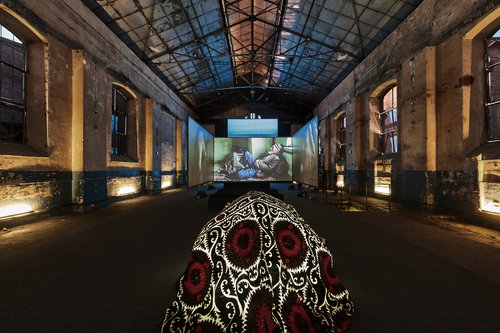
The main exhibition space, housed in the former power station and tram depot, recalls – as was so often the case with industrial architecture of the late nineteenth and early twentieth centuries – the nave of a basilica. Its soaring vaults provide ample space for monumental installations.
The new Centre for Contemporary Art in Tashkent is the flagship project of the Art and Culture Development Foundation of Uzbekistan, established in 2017. According to the press release, “the creation of the centre was made possible by the initiative of the President of the Republic of Uzbekistan, Shavkat Mirziyoyev, under which large-scale initiatives aimed at developing culture, art and international cultural cooperation are being consistently implemented in the country.”

The inaugural exhibition, bringing together the work of ten artists, is the fruit of just such cooperation. The chief curator in the centre is Dr Sara Raza, a London-born curator now living in New York and the author of ‘Punk Orientalism: The Art of Rebellion,’ a study of the art of the post-Soviet republics of Central Asia and the Caucasus. For the inaugural exhibition she chose a theme designated by the Arabic word ‘Hikmah,’ meaning “wisdom”. In Raza’s words: “Hikmah as a practice has traditionally been linked to the intellectual sciences and philosophy, and serves to unite the ideal spiritual and the material-physical forms of being… The expression of Hikmah as a living tradition spans various geographical regions. In Uzbekistan it reached its flowering in the 11th to 16th centuries under the patronage of sages and scholars such as the Khojagan (masters of wisdom), from among whom the influential Naqshbandi Sufi order emerged in the 14th century.”

The exhibition opens with a kind of historical overture: several works by Uzbek artists drawn from the celebrated collection of the Nukus Museum, the I. V. Savitsky State Museum of Arts of the Republic of Karakalpakstan. Among them is a carved wooden column by Daribai Saipov (b. 1961), made in the 1980s for the interior of a local restaurant but incorporating a fragment of ancient carving from one of the Karakalpak mausoleums. Works of this kind were produced as part of a campaign to preserve historic columns.
There are also realist sculptures from roughly the same period by Vladimir Pan (b. 1956) and Bakhtiyar Saipov (b. 1956). Saipov, a prominent monumental sculptor responsible for numerous memorials in his homeland and in Russia, was formerly an assistant to Lev Kerbel (1917–2003). The figures in these works seem lost in contemplation, as though absorbed in meditation.

The bulk of the exhibition, however, is devoted to recent work. Suspended from the ceiling of the central space is ‘Flying Carpets’, a minimalist installation in metal and rubber from the collection of the Guggenheim Museum in New York. Despite its title, the work is devoid of colour or ornament: it is, as it were, the pure idea of a carpet. The artist Nadia Kaabi-Linke (b. 1978) is preoccupied with the experience of migrants, far removed from the fairy-tale journeys evoked by flying carpets. She spent several days on Venice’s Ponte del Sepolcro with migrant street vendors, who display their wares on rugs and swiftly roll them up whenever the carabinieri appear. Kaabi-Linke measured both the rugs and the bridge itself, translating their dimensions into steel frames resembling cages.
Kimsooja (b. 1957), the Seoul-born artist renowned for her video installations, appears here in a rather unfamiliar guise. Her work consists of a vast oval wooden table on which lumps of clay are laid out, inviting visitors to mould their own figures. ‘The Foundation of Tashkent’, an installation by the American artist Nari Ward (b. 1963), created especially for the exhibition, draws instead on local materials and traditions: bricks with patinated surfaces, copper tools and the Uzbek bread stamps used to pattern flatbreads.
In the courtyard, there is a mound made from seven coloured spheres which arrests attention. This decorative ceramic work by young artist Shokhrukh Rakhimov (b. 2002), who represents the seventh generation of a dynasty of ceramicists, was inspired by the Sufi sage of Khwarazm Najm al-Din Kubra and symbolises the seven states of the soul. An equally refined philosophical undercurrent runs through ‘A Tower for One Breath’ by Muhannad Shono (b. 1977) of Riyadh. This construction of black tiles alludes to Persian concepts such as hush dar dam (“awareness of breathing”) and khalwat dar anjuman (“solitude within the crowd”).

A certain surrealism pervades ‘Mouth, Wound’ by the Beirut-born artist Ali Cherri (b. 1976): sculptures of human hands with brightly coloured mouths emerging from their palms. Cherri drew inspiration for the work from Jean Cocteau’s (1889–1963) film ‘The Blood of a Poet’. By contrast, ‘Nest’ by Tarik Kiswanson (b. 1986) – a huge egg suspended from the wall – appears at once the simplest and perhaps the most eloquent symbol of wisdom.

The work of the Art and Culture Development Foundation of Uzbekistan, headed by Gayane Umerova, is remarkably varied, ranging from marathons and concerts to major architectural projects, the Bukhara Biennale and the country’s participation in the Venice Biennale. Following the transformation of the former power station, the next building awaiting restoration is the State Museum of Arts of Uzbekistan, which is due to be expanded to a design by Tadao Ando. Already completed are the renovated Republican Children’s Library, redesigned by Ludi Architects, and a series of art residencies in the city’s traditional neighbourhoods, or mahallas.
An exhibition by the Dutch-Moroccan designer and artist Mohamed Benchellal (b. 1984), a participant in the 2025 residency programme, has also opened at the State Museum of the History of Uzbekistan as part of the CCA’s public programme. ‘Benchellal. Monumental | Sculpting the Past, Shaping the Future’ presents sculptural garments alongside photographs in which models wearing the designer’s creations are pictured against the backdrop of Tashkent’s Soviet modernist architectural landmarks. Several of these buildings have recently been added to the UNESCO World Heritage List and have become some of Uzbekistan’s most important sights, alongside the ancient monuments of Bukhara, Samarkand and Khiva. Tashkent now has another landmark – one firmly rooted in the present day – that is well worth making the journey to see.

This article was originally published in Russian on the website of The Art Newspaper Russia on 14 September 2026.