

Titan or Cog?

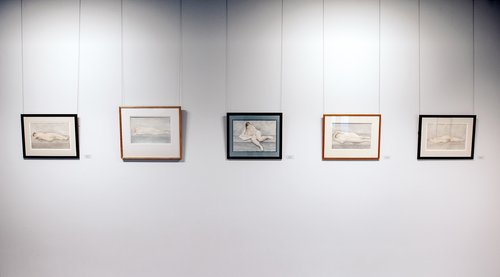
Gospel According to the Titan. Exhibition view. Moscow, 2026. Courtesy of In Artibus Foundation
The exhibition ‘Gospel According to the Titan’ at the In Artibus Foundation in Moscow explores technogenic civilisation in connection with the art of the Thaw.
The exhibition ‘Gospel According to the Titan’ consists entirely of works belonging to the Prometheus Foundation, no claim of a museum-standard selection, carefully calibrated for quality and meaning, that you might normally expect elsewhere. What is kept in the storerooms of the Foundation is what is on display. Works on paper by Ernst Neizvestny (1925–2016) dominate the show and scattered throughout are individual paintings, drawings, and collages by other leading artists of the Thaw era, and later Stagnation, and finally Perestroika including Ülo Sooster (1924–1970), Andrei Grositsky (1934–2017), Anatoly Zverev (1931–1986), Igor Vulokh (1938–2012), Dmitry Krasnopevtsev (1925–1995) and Boris Orlov (b. 1941).

Curator, architect, artist and lecturer at the Rodchenko School of Multimedia Arts Alexei Korsi (b. 1986) has created a compelling narrative from the motley stable of works acquired by the Prometheus Foundation. In his own words: “The exhibition becomes a sacred chronicle of a civilisation of a distant future that does not yet exist, yet has already sunk into oblivion, and describes the passions attending the birth of the Human-Machine. In the end, the exhibition leaves us with an inevitable question: what does it mean to be human?”

The fusion of robot and human was indeed one of the central themes in the cultural self-awareness of the 1960s through to the 1980s. On the back of the developments in cybernetics and enthusiasm for the wholesale programming of all processes within a state economy of socialism, there arose a fetish for computing machines and robotics. Hybrids of human beings and machines became the protagonists of books, films, and paintings. It must be said, however, that robots in the visual arts are a subject with a venerable history and one that began long before the Thaw.

One might argue that cyborgs, mutants, and human automatons were already known in the various capricci of the Renaissance and Baroque periods. One such figure – a mechanical giant within whose body one may wander whilst studying human anatomy – is described in Francesco Colonna’s novel ‘Hypnerotomachia Poliphili’ (1499). Figures made from springs, with composite bodies and animated mechanisms began performing an extravagant ballet in the paintings of Baroque artists – an era that prized highly curiosities, monsters, and freaks of nature. In the 1620s, Giovanni Battista Bracelli (1584-1650) produced his series ‘Bizzarie di varie figure’, in which robots made from rhombuses, cubes, spirals, and rods do battle with one another. In the Age of Enlightenment, the natural sciences entered into a programmatic dialogue with mechanicisms. The Encyclopédistes regarded Nature as an ideal construct, operating according to rational logic. The apotheosis of this engineering, pragmatic attitude towards the virtues of nature and civilisation was Julien La Mettrie’s 1747 treatise ‘L'Homme Machine’ (‘Man a Machine’). La Mettrie described the human being as a biorobot governed by bodily mechanics – a position which was exceptionally radical for its time. The French philosopher proved to be a visionary forerunner of many Romantic heroes of the following century, most notably, of course, Mary Shelley’s ‘Frankenstein.’ The first illustrations for ‘Frankenstein,’ executed in the extravagant Gothic-academic manner of Henry Fuseli (1741–1825), were made by Theodore von Holst (1810–1844) in 1831.


It was cinema, naturally, that became the true encyclopaedia of narratives concerning mutants, hybrids, and robots in the twentieth century. Armies of mechanistic human beings took up firm residence in film and became, in large measure, cultural memes. The range is vast: from Fritz Lang’s 1927 ‘Metropolis’ to Soviet children’s films such as ‘Adventures of Elektronik’ and ‘Guest from the Future,’ in which the kindly, conscientious robot Werther – his very name borrowed from Goethe’s character – comes across as a distant relation of the suffering monsters of the Romantic age.


Perceptive Soviet artists created their own version of the interaction between Organic and Inorganic life. The exhibition at the In Artibus Foundation allows one to identify several leitmotifs. Firstly the fusion of the robot theme with the idea of mechanisms possessed of autonomous life is felt as a premonition of Art & Science, a movement that announced itself at the start of the new millennium. The prophetic quality of this alliance – between science-fictional worlds and robotics on the one hand, and art on the other – is expressed particlarly well in the collages of Ülo Sooster. In 1961, on a page torn from a Soviet magazine about scientific discoveries in the life of the Soviet citizen, he drew strange objects. Above the heads of skiers in the mountains, spiky egg-shaped structures hover in suspension. They unsettle with their alienness and bring to mind the Soviet film adaptation of the Strugatsky brothers’ novel ‘Dead Mountaineer’s Hotel’ (1969), in which a UFO landing party descends upon a ski resort with equally mysterious and unsettling effect. For Sooster, these spiky giant eggs were not equivalents of horror or steampunk. They heralded new vectors for understanding a world in which the convex sphere is simultaneously the origin of life, its symbol, and a universal image of a picture that is at once object and space.

he second leitmotif is represented by works of Andrei Grositsky (1934–2017), and to some extent Igor Vulokh alongside Dmitry Krasnopevtsev. The theme might be formulated thus: ordinary things in the mode of shape-shifters. Within the everyday we discern strange hybrids of dead and living nature, pressing themselves against one another in their desire to claim the right to new forms of existence. I am reminded of Thomas Mann’s novel ‘Doctor Faustus.’ The composer Leverkühn’s father cultivated polyps in a test tube. A profound melancholy pervaded that landscape. A growth of inorganic origin, arising from chemicals, began to behave like a living creature. When the aquarium in which the fungi were reared – polyps resembling small trees, algae resembling human organs – was turned towards the sun, something remarkable occurred. The entire inorganic landscape, desiring, as Thomas Mann describes it, warmth, love, and light, literally pressed itself towards the sunny side of the aquarium and clung tightly to it. The world of objects in the paintings of Krasnopevtsev, Vulokh, and especially Andrei Grositsky behaves in much the same way. His hyper-volumetric portraits of rusted components are less about the melancholy of objects and materials than about the germination of an anxious new life within the rotting, spent remnants of the old. The colour in these paintings – with their relief-like depictions of pipes and fastenings – is simultaneously celebratory and pop-art-inflected, and decomposing. Form simultaneously asserts itself and mutates, subject to corrosion. As with old Leverkühn, we become witnesses to a new hybridisation of organic and chemical, industrial nature.

The third leitmotif is represented by the works of Ernst Neizvestny, and in part by those of Boris Orlov, joined by the slyly fantastical faces in Anatoly Zverev’s sketchbooks. Bodily mutation – that is the subject. Ernst Neizvestny rhymed neatly with the visual culture of his era in his construction of corporeal cyborgs, robot-humans who suffer after the fashion of Shelley’s ‘Frankenstein.’ Cyborgs returned from the dead and fused with the instruments of destruction of all living things – this is a narrative well supported by cinema, most notably by Arnold Schwarzenegger and ‘The Terminator’.

Ernst Neizvestny. From the 'Prometheus' series. Gospel According to the Titan. Exhibition view. Moscow, 2026. Courtesy of In Artibus Foundation

Ernst Neizvestny. From the 'Prometheus' series. Gospel According to the Titan. Exhibition view. Moscow, 2026. Courtesy of In Artibus Foundation

Ernst Neizvestny. From the 'Prometheus' series. Gospel According to the Titan. Exhibition view. Moscow, 2026. Courtesy of In Artibus Foundation
It is curious that both in Neizvestny’s work and in Orlov’s there is a certain blankness, a sterility in the presentation of techno-cyborgs. In Neizvestny’s case, the sketches (‘Gigantomachy,’ ‘Prometheus,’ ‘Triangle of Sorrow’) are unambiguously associated with the output of Soviet art-production associations. One day you are producing apocalyptic visions of cyberpunk landscapes; the next, reliefs for the Underground, or façades of theatre buildings bearing masks of sorrow and joy. Such a dichotomy is understandable, and honest enough, when one considers that in the USSR an artist was, whatever else he might be, classified as an ordinary worker in the cultural sphere. And the battle of giants, the fusion of body and technology, in Neizvestny’s case carries a deeply personal subtext: the story of a Creator’s resistance to becoming a mere cog within a totalitarian system.